Context study / DECLIVIS
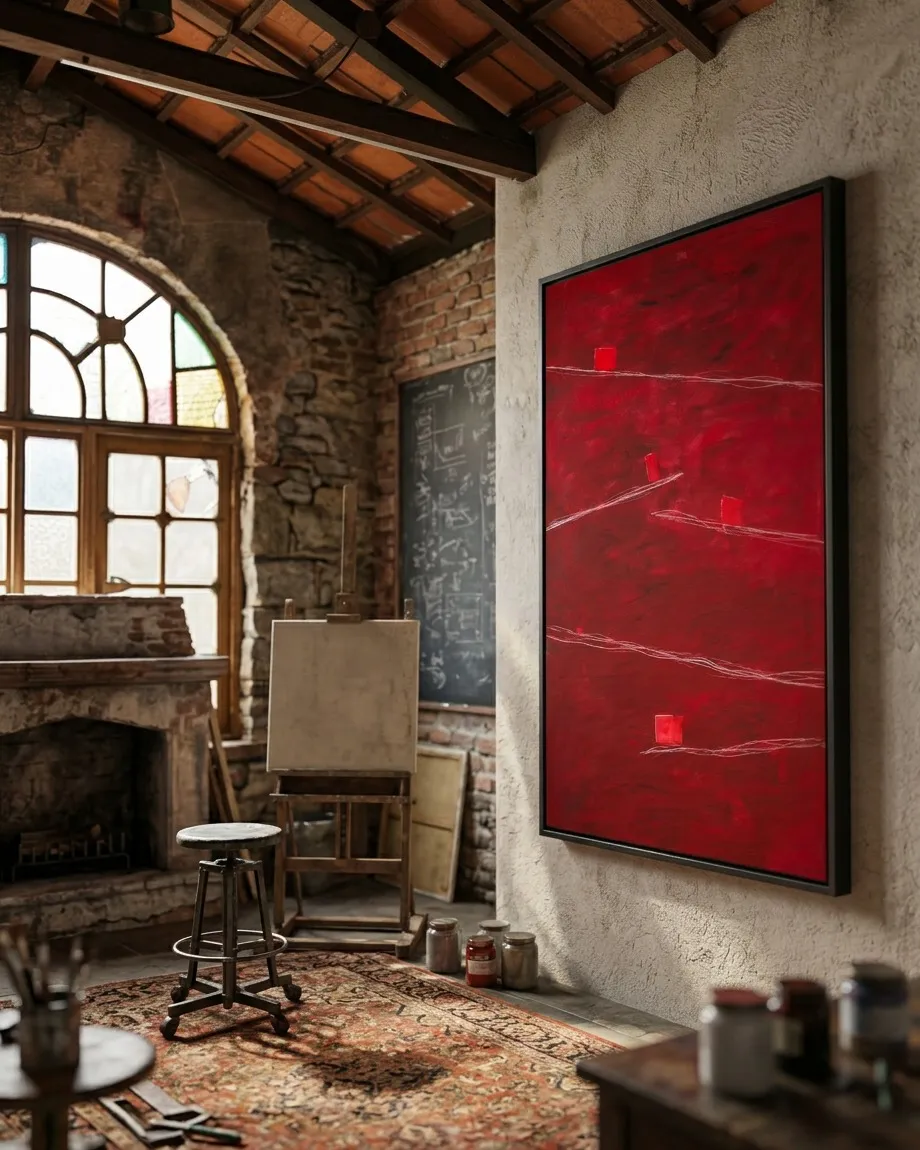
DECLIVIS by Maurizio Valch in artist studio
The surface of DECLIVIS presents itself to the viewer as a dense field of force where the stability of the pictorial plane has been definitively shut down. By eluding the orthogonal order and the complacency of the modernist grid, Maurizio Valch's composition surrenders to a rigorous physics of sliding. Fine oblique lines, executed through direct incisions upon the dense crimson matter, cross the canvas from side to side with a subtle yet implacable inclination. Upon these precarious filaments, small blocks of concentrated red seem to slide or halt in an equilibrium that challenges their own inertia. It is in this precise interval of suspension that the experience of abandonment germinates: a condition stripped of any psychological pathos, which here manifests as pure physical and existential reality. The painting does not illustrate a fall, but rather embodies the vulnerability of matter devoid of a firm ground, where bodies and lines yield with dignity to the invisible force of gravity, suspended in the immensity of a void saturated with red.
"When I confront the density of oil on canvas, my purpose is not to cover a surface, but to build a geological stratum that must then be questioned through subtraction. For me, the physical gesture of the incision—that scraping and cutting of wet paint to reveal the wound of the primary support—is a desperate search for permanence. In the tradition of the wall and matter, scraping is a mark that survives time; it is the trace of a transit that resists disappearing. Recording this decline through the furrow is not an attempt to halt the descent of forms, but a way to fix it forever in the memory of the fabric. By cleaving the canvas, the paradox is fulfilled: that which falls inevitably remains, by virtue of the cut, inscribed in a static eternity, transforming the transit of matter into an unalterable scar."
By inhabiting the tension of this wounded space, the viewer's gaze experiences a crucial shift: the recognition of decline ceases to be perceived as a tragedy of collapse, transforming instead into a strange wonder. The incisions that furrow the crimson are no longer simple cuts of rupture, but pathways of an unexpected architectural precision that sustain the gaze in its descent. In this landscape of deviation, which evokes the atomic swerve of the Lucretian clinamen, a dazzling formal honesty is revealed. There is no symmetry to protect the observer from uncertainty, and it is precisely the absence of that safety net that arouses awe. The painting demonstrates that balance is not the immobility of the center, but the capacity to sustain oneself just at the limit prior to the absolute loss of support; an aesthetic revelation where weight and lightness are reconciled on the surface of the painting.
"The choice of crimson responds to its character as living, almost visceral matter, which dialogues directly with the structure of the wall and the environment. In painting these small red blocks that seem to slide down the slopes of the canvas, I seek to embody the weight of our own daily transitions. By dispensing with rigid frames and allowing color to invade the three-centimeter edges of the stretcher, I surrender the work to the abandonment of the real space surrounding it; the painting no longer protects itself behind a physical border, but exposes itself to the light of the studio and the gallery in a vulnerable manner. This detachment from traditional limits generates a state of silent wonder in me, for the painting ceases to belong to me and the creator's ego dissolves, allowing the matter to dialogue directly with the air and the wall that support it."
In its final resolution, DECLIVIS consolidates itself as a tactile shore where painting becomes a witness to the weight of the world. In this space, the abandonment imposed by the physics of descent and the permanence of the incision engraved on the canvas merge into a single movement of astonishing material coherence. The true wonder offered to us by Maurizio Valch's work does not consist in the utopian fantasy of halting the fall or reaching an inaccessible summit, but in the supreme lesson of resistance offered by matter. In the end, the canvas is not a passive object, but an active record of opposing forces, demonstrating that vulnerability and gravity are not weaknesses of form, but the indispensable conditions for the present to unfold before us in all its density and poetic truth.
- Original artwork
- DECLIVIS
- Actual dimensions
- 31.5 × 47.2 in / 80 × 120 cm
- Presentation
- Digital contextual visualization
Context references
DECLIVIS painting in painter studio · art studio decor with paintings · crimson painting hanging on rustic wall · contemporary painting studio interior · artistic workspace environment with artwork
About this visualization
This visualization places the artwork within an architectural context to help collectors and viewers imagine its presence in a real space. It is an interpretive reference, not an exact reproduction: the original work remains the sole authority for scale, color, surface and material presence.