Context study / DECLIVIS
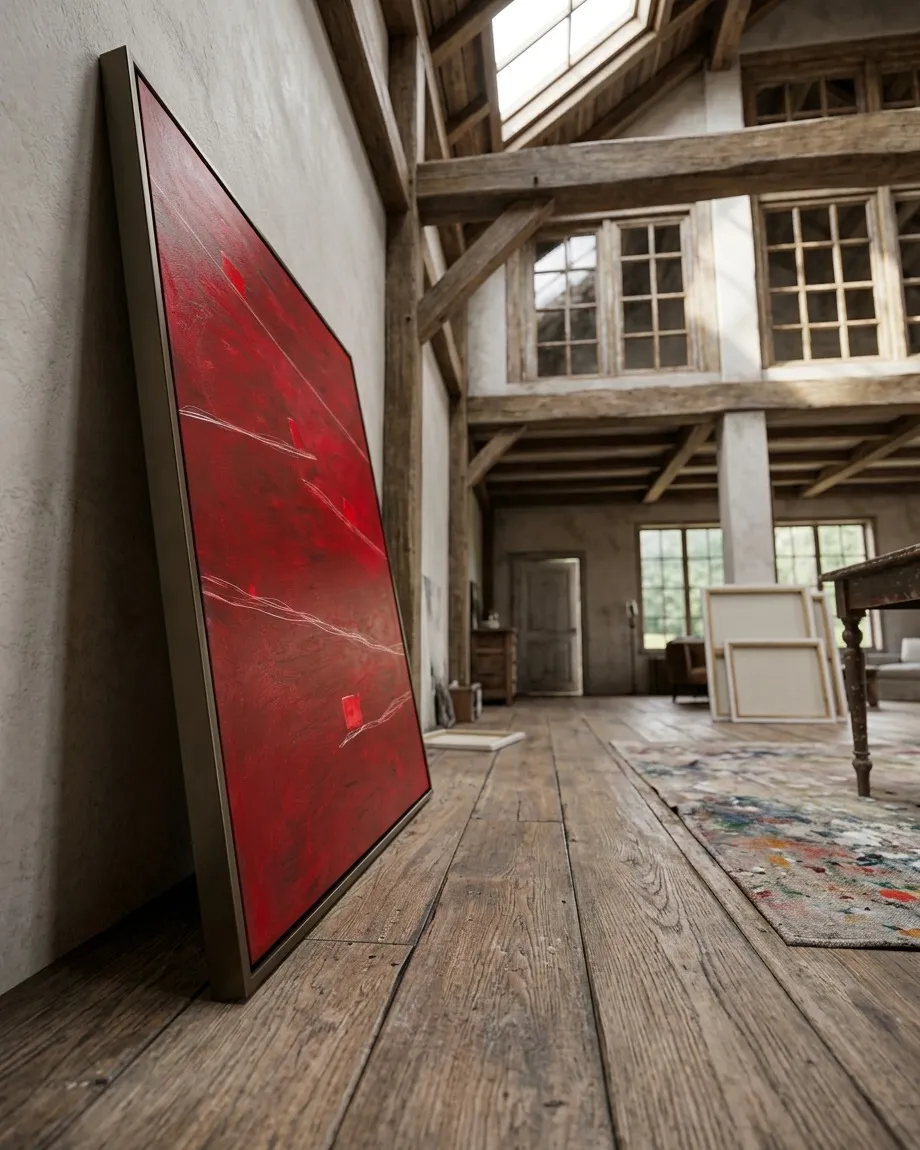
DECLIVIS painting by Maurizio Valch exhibited in rustic barn
Is it possible that safety consists in learning to slide? By resting DECLIVIS directly on the worn floorboards of the barn, stripped of the protection of a white wall or the rigidity of an easel, the large-format canvas reveals itself not as a decorative window, but as a resounding physical presence. The vertical framing of the composition, dominated by that crimson matter that seems to vibrate under the natural light descending from the beams, sustains a strange paradox: while the wooden architecture surrounding it celebrates the right angle and the stability of shelter, the painting within disobeys that orthopedics. The small blocks of color are not anchored; they seem to slide along the oblique incised lines, suggesting that true belonging is not a state of absolute fixity, but an active complicity with transit and fall.
When spreading the thick oil on the canvas, I recall the weight of my walks, the fatigue of those journeys where the only certainty was the wear of the ground beneath my feet. I did not seek to illustrate a map or build a conceptual bunker to protect myself from the world; I wanted the material itself to record the friction. As I scraped the wet pigment with the palette knife to open these white lines, I felt that I was not adding a drawing, but unearthing a trace, allowing the gesso base to emerge like a scar of light. These incised traces are not intended to guide the viewer toward a clear goal, in the same way that my Caminos de Santiago were not an accumulation of lessons, but a series of transitory rooms and detours where the character I believed myself to be began to crumble.
The renunciation of the traditional frame and the decision to carry the crimson color to the three-centimeter-deep edges transform the work into a tactile shore, a relief that physically interrupts real space. In this concrete presentation, the lateral light grazes the rough surface of the painting and projects the vibration of the oil onto the rustic wall, dissolving the boundary between the artistic object and the environment. This objectual continuity immediately evokes the material concerns of Antoni Tàpies, where the wall or the skin do not function as defensive barriers, but as archives exposed to the wear of time. However, where Tàpies seeks the accumulation of pure erosion, Valch sustains a structural tension: the decline of his white lines introduces a subtle syncopation, a suspended pulse that forces the eye to abandon the tyranny of the level to surrender to the sinuosity of internal geography.
I know all too well how thought is capable of manufacturing a trench out of any belief, how we pinch ourselves building an epic of effort to justify our right to be at peace. For a long time, I looked at my own blocks and monoliths as monuments to a personal feat that had to be defended at all costs. But when confronting the fall of these lines in DECLIVIS, I wonder if there is not more honesty in dropping the armor and letting the forms simply slide down the slope. Trusting the canvas has ended up meaning this for me: not forcing an artificial symmetry or crowning a non-existent summit, but accepting the weight of the material and the uncertainty of the detour as the only real conditions from which to become fresh earth once more.
In the end, the composition does not offer a heroic resolution or an outcome that reassures the spectator's gaze. The suspended blocks and inclined trajectories coexist in an unstable equilibrium that resists being translated into a psychological explanation or a closed dogma. The silent and monumental space of the barn welcomes this fall without judging it, transforming the interval of contemplation into a territory of somatic resonance. The serenity emanating from DECLIVIS does not come from having avoided the abyss, but from having turned the decline into a habitable space; a shared shore where beauty does not depend on the fixity of the ground, but on the temperance with which we surrender to the movement of the world.
- Original artwork
- DECLIVIS
- Actual dimensions
- 31.5 × 47.2 in / 80 × 120 cm
- Presentation
- Digital contextual visualization
Context references
Maurizio Valch DECLIVIS in barn · rustic decor with abstract art · large painting leaning on the floor · crimson painting in wooden interior · rustic contemporary art
About this visualization
This visualization places the artwork within an architectural context to help collectors and viewers imagine its presence in a real space. It is an interpretive reference, not an exact reproduction: the original work remains the sole authority for scale, color, surface and material presence.