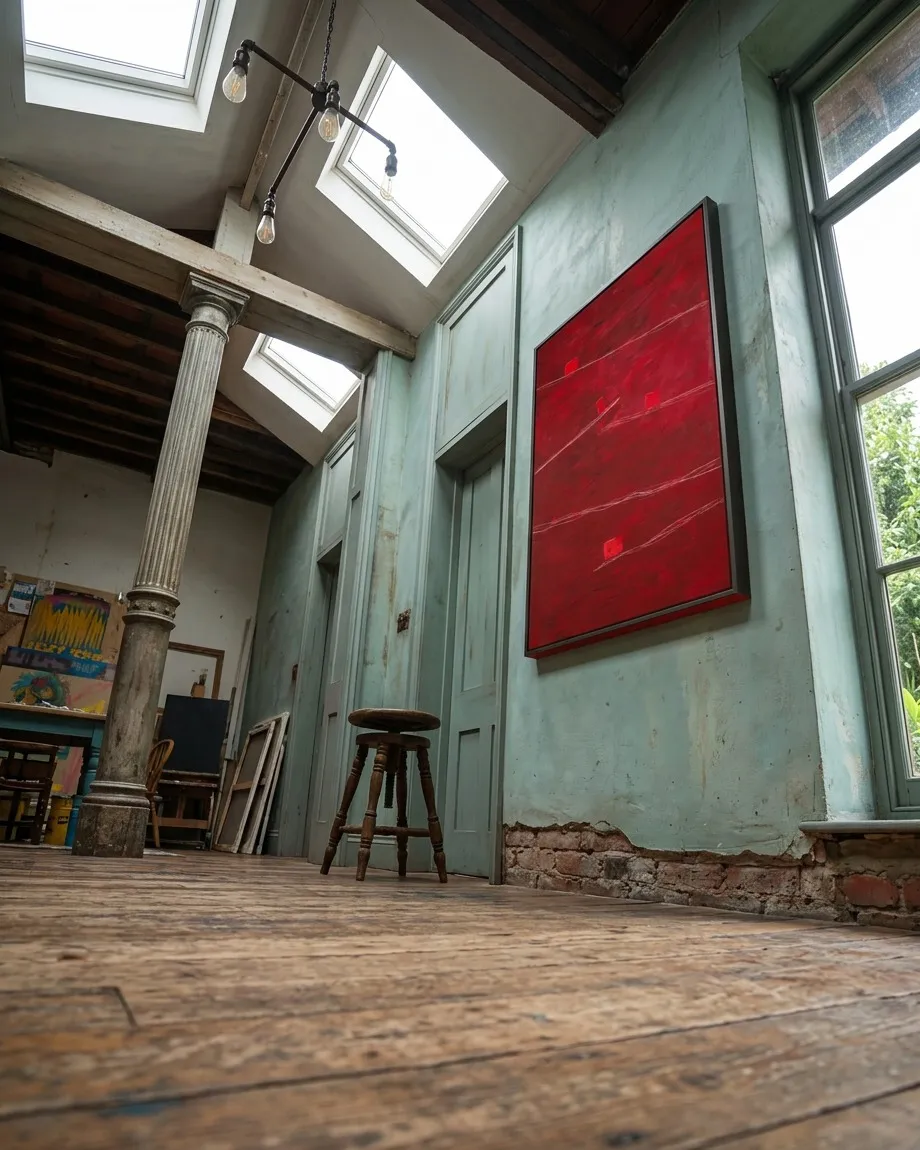
Context study / DECLIVIS
DECLIVIS by Maurizio Valch in Rustic Studio | Abstract Painting
The textured vibration of the vast crimson color field dominating the surface of DECLIVIS does not present itself as a passive background, but rather as an active matter charged with gravitational tensions. Over this dense chromatic plane, thin white incised lines cross the composition diagonally, sharply introducing the physical idea of declivis: the inclined plane, the slope that challenges the stability of the elements. Upon these subtle traces, which operate like thin cables suspended in the immensity, rest small square shapes that seem to debate their permanence in space. This arrangement immediately evokes the thought of G. I. Gurdjieff, a philosopher who investigated human automatism and mechanical nature, forcing us to ask whether these blocks represent the effort of the sleeping being to sustain a precarious balance within an existential inertia that inevitably pulls downward. Is the incised line a path of awakening that demands constant attention, or simply a route of automatic transit where shapes slide without will? This tension is enriched when contrasted with the perspective of Carl Gustav Jung, the psychiatrist who proposed the existence of a collective unconscious populated by universal archetypes. From this perspective, the red magma supporting the composition ceases to be a threatening void and becomes a primordial matter; a territory where descending the slope does not equate to a tragic fall, but rather to the necessary descent to confront the Shadow and assimilate the latent forces of the self.
When I confront the canvas in the studio, painting is not an exercise in representation for me, but an accumulation of physical energy and material resistance. The red oil and acrylic deposit themselves on the surface through a slow process of sedimentation, overlaying layers that I then scrape, sand, and cover again, seeking to give the color's density the consistency of a living bark. The incision, that white stroke cutting through the composition, is not a drawing added after the fact, but a deliberate wound in the pictorial matter: a physical groove that penetrates the strata of pigment to reveal the background light and establish a real plane of support. By placing those small blocks of red matter on the diagonal lines, I perform an act of resistance against the gravity of the painting itself; I do not seek symmetry or static order, but to test under what conditions of tilt and weight a halt is possible. Each block is a minimal shelter, a weight calculated with precision so that the composition does not collapse, a tactile sign that even in the steepest territory, the painter can claim a space of permanence.
The distance and the interval separating these suspended blocks on the slope raise a profound question about the nature of security and limits. Observing the isolation of these shapes on their respective paths, it is fruitful to summon the thought of Osho, the philosopher who radically contrasted the intrinsic freedom of the being with structures of mental and social control. From his perspective, clinging to these incised lines—which act as scaffolding or safety lines within the painting—could be interpreted as a symptom of fear before the untamed immensity of the crimson field, a resistance to experiencing dissolution into the totality of the color. Are these blocks protected by the line that holds them, or, conversely, are they trapped by it in an illusion of order? The visual tension between the minuscule size of one of the blocks and the more settled volume of the others highlights this paradox: human consciousness tends to seek the shelter of a border, of a traced path, even when the ground beneath its feet is tilted and in the process of crumbling.
Often, the memory of the Mediterranean territory guides my hand back to the extreme aridity and untamed geography of the south. In drawing these diagonals, I instinctively evoke the dryness of the Andalusian hillsides, those ravines and goat tracks that cut horizontally across the steep mountains, challenging the verticality of the rock with a precarious but passable horizontality. In those landscapes, the sunlight is so intense that it seems to consolidate the ground, fixing stones and dust just before they slide down the ravine. It is at this physical border where the idea of SITUS—the specific place claimed and inhabited—ceases to be an abstract concept and transforms into a bodily urgency: the question of how to sustain oneself in a time that runs downhill and on a ground that lacks flatness. The silence I place between each block of paint is not an absence of events, but the precise and necessary distance for the space to breathe, an interval of stone and wind that allows each element to keep its own gravity.
In contemplating the work as a whole, the vibration of the background brushstrokes, the fragility of the white marks, and the subtle irregularity of the blocks assemble into a map of what remains against the wear of time and space. The pictorial surface becomes the record of an unresolved conflict between the inertia of descent and the will to remain. This places us at an interpretive crossroads that the painting refuses to resolve in a definitive way: is DECLIVIS the visual testimony of an imminent collapse, the instant before everything slides into the lower abyss, or is it the proof that a simple line, an incision made by the human hand in the matter of the world, is enough to establish a habitable place in the midst of the fall? In this suspension lies the power of the painting, reminding us that space is not possessed, but resisted.
- Original artwork
- DECLIVIS
- Actual dimensions
- 31.5 × 47.2 in / 80 × 120 cm
- Presentation
- Digital contextual visualization
Context references
crimson red abstract painting · textured minimalist painting · rustic art studio decor · contemporary art maurizio valch · abstract paintings for living room
About this visualization
This visualization places the artwork within an architectural context to help collectors and viewers imagine its presence in a real space. It is an interpretive reference, not an exact reproduction: the original work remains the sole authority for scale, color, surface and material presence.