Context study / ATHAR
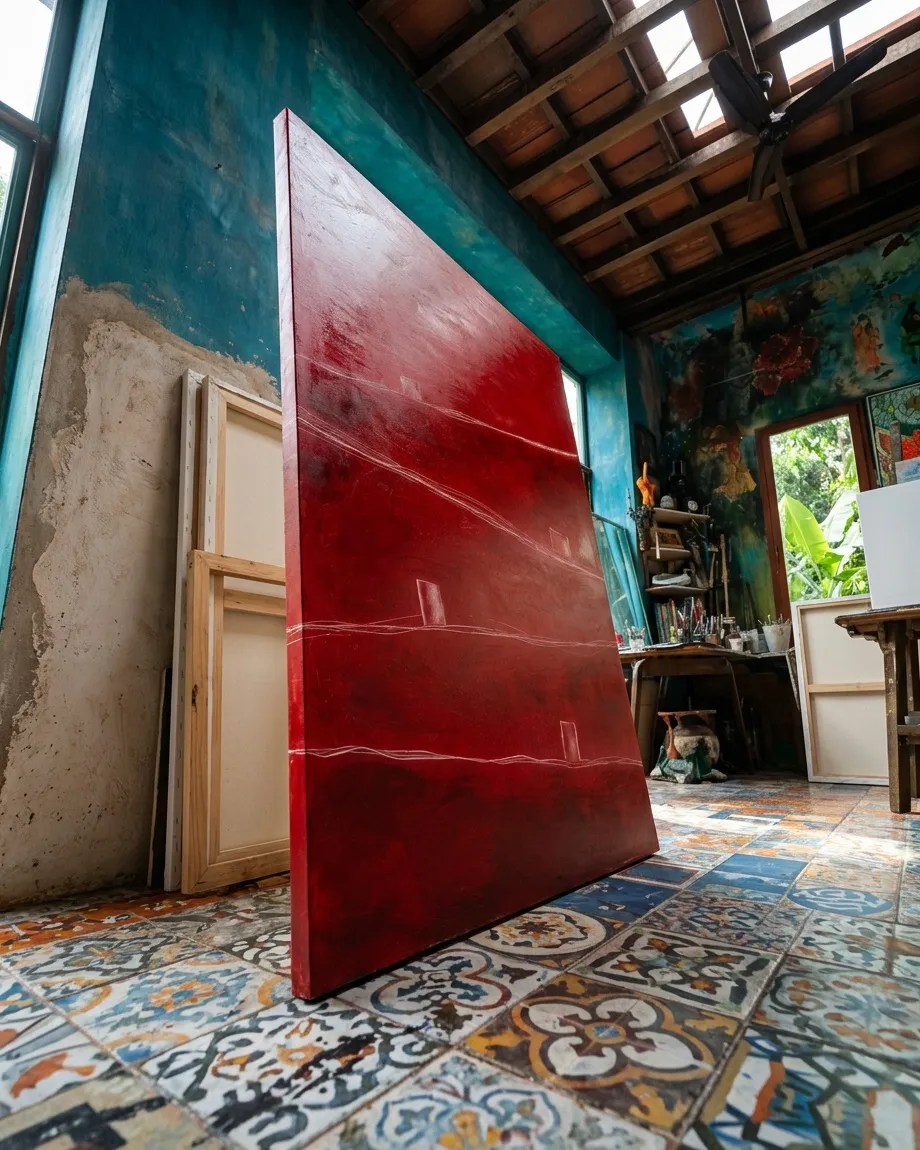
Minimalist red painting ATHAR leaning on creative studio floor
Before the imposing chromatic field of ATHAR, the gaze collides with a wall of dense matter, an absolute crimson red that seems to absorb and contain all the gravity of the studio. We are not before a flat or decorative color, but rather one of those layered surfaces where oil paint has been deposited through physical sedimentation, layer upon layer, building a dense and hermetic mineral geography. Here, permanence does not manifest as an abstract idea of suspended time, but as a somatic accumulation of pigment defending itself against oblivion. It is a thick, almost geological skin that refuses to be erased and proclaims its physical presence through its thickness, forcing us to confront the canvas as a body tenaciously resisting external wear.
When I sink the tool into that dense crust of crimson color, I hear the dry crackle of the pigment yielding under the physical pressure of the metal. Scraping the thick oil paint is not an act of destruction for me, but a surgical incision that seeks to rescue the truth of the support; it is a necessary violence to make the rustic, almost raw light of the underlying canvas emerge through this process of subtraction. In that open scar, in that incised line that tears the sovereignty of the color, I immediately recognize the dimension of helplessness. By removing the matter, I expose an irreparable fragility, an unprotected void that previously lay hidden beneath the opulence of the paint. It is the revelation of an intimate exposure, a gash showing that every constructed order, no matter how dense and permanent it seems, contains at its core an unfathomable and naked vulnerability.
If we pause at the meticulous geometry of the work, we notice that the vast red plane is traversed by four incised lines crossing the canvas in a subtle diagonal. Suspended from these marks, in a precarious and almost miraculous balance, are small white cubes or niches floating in the immensity of the red void. These minimal blocks, traced with almost constructivist sobriety, seem to function as fragile, solitary shelters resisting the chromatic tide around them. In them, an indissoluble tension unfolds: on one hand, they embody the isolation of helplessness, exposed to the immensity of this radical abstract landscape; on the other, they reaffirm the silent permanence of their pure, elemental forms, clinging to the groove like someone holding onto a handhold of light in the middle of a storm.
In the midst of this process of subtraction, I am always struck by the silent awe of wonder. It is a humble yet absolute discovery: understanding that the beauty and strength of the painting do not come from the addition of matter, but from its patient removal. The true light of ATHAR is not a reflection projected from the outside onto the varnished canvas; it is a glow emerging directly from the wound, from the depth of the scraping that reveals the original ground of the support. This moment of revelation completely transforms my relationship with the canvas: the physical effort of scraping and the friction of the spatula cease to be a gesture of confrontation to become a quiet joy, a strictly material miracle that occurs when I allow the void to breathe and the painting’s own light to declare itself free from the dictatorship of color.
When standing before the work in its real context, leaning directly on the studio floor like a monolith or a tactile threshold, its physical scale of 80 x 120 centimeters acquires a unique architectural gravity. ATHAR is not offered to the gaze in a merely contemplative way, but imposes itself in the space as a corporeal and object-like presence dialoguing with the roughness of its surroundings. It is in this three-dimensional encounter where wonder, helplessness, and permanence cease to operate as opposing concepts to merge into the rough materiality of the painting. Through its scars and its dense crimson skin, the work shows us that its wounds are not signs of ruin, but the indispensable condition of its eternity; a vulnerable surface that, stripped of all temporal urgency, stands whole and returns a clean, quiet, and deeply human gaze.
- Original artwork
- ATHAR
- Actual dimensions
- 31.5 × 47.2 in / 80 × 120 cm
- Presentation
- Digital contextual visualization
Context references
artwork leaning on floor · crimson red abstract painting · bohemian art studio decor · Maurizio Valch abstract painter · red canvas on decorated tiles · creative workshop interiors
About this visualization
This visualization places the artwork within an architectural context to help collectors and viewers imagine its presence in a real space. It is an interpretive reference, not an exact reproduction: the original work remains the sole authority for scale, color, surface and material presence.