Context study / ATHAR
Abstract Painting ATHAR in the Artist's Studio | Maurizio Valch
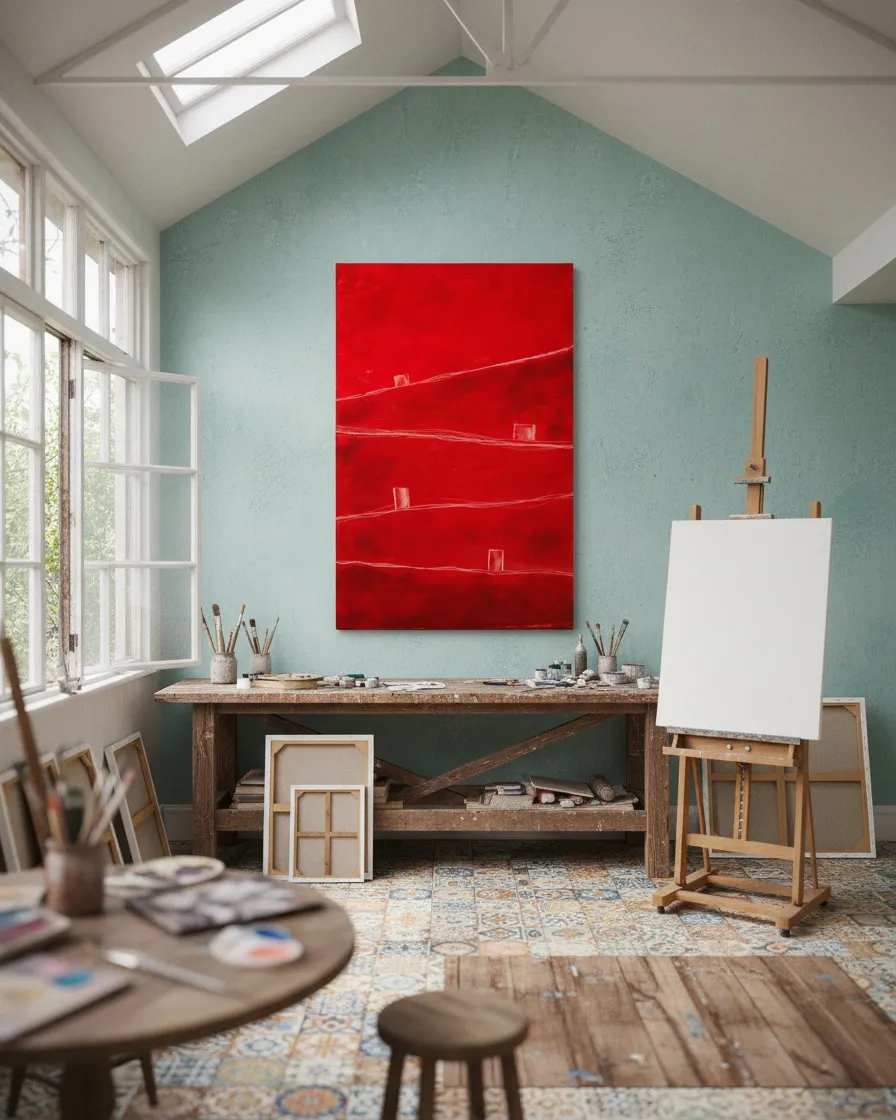
Hanging in the heart of the studio, surrounded by the everyday tools that gave it birth, ATHAR does not act as a record of memorable events, but as the silent accumulation of an existence that dispenses with anecdote. The large crimson canvas is presented in this creative space not to narrate a story, but to suspend it. While the rustic furniture and empty easels speak of chronological time and concrete activities, the painting proposes a different temporal geography, where experiences are not ordered chronologically but superposed through sedimentation. Here, the artist's biography is stripped of proper names, mapped journeys, or documented crises, translated solely into the physical pressure of color and the resistance that the matter opposed to his hand.
I am often asked where a line comes from or why I choose to bury weeks of work under a new layer of dense oil, looking for an explanation to satisfy the need to find an external cause. However, when I run the palette knife across the surface of ATHAR, cutting the red pigment to open these fine horizontal incisions, I am not illustrating a concrete memory or commemorating a specific day of my journeys. These crevices, from which the small white blocks hang like tightrope walkers in the elements, are simply the physical trace of accumulated fatigue, the echo of having walked for hours under a mute sky where nothing visible occurred. I do not paint what happened to me; I paint the somatic structure that remained after the facts ended up buried under their interpretations.
The material density of ATHAR dialogues with that tradition that Antoni Tàpies understood as the surface-wall: a rough body that preserves the traces of its own erosion and the wear of time. In this studio presentation, bathed in a natural light that highlights the relief of the incisions and the texture of the crimson, the painting reveals its true tactile dimension, behaving more like a skin than a window. The four translucent blocks, aligned on a slope that disobeys the rigidity of the studio grid, do not function as symbols with translations in a psychological dictionary. They are compact presences, minimal anchors registering tensions of stability and weight, offering the viewer an autobiography stripped of literature, where what has been lived manifests solely through gravity and balance.
Looking at the painting now, suspended on the very wall where it was conceived, I realize that the need to turn life into a grand heroic quest dissolves completely into the sobriety of these strata. There was a time when I believed that painting was a way to justify my existence, to build a coherent narrative about who I am or where I am heading. But the canvas refutes me with its own silence; there is no narrative of victory here, nor any intimate confession to decipher. These blocks that barely hold on the slope are my contradictions made physical: the tension between the desire for shelter and the inevitable fall, resolved not with a theory of self-control, but with the technical honesty of a scraping that reveals the light the color tried to hide.
By dispensing with recognizable anecdote, the work opens a space of resonance where the viewer no longer seeks to decipher the creator's intimacy, but rather to confront the scale of their own experience. The empty easel in the foreground and the workbench splattered with pigments act as silent witnesses to a process that has concluded, letting the painting assume its physical autonomy in real space. ATHAR demonstrates that a life can appear whole in the pictorial space without needing to exhibit its events. In the end, what survives on this tactile shore is not the detail of the artist's personal shipwreck, but the vibration of a surface that remembers, reminding us that we are, above all, the result of the pressures and cuts that have shaped us.
- Original artwork
- ATHAR
- Actual dimensions
- 31.5 × 47.2 in / 80 × 120 cm
- Presentation
- Digital contextual visualization
Context references
painting studio decoration large painting · display abstract red oil painting · maurizio valch artist studio · red painting on blue wall · painting mockup in rustic studio
About this visualization
This visualization places the artwork within an architectural context to help collectors and viewers imagine its presence in a real space. It is an interpretive reference, not an exact reproduction: the original work remains the sole authority for scale, color, surface and material presence.