Context study / ATHAR
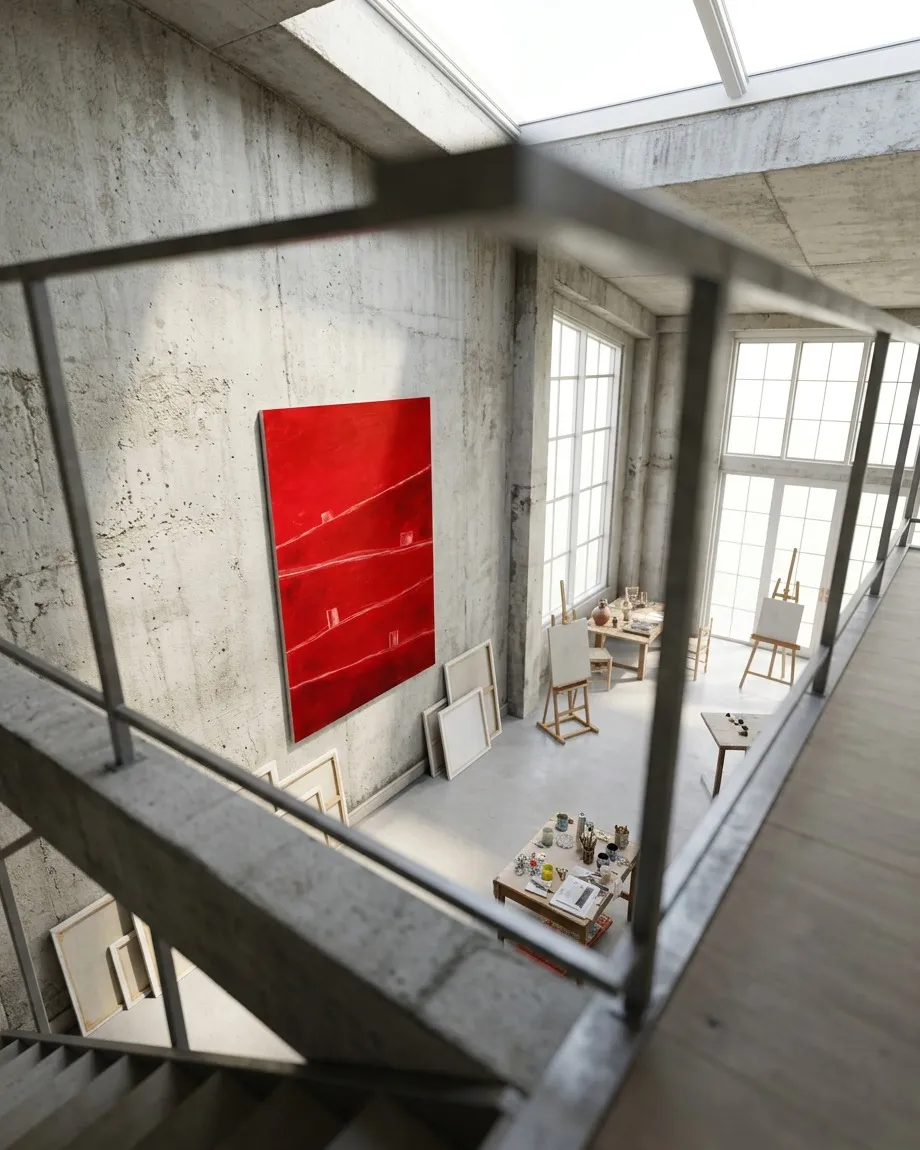
ATHAR red abstract painting by Maurizio Valch in art studio
The elevated perspective offered by this concrete and metal railing places the viewer in a position of silent vigilance, almost as if contemplating a geological territory from the edge of a cliff. Below, in the sober industrial gloom of the workshop, "ATHAR" imposes itself on the grey wall not as the representation of an event, but as a violent and compact state of vibration. Crimson red does not illustrate anger, melancholy, or urgency; the color is the urgency, a mass of dense pigment that seems to have absorbed and retained all the temperature of an instant before thought could translate it into words or theories. The image deliberately renounces anecdote and biography to sustain a presence that is felt in the body before being deciphered by the intellect.
When I face this red surface with the spatula, I do not seek to transfer a personal diary to the canvas or explain a prior psychological experience. I work by pure accumulation and subtraction, sinking the metal into the layers of wet oil until the scraping reveals the light pulsing behind the crimson. In this physical effort, each horizontal incision becomes a direct record of the tension accumulated in the arm, a discharge of energy that freezes in the matter and does not need to narrate its origin to become visible. The painting is thus constructed as a record of impulses, a map where emotion is not described, but physically executed upon the support.
Faced with the rational and geometric order imposed by the studio—with its empty easels, its aligned paintbrushes, and the overhead light descending cleanly through the window—the work acts as a focus of rebellious friction. The incised lines that furrow the canvas from side to side introduce a trembling vibration, a series of cuts that interrupt the flatness of the crimson and suggest that the apparent stillness of the surface is only the result of forces in constant conflict. There is no hero's journey here with departure stations and triumphant returns; there is a fertile standstill, a visual grounding that forces the gaze to halt on the very texture of the relief, where time seems to have thickened.
The four small white blocks hanging from the incisions are, for me, the point where the noise of the mind attempts to find a foothold in the middle of the chromatic storm. I did not paint them thinking of self-defense structures or psychological bunkers, but as a physical counterweight to the constant fall suggested by the decline of the painting; they are blocks of contained light that stop the sliding of the eye for an instant. Placing these small presences on the surface produces a strange mixture of disorientation and calm in me, as if by giving them a place on the canvas I were simply accepting the fragility of the structures we build to protect ourselves from the void.
From this overhead distance, the work finally reveals itself as a tactile membrane that regulates the relationship between space and the viewer's body. By dispensing with the frame and continuing the pigment along the edges of the stretcher, the painting renounces being a window onto an illusion and asserts itself as a three-dimensional object sharing our own gravity. Contemplating ATHAR in the stillness of this stripped workshop is to witness the pure condensation of an emotional state sustained without the crutch of narrative, demonstrating that the image is most eloquent when it silences its motives and hands us, simply, the honesty of its wounded matter.
- Original artwork
- ATHAR
- Actual dimensions
- 31.5 × 47.2 in / 80 × 120 cm
- Presentation
- Digital contextual visualization
Context references
crimson red abstract painting · contemporary textured painting · maurizio valch original artwork · industrial art studio decor · large minimalist abstract art · oil on red canvas
About this visualization
This visualization places the artwork within an architectural context to help collectors and viewers imagine its presence in a real space. It is an interpretive reference, not an exact reproduction: the original work remains the sole authority for scale, color, surface and material presence.