Context study / ATHAR
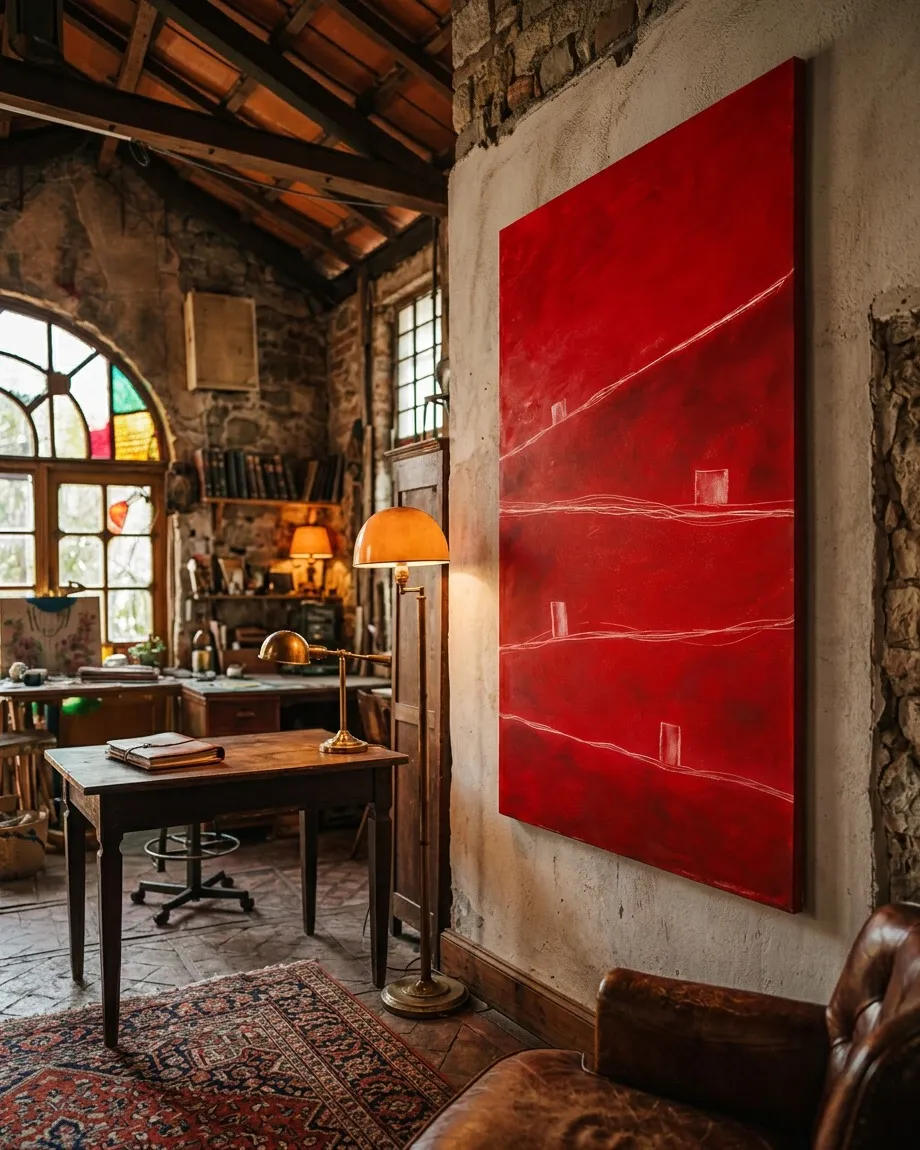
Maurizio Valch's red abstract painting ATHAR in a rustic studio
ATHAR
At a certain distance, before touching the first line, ATHAR seems like a territory that still refuses to declare itself. Red occupies the upper reaches of the painting with an unstable authority: it is not a wall, though it has thickness; it is not an atmosphere, though it seems to envelop; it is not a wound, though in some places the gaze pauses as if before too close a pressure. There are reds that advance, reds that retract, reds that fade toward an almost silent depth. The field does not offer a single temperature: sometimes it burns without fire; sometimes it cools as if holding shadow within itself.
The four white lines cross this extension without ever dominating it. From afar they could be horizons, seams, cables stretched between points we do not see, measurement marks, incomplete maps, attempts not to get lost. But none of them manages to be straight. Each one trembles slightly, duplicates, deviates, rises where it should rest. They seem to have been traced by a hand that did not fully trust the stability of the ground, or by a terrain that moved while being traversed.
Then the four light shapes appear: small, almost rectangular interruptions, separated from one another. Doors? Blocks? Signals? Refugios seen from very far away? At this distance it is best not to decide. The small does not yet ask for a name; it asks for a shift in attention. Because something minimal, here, alters the gravity of an immense surface. It does not defeat it. It does not explain it. But it manages to make the red cease to be simply an extension and begin to tilt around these presences.
Carlo Scarpa: knew that a joint, an edge, or a threshold can make an entire space important.
Before those small shapes, his intelligence becomes almost uncomfortable. He looks at them as if they were entrances that have lost their room, thresholds without a wall, pieces destined to sustain a relationship between two voids. He does not need there to be a house for an entrance to exist: a difference in level is enough, an interruption in continuity, a place where space seems to hold its breath before passing.
But ATHAR does not entirely obey him. Scarpa would want to draw close to those small clearings to measure what they separate and what they connect. However, they seem too lonely to serve as access to anything. Some tilt or dissolve into the vibration of the line that accompanies them. They do not have the security of architecture. They do not rest with precision; they barely persist. Perhaps they are not thresholds, but the memory of a threshold after the entire building has withdrawn.
I look at these four shapes and can no longer return them to a single intention. I see that the lines are less obedient than they seemed and that the red does not let itself be possessed by my gaze. Perhaps I wanted to order distances, but now each small clarity has separated from me and guards a decision I no longer know how to explain.
Further down, at the height where a line ceases to be a line, the eye draws close. The white strip that from afar seemed a light gesture becomes a multitude: parallel paths, abrasions, small deviations, insistences that do not quite coincide with themselves. There are areas where the white seems to want to advance decisively and others where it retreats, thins out, opens into filaments. The line does not cross the red like a ruler on a table; it feels its way through it.
Here the scale is inverted. What seemed immense—the red field—is momentarily out of focus. What is decisive occurs in a minimal alteration of the edge, in the distance between two white threads, in the precise place where the line changes height so as not to collide with one of those light shapes. The reader leans in without realizing. The head seeks to follow the path, as if it could hear the hesitation.
Henri Cartier-Bresson: watched for the instant in which shapes, for a second, find an unrepeatable relationship.
His question would not be what these small shapes are, but: when were they on the verge of not being there? One of them seems newly arrived at its line, as if it had entered the frame too late. Another seems out of time: too high, too separate, conserving a light that the rest of the painting does not share. A third gives the impression of looking toward an non-existent edge. The last almost interrupts nothing, and precisely because of that obliges us to look with greater care.
The photographer would find frames within the frame: each white strip delimits a band of event; each light shape alters the balance of its neighborhood; each distance seems to have lasted just long enough not to disappear. But painting poses a difficulty for him that his sensibility cannot fully resolve. Here the instant does not occur all at once. It accumulates. A line contains several presents that have not been contemporary with one another: that of its first deviation, that of its insistence, that of its near-correction, that of its abandonment of straightness.
And, suddenly, a small question turns them both aside: if that little white house has no floor, how does it know where it stops falling? It is not a question to answer easily. It returns to the shapes their fragility and to the lines their secret work. Perhaps none of those presences is supported; perhaps the red is not a background, but that which keeps them suspended without touching them.
In the strip that forces the body to bend, the two ways of looking begin to rub against each other poorly. Scarpa insists on relationships of weight: a light shape displaces the tension of the line that brushes it; a void organizes the space around it; an interruption, however minimal, can change the flow of the entire surface. For him, the white bands are not mere lines: they are edges that distribute support, breath, zones of passage.
Cartier-Bresson does not fully accept this slowness. He sees intervals, framing decisions, events that are about to escape through one end of the painting. The tilt of a line, the small rectangle that separates from its neighborhood, the narrow red strip that remains between two whites: everything could have been different a fraction before or after. For him, tension is not solely constructed; it also appears, is lost, and reappears with a precision that no blueprint guarantees.
Neither gets the last word. The painting reminds Scarpa that not all space is made to be inhabited. There are voids that do not wait for a body, thresholds that do not lead anywhere, layouts that do not want to become a building. And it reminds Cartier-Bresson that not every instant wishes to be retained. Some relationships last too long; they settle, change density, and resist being fixed as a single coincidence.
Descending through the four strips, the reader's body begins to obey a strange choreography. Breath shortens before each line, as if crossing it required permission. The head tilts toward the small light shapes; it wants to get close to them, to check if they are doors, if they have thickness, if they guard a shadow. But on returning the gaze to the red, the field no longer seems the same. It has gained weight. The surface that previously welcomed the lines now seems to be pressing them from behind.
I measure the distance between my body and these minimal shapes and discover that it does not remain fixed. When I draw near, I do not possess them: doubts multiply around them. When I move away, they continue to work on me as if they were points of support for a gravity that never fully reveals itself. I do not know what holds what, but I feel that the painting continues to displace my way of standing before it.
In the last strip, seen once more from afar, everything returns and nothing remains the same. The four white lines reappear as a light, almost airy structure, but they can no longer be mistaken for simple horizons. Each one carries with it the memory of its hesitations, its unfoldings, its small escapes. The red returns to occupy almost everything, though it no longer seems an indifferent immensity: it is perforated by acts of attention.
The four light shapes have also changed. They are not decorative details or signs that can be translated all at once. They could be thresholds to nothingness. They could be errors of scale: rooms reduced until they fit within a breath, buildings forgotten by their own landscape. They could be small resistances against the red extension, tiny refusals to disappear within it. Or perhaps they are the place from which the painting looks back.
The initial question persists, but it has shifted. It is no longer solely about how something so small can alter the gravity of so immense a red territory. Perhaps gravity was already altered before, and those minimal shapes are the only thing that allows us to notice it. Perhaps the lines do not attempt to measure the field, but to test if it can still hold itself up.
There remains a strip that is not fully explained: that which seems to rise when it should remain horizontal. There remains a small shape that does not fit with any of the others. There remains, near one of the edges, a darker red that admits no name without losing some of its thickness. The gaze returns there, not to resolve it, but to check if that minimal architecture continues without falling.
- Original artwork
- ATHAR
- Actual dimensions
- 31.5 × 47.2 in / 80 × 120 cm
- Presentation
- Digital contextual visualization
Context references
red artwork in studio · large format red painting · rustic design with abstract painting · red canvas with white incisions · art workshop decor with paintings · Maurizio Valch STRATA ATHAR
About this visualization
This visualization places the artwork within an architectural context to help collectors and viewers imagine its presence in a real space. It is an interpretive reference, not an exact reproduction: the original work remains the sole authority for scale, color, surface and material presence.