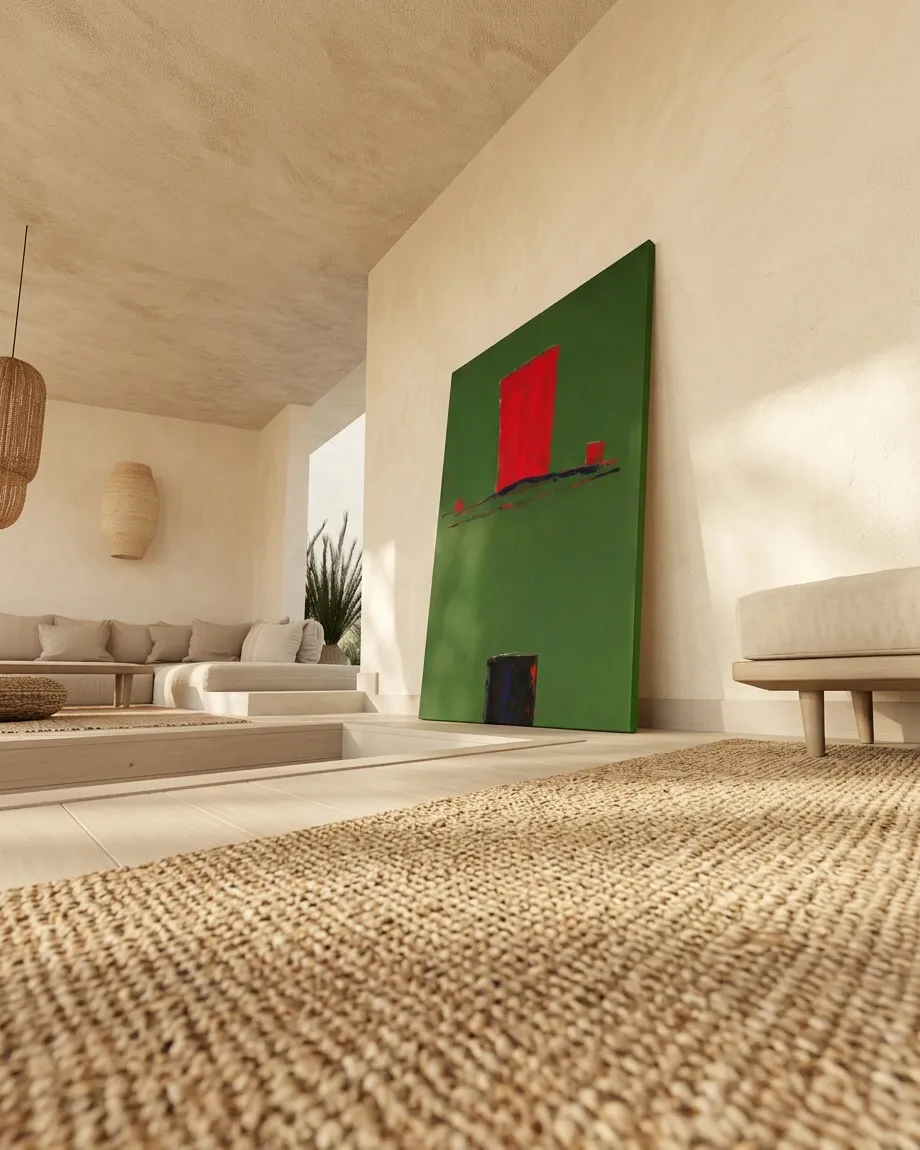
Context study / ASCENSUS
Maurizio Valch - ASCENSUS in a Contemporary Wabi-Sabi Living Room
The gaze immediately stumbles upon the wound crossing the plane: a dark, summary horizon cutting through the vast green plain of ASCENSUS, forcing the eye to halt before the absolute gravity of a red block suspended in the void of the surface. This spatial arrangement immediately evokes the warnings of G. I. Gurdjieff, the mystic and philosopher who questioned human automatism and advocated for conscious effort to awaken from everyday "sleep," suggesting that unexamined existence is nothing but mechanical inertia. In this sense, the painting does not function as a contemplative window, but as a device of friction where the large red block operates as a "self-remembering," an axis of pure attention struggling to sustain itself against the lethargic tendency of a territory pushing toward the horizontal. The color does not float placidly; it stands as a monument of conscious resistance against the numbness of its surroundings.
When I confront the 80x120-centimeter canvas, I do not think of metaphysical absolutes or transcendental revelations, but of the physical resistance of matter. I feel the real weight of the acrylic, the density of a red pigment demanding its own space on the canvas, which, far from rising lightly, presses down on the surface with the obstinacy of a physical body. That dark line cutting the green was not born to be a peaceful horizon inviting rest; it is a violent scar, a raw incision upon which I decided to suspend the main block to expose the fracture of space. Readings that seek an incorporeal mysticism in my paintings are foreign to me, because before this plane is an allegory of elevation, it is an accumulated mass of paint that pushes, collides, and asserts its tactile presence before the gaze.
Descending toward the base of the painting, the composition reveals its most enigmatic foundation in that dark, dense block anchoring the work, flanked above by two small red satellites that seem to guard the limits of the structure. From the perspective of Carl Gustav Jung, the Swiss psychiatrist who mapped the archetypes of the collective unconscious, this lower mass could be identified with the Shadow—that primordial ground of the psyche that supports, from darkness, every attempt at individuation and spiritual ascent. However, this interpretation clashes with the vision of Osho, the philosopher and mystic who defended freedom and the celebration of the body against rigid structures, who would urge us to distrust this vertical order. Under this discordant lens, one wonders if the "ascensus" suggested by the title is actually a subtle moral trap: a domesticating of vital energy in favor of a dogmatic architecture that, by imposing its hierarchy, watches and controls the territory from above.
I accept that tension; the geometric rigidity I impose on my blocks does not seek to chain the vibrant force of color, but to offer it a firm ground to embody and manifest itself with true power. I often return mentally to the severity of the Mediterranean landscape, to the stark presence of ancient monoliths cut against an implacable sun, where the standing stone does not deny the earth but affirms it through contrast. In my painting, order and fracture need each other to exist, just as silence needs a shout to be heard. I do not intend for the canvas to harmoniously resolve the eternal conflict between the inertia of the earth and the call of the sky; my only purpose is to sustain that open wound in space, allowing the contradiction to breathe.
In the end, contemplating this 80x120-centimeter painting returns us to the raw vibration of matter on the surface, a reminder that the vertical tension of ASCENSUS appeals to an extremely ancient human memory. One we share with those who erected the first menhirs and dolmens in the European landscape—megalithic monuments where raising a stone from the ground was not a mere constructive exercise, but a primal act of insurrection against gravity and oblivion. Valch updates this ancestral impulse, stripping the space of any unnecessary ornament to confront us with the pure gravity of color. In front of the canvas, stripped of absolute certainties, we are left only to inhabit the intermediate space opening between the inertia of the green and that suspended red that obstinately refuses to fall.
- Original artwork
- ASCENSUS
- Actual dimensions
- 31.5 × 47.2 in / 80 × 120 cm
- Presentation
- Digital contextual visualization
Context references
Maurizio Valch ASCENSUS painting · olive green and red abstract painting · abstract art wabi-sabi decor · contemporary brutalist painting · 80x120 cm artworks
About this visualization
This visualization places the artwork within an architectural context to help collectors and viewers imagine its presence in a real space. It is an interpretive reference, not an exact reproduction: the original work remains the sole authority for scale, color, surface and material presence.