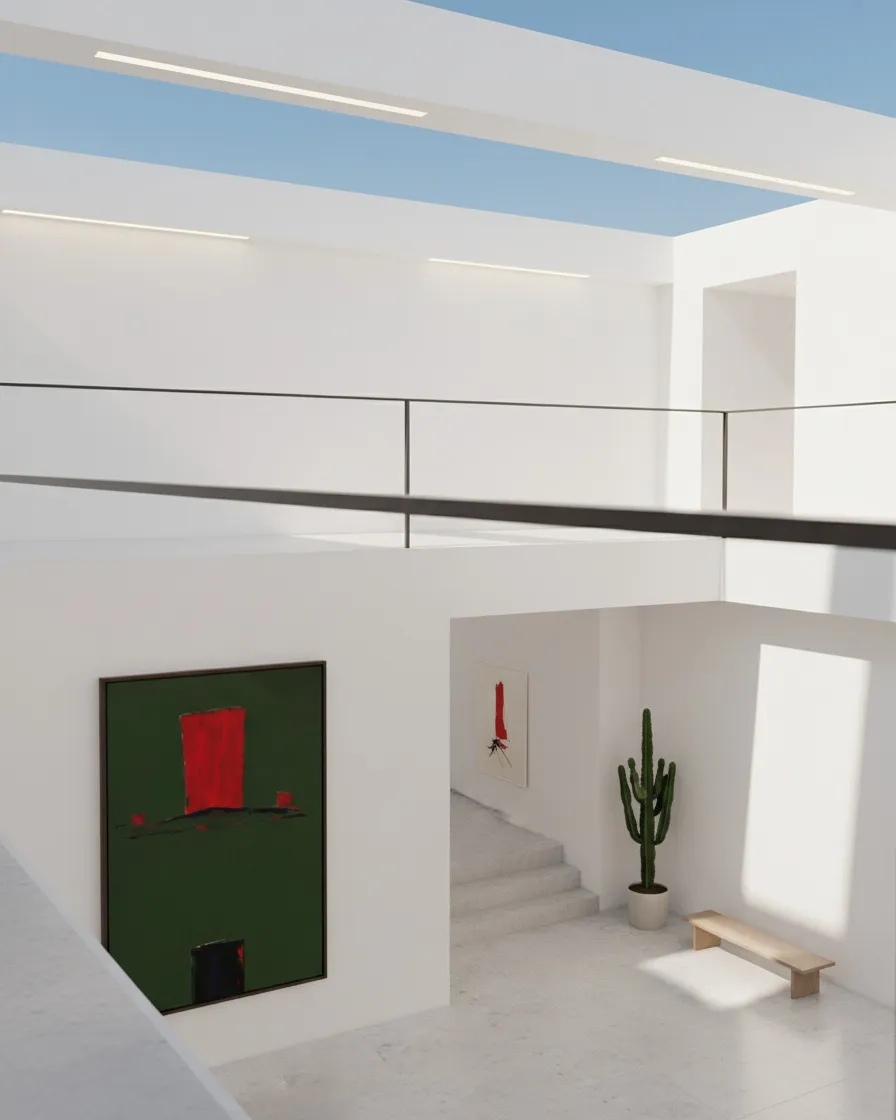
Context study / ASCENSUS
Maurizio Valch - ASCENSUS in Gallery or Open Architecture Interior
The journey starts at the bottom, where the dark block does not quite fully enter. Cut off by the bottom edge, it yields only bluish and red reflections, as if it had arrived too late to the green field or as if it belonged to the side from which one looks. It does not offer a firm base. Rather, it interrupts the ground: it occupies the space where the eye would want to rest its weight before ascending. In ASCENSUS (80 × 120 × 3 cm), gravity fails there first. The dark green opens above with an extensive calmness, almost without event, but that calm does not sustain: it leaves the block suspended between appearing and falling.
Look at it first like someone waiting for an elevator that never opens. Do not look for the door yet: wait. Let your breath slow down a bit in front of that lower rectangle, as if arrival depended on a light that does not turn on. Then tilt your head slightly, or take a step back. The block stops seeming like an object placed inside the painting and begins to seem like a slit at the edge of vision. With that minimal shift, it is not the painting that remains in front: it is the viewer who seems to be peering from below, incomplete, held back by the frame.
Leonardo da Vinci, the artist and researcher who turned the observation of bodies, currents, mechanisms, and shadows into a restless way of asking how the world works. He would detect a mechanical anomaly here: there is an ascending device, but there is no cable, counterweight, ladder, pulley, or place of arrival. The lower block could be a weight; its cut by the edge would suggest that it continues to descend outside the visible field. But nothing confirms this hypothesis. Above it extends the dark, broken horizontal strip, tilted at times, too unstable to be ground and too insistent to be just a line. It seems to carry something. It also seems to prevent it.
The gaze attempts to advance along that band and stumbles. It goes from left to right, returns, stops at its small changes in height; it finds two red bodies at the sides of the large vertical, two minimal presences that do not entirely obey the scale of the rest. One seems closer to the strip; the other separates slightly, as if it had lost contact with the ground. They are not auxiliary signals. On the contrary: they reduce the safety of the scene. If they were supports, they are insufficient. If they were witnesses, they do not look. If they were remnants of a single force, they have become independent.
A young girl, stopping in front of the painting, asks: "Why don't the two small red ones help the big red one not to fall?" The question shifts the problem. It is no longer a matter of identifying a door, a block, or a figure, but of measuring an imbalance of responsibilities. The small red shapes are there, on the sides, free, while the upper vertical carries its density alone. The band below seems to support and deny it at the same time. Like an edge that has accepted a weight without acknowledging that it accepts it.
Maurizio Valch then steps into the distance that the work has opened:
I look at that red shape and cannot decide whether it welcomes me or holds me back. I see it stand upon the line, but I do not feel it is stable; the more I fix it with my gaze, the more it seems to pull away from that which supports it. I cannot approach it without the green becoming wider, nor walk away without its irregular edge forcing me to return. The finished painting retains a will that does not coincide with my need to name it.
The large red vertical interrupts the green field in its upper half. It has the compact presence of an upright plank, the frontality of a closed door, the density of an elevator stopped between floors. Yet, none of these possibilities manages to dominate the next. A door should promise another side; here, no hinge, gap, or inner frame is visible. A block should obey a weight; here, one does not know what it rests upon. A figure should orient a human scale; here, the human gaze becomes too small, like one of the lateral red accents that fails to intervene.
Leonardo would want to isolate the forces: calculate where the load falls, look for the point of support, determine if the horizontal strip functions as a platform or as a cut. But the vertical does not respond like a thing subjected to gravity. It is too close to the ground to float and too far from it to rest. Its red does not clearly ascend: it occupies, presses, demands that the eye rise. The title, ASCENSUS, begins to behave as a suspicious instruction. Rise, it seems to say. Or perhaps: believe that something is rising.
John Berger, the writer and critic who taught us to distrust the apparently innocent gaze and to ask from where, for whom, and with what desire we see. He does not accept that the problem is solely one of forces. He asks who has the right to call that red shape a door; who expects to be admitted; who remains below while another names the ascent. Before the dark block on the bottom edge, his doubt is more unsettling: does it belong to the world of the painting or to the place from which it is observed? If it belongs to this side, the work does not show an enclosure: it raises a barrier in front of someone who is already waiting.
Then the vertical changes function without changing shape. Looking at it can mean obeying a silent command to look up. But that obedience does not lead to a summit. The gaze rises from the interrupted block, crosses the band that refuses to be ground, passes by the small red shapes that assist no one, and reaches the large red mass. There, it does not enter. It remains in front. Berger discovers that the wait is not represented in the painting as an external scene: it installs itself in the body of the viewer, in the slight imbalance of the neck tilted upward, in the breath held before an opening that does not occur.
Later, the lower block claims its place once more, but no longer as a possible counterweight. Its darkness contains small returns of color, as if it had gathered from below something of the vertical and its lateral bodies. It is not empty. It is not simply the beginning of the path. It becomes an active interruption: a fragment that does not consent to being completed by the ascent.
I return to the block below and discover that I cannot use it as a foundation. I look at it as a part that has remained out of my reach, and yet, it is the one that supports my way of looking upward. I feel that the painting does not ascend in front of me: it looks from a low depth, from an edge that I cannot possess. I keep my eyes on that dark opening and the red shape stops being a destination.
Leonardo remains before a stability he cannot prove. Berger remains before a relationship of waiting he cannot distribute with justice between inside and outside. Neither can reduce the other: the first sees a machine without a mechanism; the second, an admission without a guarantee. The painting adds its own third rule: a form can demand orientation without giving orientation; it can appear higher without moving; it can make the ground be that which loses authority first.
Returning to the image, the precise distance remains between the dark block peering from the bottom edge and the red vertical that does not finish rising: between them, the horizontal strip supports something it cannot fully support, and the two small red shapes continue on the sides, separated, without helping.
- Original artwork
- ASCENSUS
- Actual dimensions
- 31.5 × 47.2 in / 80 × 120 cm
- Presentation
- Digital contextual visualization
Context references
Maurizio Valch gallery paintings · modern minimalist home art · large vertical abstract painting · contemporary art decor · STRATA series artworks
About this visualization
This visualization places the artwork within an architectural context to help collectors and viewers imagine its presence in a real space. It is an interpretive reference, not an exact reproduction: the original work remains the sole authority for scale, color, surface and material presence.