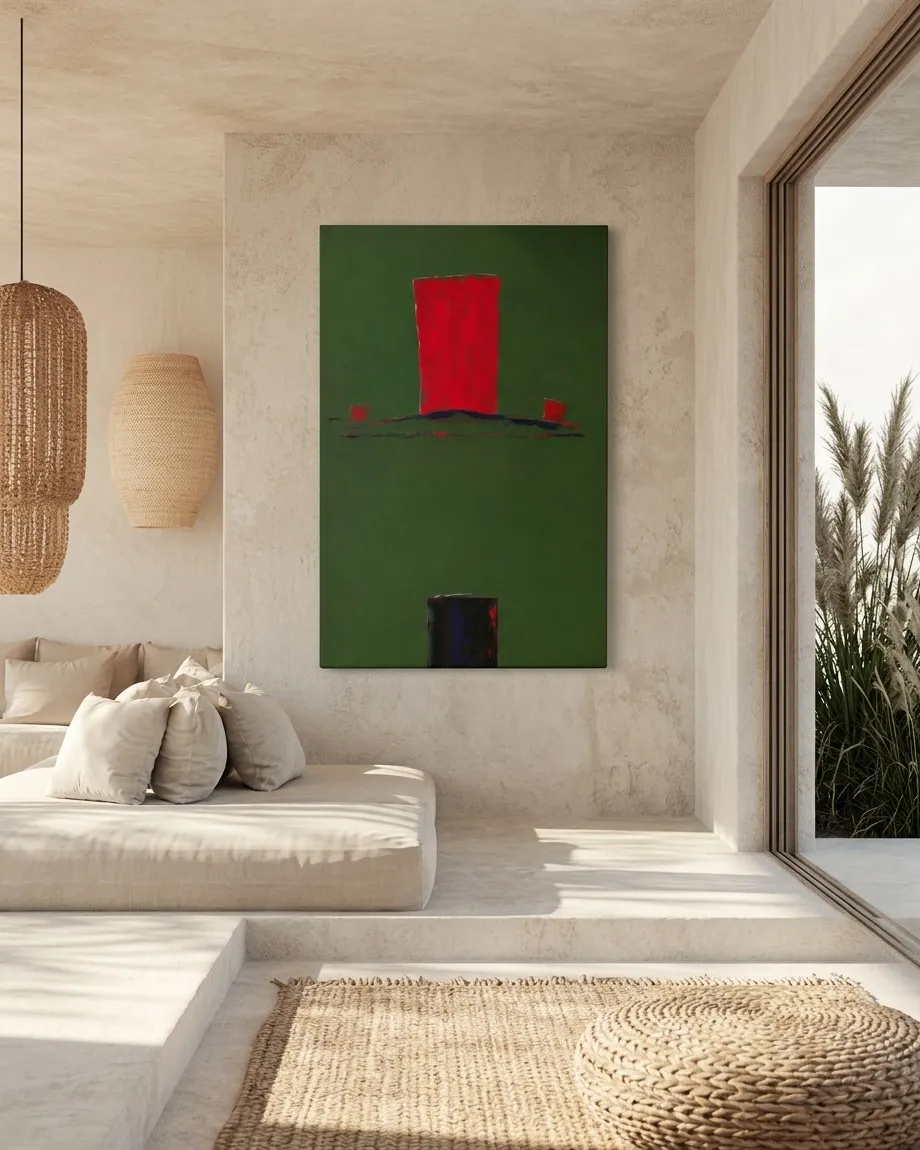
Context study / ASCENSUS
ASCENSUS in Minimalist Mediterranean Living Room - Art Presentation by Maurizio Valch
ASCENSUS presents itself first as a place where gravity has been interrupted, not defeated: suspended mid-command. The dark green occupies almost everything, but it does not behave like a background. It holds the air. It thickens it. It makes breathing slow down, as if each inhalation had to cross a windowless room. In this expanse there is no rest; there is a gentle and continuous pressure, a kind of climate that prevents forms from settling comfortably. Above, near the upper third, a red presence remains high, perhaps too high, with edges that do not fully accept straightness. It does not rise clearly. Nor does it fall. It seems to have arrived before its own movement.
Merce Cunningham, a choreographer who imagined dances capable of separating movement from music and letting chance, body, and space affect each other without obeying one another. Eduardo Chillida, a sculptor who thought of the void, weight, and limit as materials capable of being touched with the hands. Between the two, the green ceases to be an available surface. For Cunningham, there would be an immobile body executing a very long fall: a fall so slow that it can be confused with an elevation. For Chillida, on the other hand, there is neither fall nor elevation, but a arrested pressure; the green space would have thickness, pushing from behind the red form, keeping it in place like an open hand that does not want to touch.
I look at that red and find that I can no longer decide its direction. I feel it separated from me, even when it seems so close: its weight is above, my attention is below, and between the two a physical distance opens that I do not know how to measure. I want to say it is arriving, but it could also be leaving; I want to fix it in a position, but the painting does not accept that obedience. What I made has begun to look toward a side I do not control.
Below that red form, the horizontal strip does not organize the image: it disorganizes it with a fierce economy. It may be ground, but it does not fully sustain. It may be a scar, but it does not follow a recognizable wound. It may be the edge of a mechanism without a machine. On its sides, two small reddish presences seem to have turned away slightly, as if a conversation had been suspended just before starting. Here the gaze must slow down. Here time becomes narrow. How does the high red know that its lower edge must not cross that strip, even if it does not seem to rest on it? The childish question displaces everything: the elevated mass no longer occupies a position, it obeys an unknown rule.
Cunningham insists on testing an impossible choreography. The body cannot touch the ground; the ground, for its part, does not fully offer itself. Thus each pause weighs more than a gesture. The red figure could be the instant before a jump, but also the instant after, when the body has not yet understood that it will return. Chillida is suspicious of this suspension: the strip, the painting says without saying it, is not a timeline but a zone of compression. The weight that the red seems to have lost accumulates there. Yet something forces the sculptor to count: first the large green retention, then the dark edge, then the unresolved red, then the two small detours. A sequence. Cunningham, in turn, finds gravity in stillness: immobility is not the absence of movement, but movement forced to stay inside.
Further down appears the dark, vertical, and compact block, close to the bottom edge. It holds no proportion to the large red form, and therefore alters its scale. Its darkness receives blue and red glints, as if it had gathered colors that the rest of the painting let fall without realizing. Is it a remnant? A door too small for the place where it has appeared? The shadow that grew tired of obeying that which was supposed to project it? It does not answer to the strip, but it makes it stranger. It does not sustain the composition: it unbalances it from below, with the stubborn discretion of something that has remained outside the system and now demands to be seen.
Looking at that block, I receive a different resistance from the one I found above. It is no longer a matter of not knowing if something rises or falls: it is about accepting that this small form returns a measure I had not asked for. It seems too low, too dense, too alive to be a detail. I would like to name it without reducing it, but each name falls short and returns to me like a miscalculated object. The finished painting retains something there that I cannot abandon.
The green, then, reveals itself charged: it does not surround the shapes, it keeps them apart through a silent force. The red mass is suspended, yes, but its suspension begins to feel heavy; the strip ceases to be a simple division and becomes the place where laws change hands; the lower block can no longer be reduced to a dark note in the margin. Its presence makes everything else have to measure its distance from the edge once again. ASCENSUS does not necessarily ascend: perhaps it essays, over and over, the difficulty of staying up when the bottom has already begun to claim its share.
- Original artwork
- ASCENSUS
- Actual dimensions
- 31.5 × 47.2 in / 80 × 120 cm
- Presentation
- Digital contextual visualization
Context references
interior design with abstract art · minimalist living room painting ideas · contemporary art in organic spaces · art frame mockup in living room · large green and red painting
About this visualization
This visualization places the artwork within an architectural context to help collectors and viewers imagine its presence in a real space. It is an interpretive reference, not an exact reproduction: the original work remains the sole authority for scale, color, surface and material presence.