Context study / ADITUS
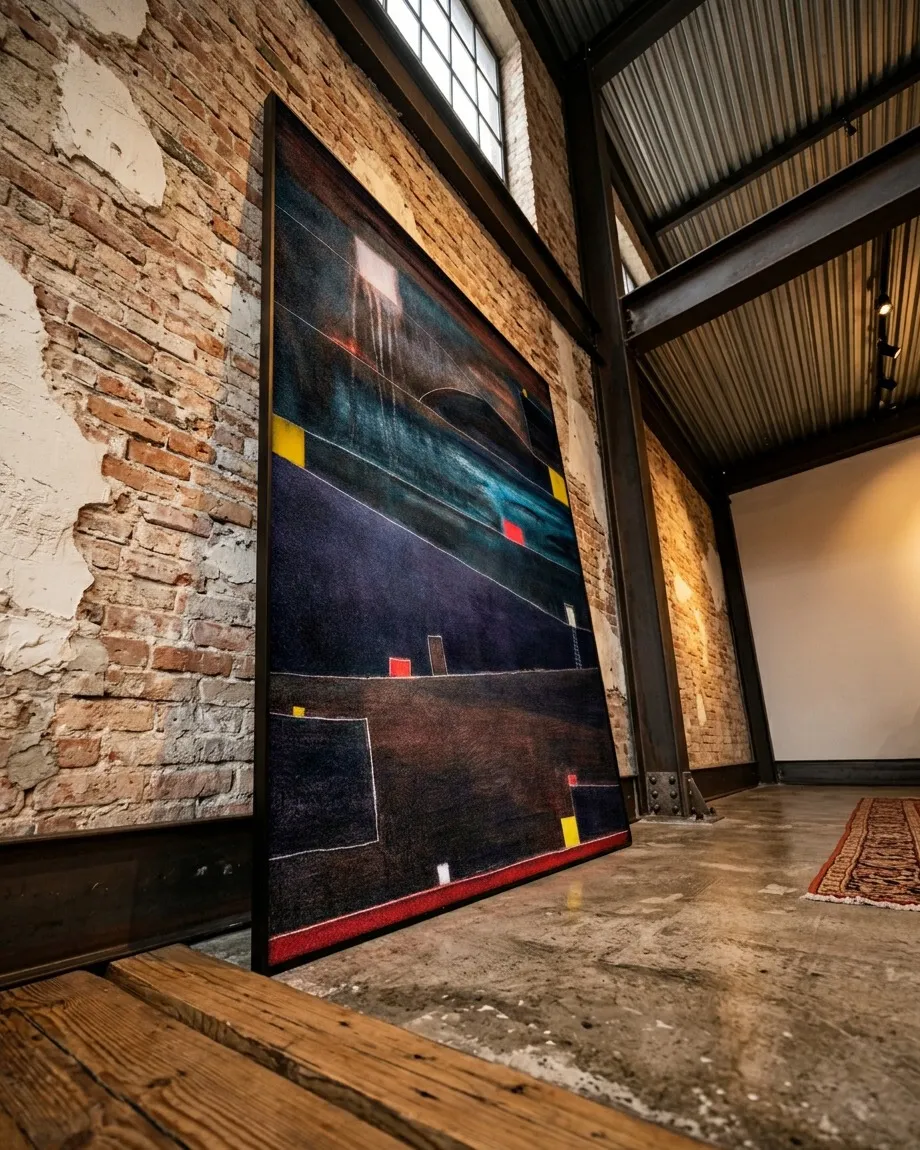
ADITUS by Maurizio Valch in a Ground-Level Industrial Setting
Viewed from floor level, ADITUS’s 120 cm height ceases to be a measurement and begins to impose a relationship. Its lower edge, close to the floor, supports the ascent of dark bands, slopes, and cuts towards the upper zone; the eye does not take command of the whole immediately, but must travel through it. This physical condition makes Maurizio Valch’s language especially legible: stratified fields, territorial divisions, and incisions that do not describe a place, but make the surface carry the idea of terrain. Against the vertical regularity of the brick wall, the canvas’s internal slopes retain a rough autonomy. The small luminous rectangles and barely indicated staircase do not diminish that mass: they measure it, introducing an uncertain human scale within a field that retains weight and distance.
This negotiation between body and format finds a relevant echo in the experience of displacement that runs through Valch’s thinking. His journeys do not appear here as biographical narrative, nor do they turn the staircase into an emblem of overcoming; rather, they help explain why a visible direction can remain open. The staircase in ADITUS indicates a possible level without resolving what it might allow one to reach, while the frames and colour signals suspend any definitive instruction. Seen from below, approaching means recognizing that access is not an abstract idea: it requires distance, orientation, and a bodily response to something that still resists possession. The inner territory the painting may suggest does not replace the outer one; it arises from the same difficulty of positioning oneself before a limit.
In “The Incisions of the Map,” Valch proposes that a scored line does not add information to the canvas: it opens a passage through subtraction. Although ADITUS does not share the dense red surface described in that essay, the idea makes it possible to see its light traces as interventions that alter the continuity of the planes, rather than as mere drawings upon them. The text also insists on the moment when a canvas frees itself from the control of the easel and assumes its physical autonomy. This presentation makes that question tangible: the low angle and proximity to the floor give the painting an almost upright presence, prior to any reading of its signs. The threshold of the title then shifts from what is represented to the actual interval separating the viewer from the surface.
The affinity with Antoni Tàpies illuminates this material presence without turning it into a genealogy. In both cases, painting may be read as a surface exposed to layers, wear, and marks; a plane that retains the memory of having been worked. Valch departs, however, from Tàpies’s almost mural concentration: in ADITUS, erosion remains organized by a territory of levels, seepage, and unstable horizons. The industrial wall neither absorbs the canvas nor lends it its meaning; by contrast, it reveals that its incisions and edges obey another topography. The work occupies a specific place and, precisely for that reason, retains the uncertainty of what it proposes to cross.
- Original artwork
- ADITUS
- Actual dimensions
- 31.5 × 47.2 in / 80 × 120 cm
- Presentation
- Digital contextual visualization
Context references
vertical abstract painting in industrial space · abstract art beside brick wall · floor-level painting presentation · large abstract work in industrial loft · low-angle view of contemporary painting · abstract art mockup in industrial building
About this visualization
This visualization places the artwork within an architectural context to help collectors and viewers imagine its presence in a real space. It is an interpretive reference, not an exact reproduction: the original work remains the sole authority for scale, color, surface and material presence.