Context study / ADITUS
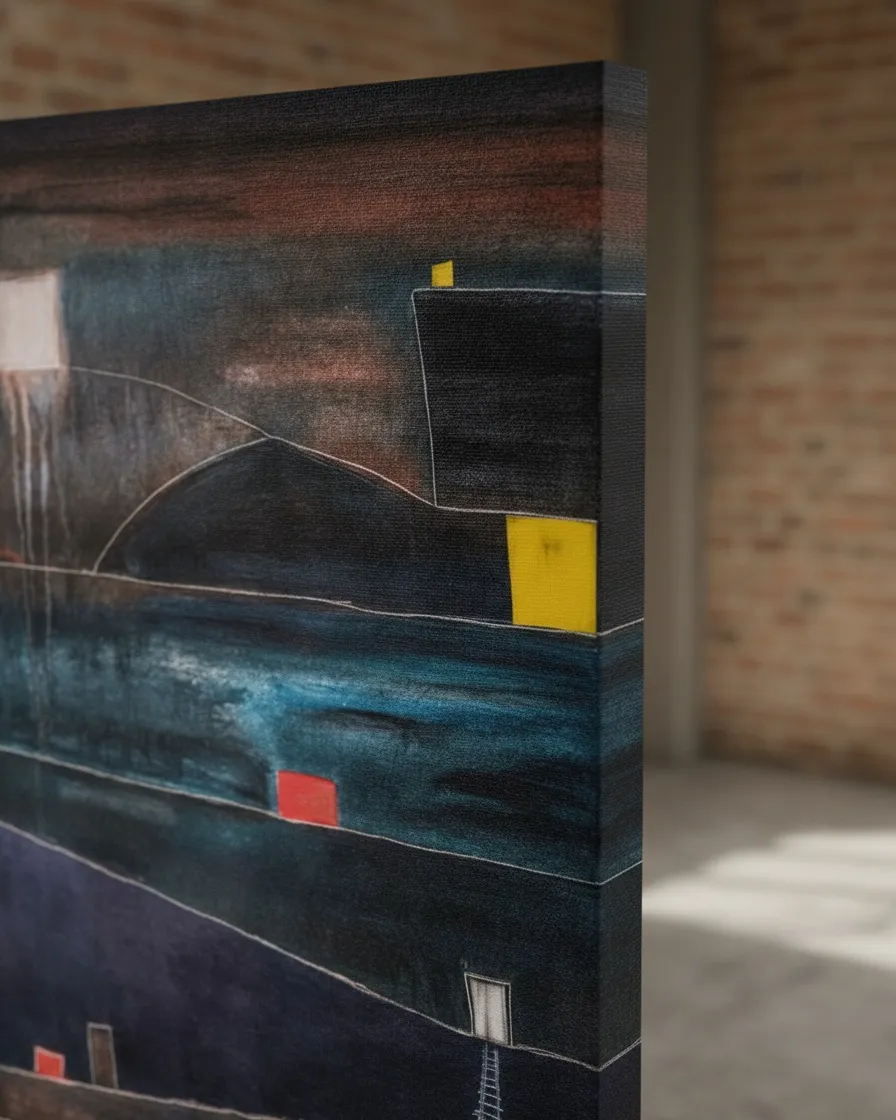
Side Detail of ADITUS by Maurizio Valch
Access becomes more uncertain precisely when the canvas leaves frontality behind. Seen up close and from the side, ADITUS reveals its 3 cm depth: the dark fields and turquoise band continue around the stretcher, while the canvas weave interrupts the illusion of a smooth, readily available image. The large black rectangle, the yellows and the pale lines no longer compose an order that can be taken in at once; part of it withdraws from view. This condition makes Maurizio Valch’s language especially tangible: his divisions and incisions do not act merely as signs within an abstract territory, but as interventions that physically engage the surface. The entry announced by the Latin title is not confirmed as unobstructed passage: it is experienced in the contact with a material limit.
This visual reserve finds an echo in an experience of passage that runs through his thought without reducing the painting to biography. For Valch, an outward path can be traced on a map, while inner movement guarantees neither direction nor arrival. The small staircase visible in the lower area and the barely suggested enclosures sustain this difference: they indicate a route without explaining it. On approaching so closely that the front can no longer be seen as a whole, the viewer neither masters the scene nor obtains a conclusive cartography; they must accept a partial orientation. Darkness, which in his imaginary can contain silence and distance rather than threat, here acquires a concrete density: it is not a psychological background, but an area that persists without fully yielding itself.
In “The Tactile Shore,” the artist writes that a border can cease to operate as a battle line and become a membrane of contact. Proximity to ADITUS makes it possible to bring this intuition to the painting without turning it into a literal equivalence. The edge does not erase the separation between viewer and viewed, but activates it: the eye registers the texture, thickness and continuation of pigment onto a plane that cannot be reached frontally. The limit does not disappear; its status changes. Against the temptation to read the rectangles and lines as a code of doors, the presentation returns attention to the fact of looking: access also entails meeting the resistance of that which retains its opacity.
The affinity with Antoni Tàpies helps define this experience of the edge. In both cases, the surface may be understood as a marked wall or skin, rather than as a neutral support for an image. Yet ADITUS departs from an exclusive concentration on wound or wear: its matter remains contained by levels, signals and a territorial organisation that keeps the question of passage open. The side angle makes this difference evident. Where frontality might promise a legible architecture, the depth of the canvas introduces a shore: a place where the image continues, yet can no longer be possessed in its entirety.
- Original artwork
- ADITUS
- Actual dimensions
- 31.5 × 47.2 in / 80 × 120 cm
- Presentation
- Digital contextual visualization
Context references
ADITUS Maurizio Valch side detail · abstract painting with 3 cm canvas depth · abstract canvas texture detail · abstract art with incised lines · turquoise and black material-based painting · 80 x 120 cm vertical canvas · contemporary abstract painting with coloured rectangles
About this visualization
This visualization places the artwork within an architectural context to help collectors and viewers imagine its presence in a real space. It is an interpretive reference, not an exact reproduction: the original work remains the sole authority for scale, color, surface and material presence.