Context study / ADITUS
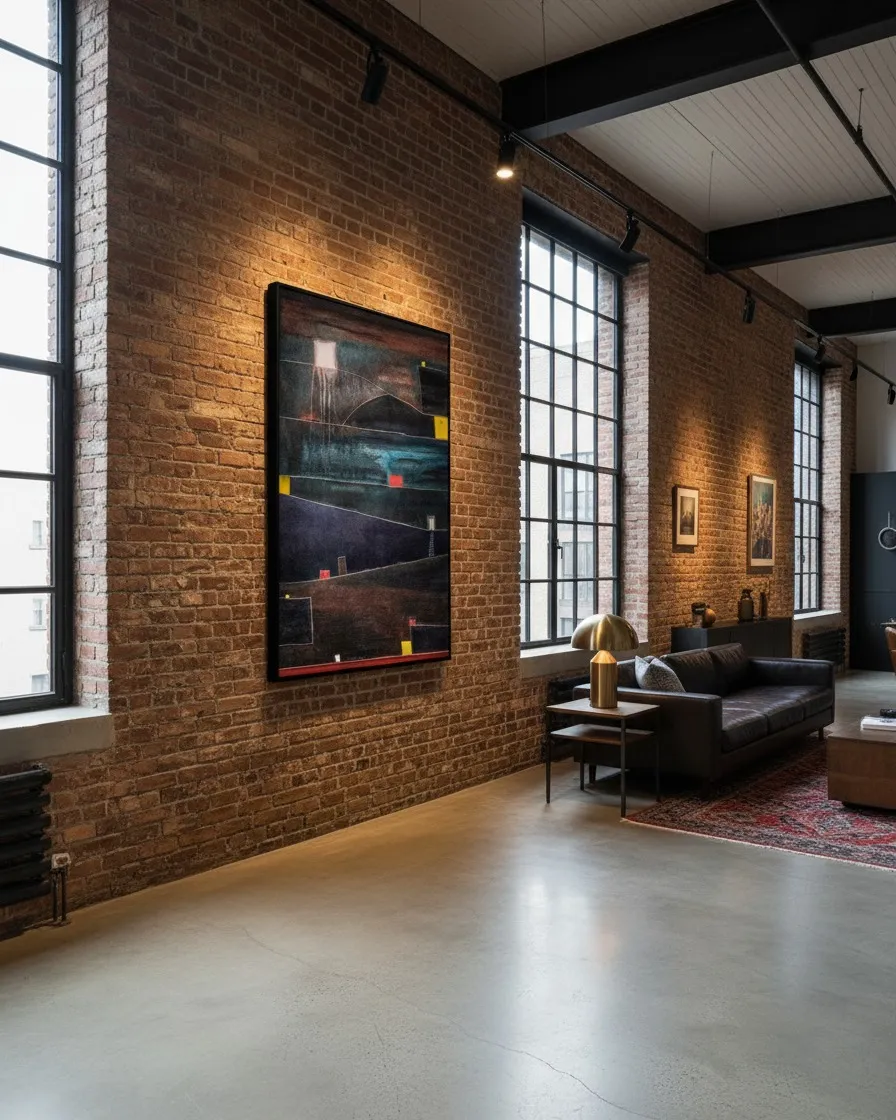
ADITUS by Maurizio Valch in an Industrial Interior
A minimal red is enough to alter the duration of ADITUS. Between fields of violet, rust and dark blue, the central turquoise band lets the eye move slowly; the small yellows, whites and reds arrest it at once. They do not complete a harmonious palette: they break in as uneven signals that require the picture’s levels to be reassembled. This economy belongs to Maurizio Valch’s language, built through colour fields, divisions, contained horizons and incisions that function as material traces rather than outlines. In the vertical 80 × 120 cm format, presented at some distance from the brick wall, the accents do not lose their scale: they become even more precise against the dark expanse around them. The painting does not yield an image all at once; it alternates delay and alert.
This experience finds a possible resonance in the attention the artist has given to distinguishing a fact from the explanations that extend it. ADITUS first proposes spare visual facts: a watery band, an empty frame, descending glazes, a tiny staircase, isolated rectangles. Yet the mind immediately tends to connect them into a route and turn each chromatic appearance into a promise of orientation. The work holds that impulse without denying it. The red, for instance, concentrates the gaze for a moment, but does not clarify where to continue; the yellow marks a presence while retaining its reserve. Thus, viewing time ceases to be that of a continuous reading and comes closer to a succession of approaches, interruptions and restarts.
In “The Missing Beat,” Valch writes of syncopation as an absence that compels the body to sustain inwardly the pulse it expects. This idea allows the accents in ADITUS to be considered without reducing them to musical equivalents. The broad turquoise area establishes a sustained, almost suspended duration, while the small red and yellow notes arrive offset from any compositional regularity. They are not conclusive beats: they leave a brief wait in their wake. The pale incised lines in the lower area also take part in this broken rhythm, as they lead toward the staircase without turning it into a resolution. The painting makes the eye complete intervals that are not given, and through this discreet work turns the pause into a form of presence.
The affinity with Paul Klee is specific and illuminating in the function of these smaller forms: the luminous rectangles and the short stretch of staircase measure the vast territory without fixing it as recognisable architecture. But where Klee may unfold an agile syntax of signs, Valch places his appearances beneath more opaque matter and an atmosphere of weight. In this presentation, the grid of the windows and the repeated pattern of the brick make ADITUS’s refusal to adopt a stable cadence perceptible by contrast. Against the repetitions of its surroundings, its accents persist as isolated events: they do not organise the field from above, but intermittently open it to an attention that must begin again.
- Original artwork
- ADITUS
- Actual dimensions
- 31.5 × 47.2 in / 80 × 120 cm
- Presentation
- Digital contextual visualization
Context references
ADITUS Maurizio Valch · 80 x 120 cm vertical abstract painting · abstract art with turquoise and red · geometric painting in an industrial interior · wall art for a loft with exposed brick · large contemporary abstract painting · territorial abstraction with incised lines
About this visualization
This visualization places the artwork within an architectural context to help collectors and viewers imagine its presence in a real space. It is an interpretive reference, not an exact reproduction: the original work remains the sole authority for scale, color, surface and material presence.