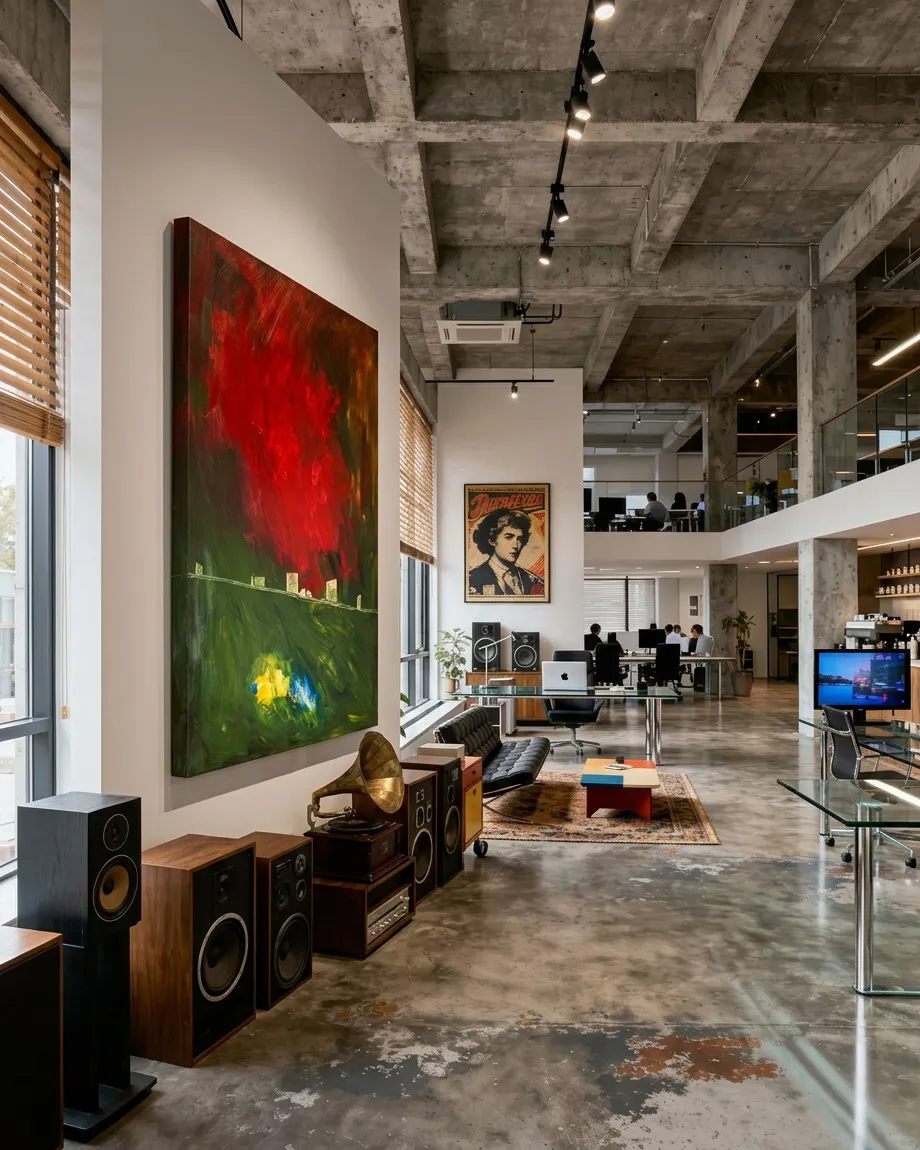
Context study / A THEORY OF LIGHT AND SHADOWS
A THEORY OF LIGHT AND SHADOWS — Context Study
I. The Measure of the Horizon
In front of the surface of A Theory of Light and Shadows, space ceases to be a neutral coordinate to become a theater of carnal tensions. It is here that Protagoras stops: the philosopher of Abdera who shook ancient thought by asserting that human being is the measure of all things, returning truth to the scale of perception and the feeling body.
The sophist does not look at the work with aesthetic detachment; he extends his own right hand, measuring with the span of his fingers the distance between the upper abyss and the lower nest. His attention is fixed on that thin horizontal line that cuts across the canvas, where small, luminous plates tremble like the beads of a suspended abacus. For Protagoras, that line is the triumph of the limit: human geometry imposing an order, an attempt to measure and partition light and shadow so that the eye does not shipwreck in chaos. Those suspended cards are our own scale, the truth of mankind standing out against the vastness so as not to be devoured by it.
II. First Incision (Maurizio Valch)
Excuse me for interrupting your speculative distance, but I must cast my eyes down to the workshop floor. While you discuss limits, I can still smell the solvent and the fresh acrylic permeating the wood. That horizontal line you see there was not born from a desire for order, but from a stroke of anger and suspicion. I remember the metallic drag of the palette knife scraping the wet green, tearing a trench in the plane to halt the painting's fall. I painted that red mass not to explain the mystery of light, but to flee from any explanation. I wanted the color to hurt the eyes physically before the brain had time to give it a name. Do not search for a metric system in my canvas; what is there is the desperate attempt of a body to force its way through matter.
III. The Bleeding Flow
Hearing the artist, Eugène Minkowski—the psychiatrist who understood that the essence of human suffering lies not in space, but in the loss of attunement with lived time and the creative impulse of the future—smiles with deep melancholy. He approaches the canvas and, with a gentle gesture, asks us to ignore the line of the wire.
"That border is an analytical illusion," says Minkowski, pointing to the large red stain. "What beats up there is not a colored space, but a 'bleeding time.' It is the future itself, dense and threatening, pressing with all its weight upon our present."
For the psychiatrist, the true core of the work is not in the cards that try to measure the wind, but below, in that yellow and blue chrysalis shining in the green shadow. There lies the "vital contact with reality," a redoubt of pure intimacy that resists being measured, a zone of refuge where the soul breathes safe from becoming.
At that moment, a childlike strangeness suspends the discussion. Someone—perhaps the child we once were and who still looks from behind our tired eyes—asks a devastating question: Who holds the ends of the wire so that the lights do not fall? And why does the red storm, if it is so big, fail to put out the tiny nest below?
IV. Second Incision (Maurizio Valch)
I find myself in your words and, at the same time, I do not recognize myself. It is true: there is a physical fear in this painting, the fear of a body that ages and feels the urgency to retain time before it dissolves into the shadow. I confess that I distrust my own symbols. Those small rectangles aligned on the thread... sometimes they seem like my own numbered days, identity cards exposed to the elements, a useless invention to convince myself that I am still here. While I was painting the lower nest, I felt the beating in my temples, a racing pulse demanding that I save that little blue light from the general burning of the canvas. Painting is this combat: the desire to endure against the certainty that the red will end up covering everything.
V. The Vibration of the Unfinished
The poetic collision between the measure of the body and lived time is not resolved on the canvas; it is embodied in the viewer. In the end, A Theory of Light and Shadows operates as a transponder of our own finitude. The dark green background is experienced as a breath held in a dim room, while the upper red expands with the vibration of a bloodstream exposed to the air.
Are we the scale of this universe of frictions, or are we just one of those small plates suspended from an invisible thread, trembling before the advance of an inflamed cloud? The painting does not answer. It leaves us standing on its threshold, with the physical suspicion that light and shadow know a secret about us that we have not yet learned to name.
- Original artwork
- A THEORY OF LIGHT AND SHADOWS
- Actual dimensions
- 31.5 × 47.2 in / 80 × 120 cm
- Presentation
- Digital contextual visualization
Context references
Loft decor with large abstract paintings · Contemporary art for architecture offices · Large paintings by Maurizio Valch · Abstract painting on white concrete walls · Art ideas for open plan spaces
About this visualization
This visualization places the artwork within an architectural context to help collectors and viewers imagine its presence in a real space. It is an interpretive reference, not an exact reproduction: the original work remains the sole authority for scale, color, surface and material presence.