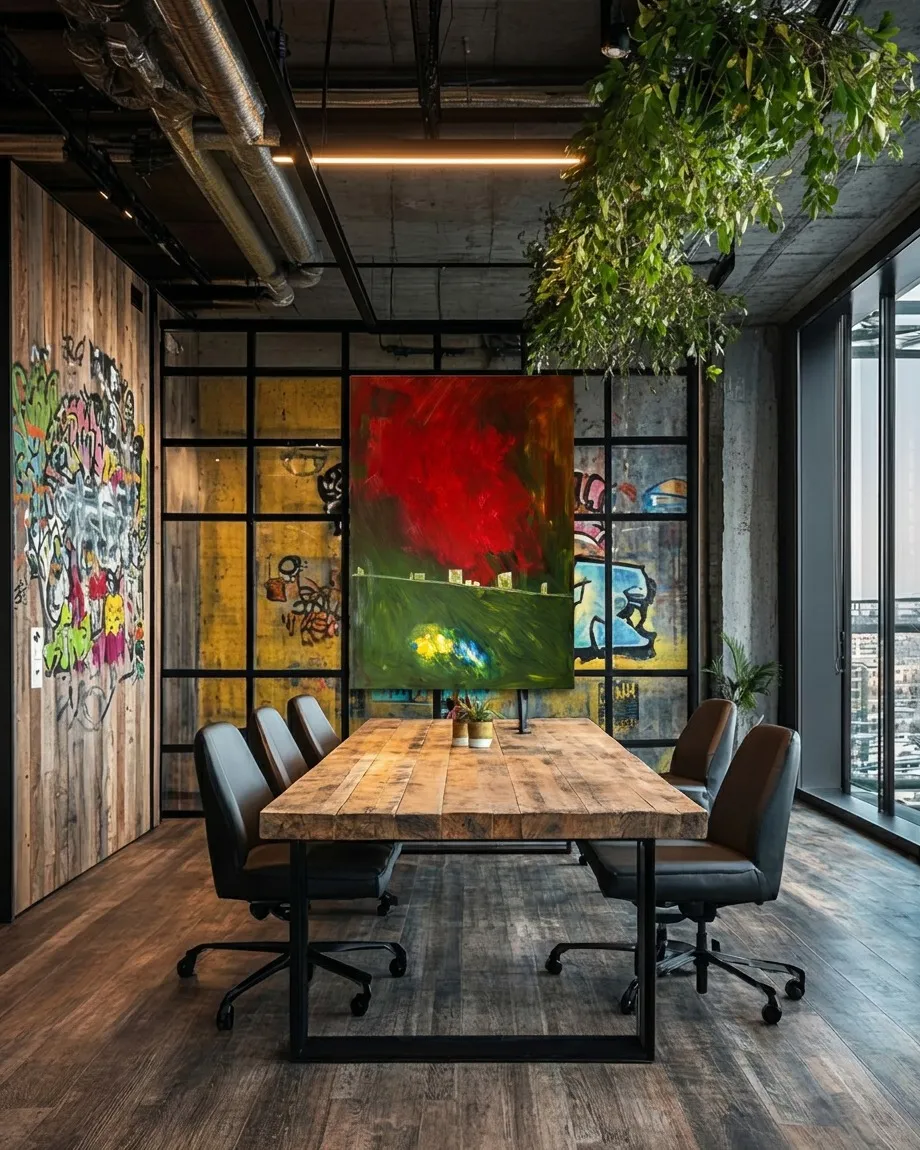
Context study / A THEORY OF LIGHT AND SHADOWS
Abstract Painting in Meeting Room | A Theory of Light and Shadows
I
I look at my right hand, still stiff from the tension of holding the palette knife, and then I look at the wet canvas. The carmine red has escaped my fingers; it is not a color I have applied, but a hot tide that has decided to occupy the upper third of the space, floating like an exposed lung or a fire that refuses to descend. In tracing that extremely thin horizontal line with an almost surgical pulse, I was not seeking a rational limit, but a refuge. I needed those small, suspended rectangles of light to have a wire to cling to, a minimal floor of chalk and oil to avoid being swallowed by the green abyss roaring below. The green, dense as the mud of a primeval forest, weighs on my wrists. I feel that the painting is not a surface, but an open wound where the outside air is beginning to coagulate.
II
Before the vastness of the work, two silent observers halt their pace. Ernst Cassirer, a German thinker who believed that human beings inhabit a universe made of symbols and myths rather than mere physical things, approaches the canvas and points with his index finger to the thin line supporting the suspended forms. "Contemplate this," he murmurs, "it is the heroic effort of consciousness. Those pale rectangles are our fragile dwellings of meaning; the line is the raft of language floating on the absolute chaos of the green." Beside him, Fakhr al-Din al-Razi, a medieval Persian scholar who spent his life doubting logical certainties and seeking the presence of the divine in the physics of light, slowly shakes his head. His eyes are fixed on the lower part, where an electric nest of bright yellows and blues pulses. "You are wrong, Ernst," the theologian replies. "That light at the bottom is not a construction of your mind, nor is it a symbol for us to decipher. It is an uncreated presence, a vibration that existed before we invented the words 'above' and 'below.' There are dimensions to this light that escape our need for control; they do not demand understanding, they demand reverence."
III
A child enters the empty room, stops in front of the painting, and immediately forgets the names of things. He does not see "houses," "bridges," or "abysses." To him, the great carmine stain is the warmth of an embrace that does not squeeze, a love that does not need to possess what burns to keep it warm. He wonders, with the gravity that only childhood possesses, how much darkness that yellow flash at the bottom needs in order not to go blind, in order not to dissolve into nothingness. The secret law of this territory begins to operate in the silence of the room: that blue and gold pulsation at the base of the painting is, in reality, a collapsed star that decided to fall to earth and, instead of going out, preferred to dream of itself as painting, beating eternally beneath the weight of a green ocean.
IV
I hear their distant voices bouncing off the studio walls, wanting to explain what I myself can barely endure. They say "symbol," they say "divine," they say "chaos." How easy it is to speak from the distance of the concept. I only remember the exhaustion in my shoulders, the sharp smell of the solvent, and the feeling that painting A THEORY OF LIGHT AND SHADOWS was a desperate attempt to find refuge in the middle of the storm. The palette knife knows things that my brain cannot yet formulate; it knows that to support the weight of that red sky, a very light touch was needed, a stroke as fine as a human hair. I did not want to resolve the mystery of the world; I only wanted that tiny yellow star at the bottom to have enough shadow around it to go on breathing without the daylight destroying it.
V
In the end, the theory of light and shadows reveals itself not as a doctrine, but as a state of physical suspension. The canvas remains there, vibrating in the dim light, offering a border that is also an open sore. The horizontal line neither unites nor separates: it supports the weight of our fragility over a background that insists on beating with the persistence of an unearthed heart. In the space left free between the scorching red and the blue nest at the base, the viewer finds himself suspended, not knowing whether what he contemplates is the dawn of a new world or the last ember of a sun that has learned to shine in the invisible.
- Original artwork
- A THEORY OF LIGHT AND SHADOWS
- Actual dimensions
- 31.5 × 47.2 in / 80 × 120 cm
- Presentation
- Digital contextual visualization
Context references
Abstract paintings for industrial design offices · Boardroom decor with contemporary art · Red and green abstract painting over rustic table · Industrial chic interior design decor · Maurizio Valch INCARNATE series
About this visualization
This visualization places the artwork within an architectural context to help collectors and viewers imagine its presence in a real space. It is an interpretive reference, not an exact reproduction: the original work remains the sole authority for scale, color, surface and material presence.