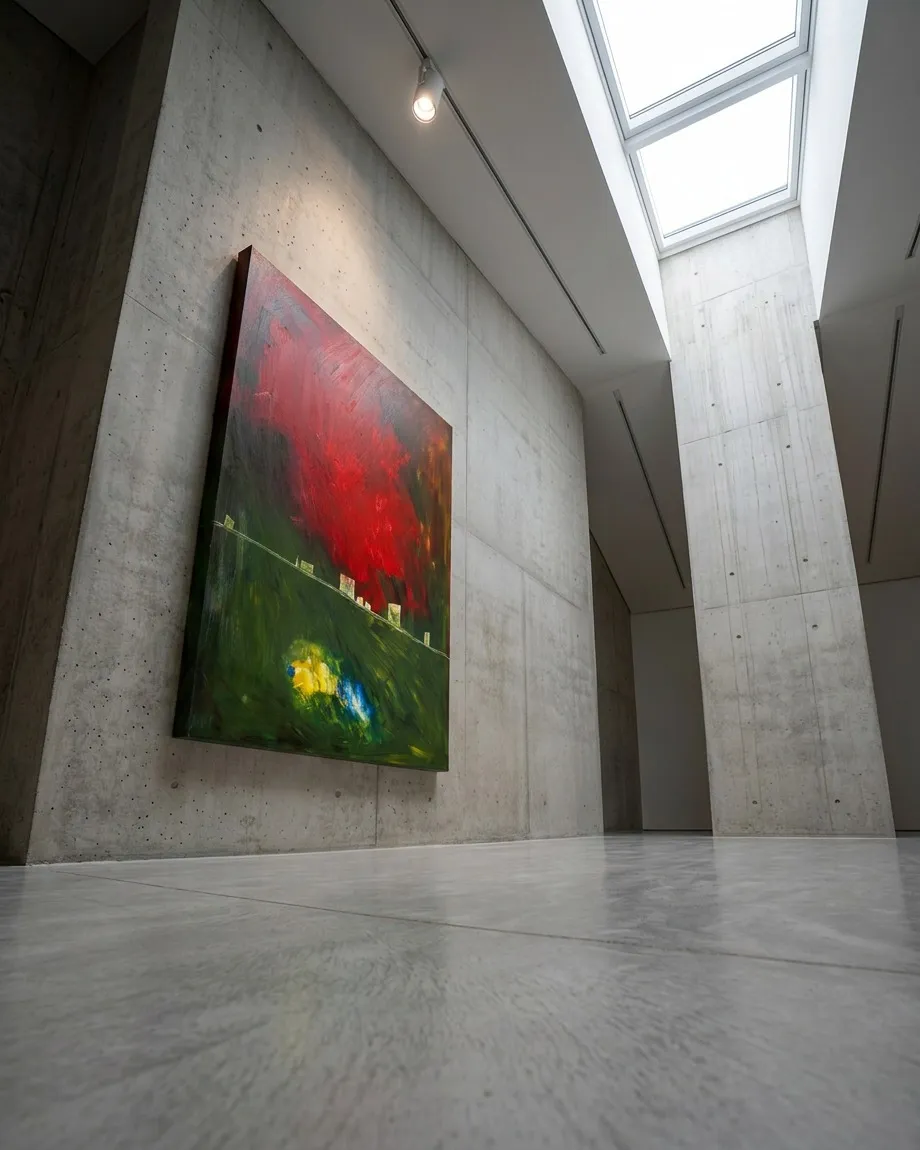
Context study / A THEORY OF LIGHT AND SHADOWS
A Theory of Light and Shadows by Maurizio Valch | Abstract Painting
Fragment I: Measuring the Boundary
Night does not fall upon the canvas; rather, it emerges from its center, dictated by a horizontal scar that separates that which burns from that which is silent. Before this border, two weary travelers halt. The first, Nasir al-Din al-Tusi, is a Persian astronomer who spent his life mapping the cold, predictable rotation of the stars to soothe his terror of the disorder of the human heart. The second, Friedrich Nietzsche, is a solitary wanderer who traversed the cliffs of existence searching for a light that did not conceal its power to destroy. Al-Tusi brings his imaginary astrolabe close to the small, pale blocks aligned along the dividing line. He wishes to see in them a row of guard posts, an architecture of reason holding back the weight of the crimson sky. For the mathematician, if those tiny monoliths maintain an exact proportion, collapse is impossible. Nietzsche, however, smiles bitterly and points to the roaring red mass above—a suspended fire that seems to lick the boundary with the impatience of a cornered beast: "Do you not see it, astronomer? Those small cubes of lime are not defenses; they are the toys that human weakness places on the edge of the abyss so as not to look at the beautiful storm about to devour them."
Fragment II: The Creator's Confession
I remember the physical exhaustion of drawing that horizontal line. It was not just a matter of pulse; it was a muscular effort to contain the overflow, to impose a truce on my own mental noise. As I worked the red oil paint on the upper section, dragging it in a rush, I felt an almost biological urgency to cover everything, to flood the support with that dense vibration. But I forced myself to stop. I needed that razor-thin boundary. Painting those small, pale blocks, one by one, was like trying to build a row of tiny houses on the edge of a blade. What was I trying to protect? I often wonder if art is nothing more than this ridiculous and beautiful attempt to compartmentalize our interior battles, to trace a fictitious border to convince fear that there is a place where the fire cannot enter.
Fragment III: The Well of Light
The gaze of both thinkers now slides downward, sinking into the green shadow. There, within the density of a matter that seems to breathe with the slowness of ancient forests, pulses a bioluminescent pit of yellow and blue tones. It is not a light that illuminates the exterior; it is an exposed organ shining from its own wound. Al-Tusi bends down, fascinated by the possibility that this light is the remnant of a buried star, a mathematical coordinate forgotten by God at the bottom of the earth. But the matter there feels damp, almost tactile. A child looking at this corner would not think of celestial bodies; they would simply wonder if that yellow smudge is desperately trying to climb toward the red sky or if, on the contrary, it is slowly drowning in the green mud. Nietzsche kneels before the pit and plunges his fingers into the vibration of the color: "There is no geometry here, astronomer. This is the will to live insisting on shining in the deepest darkness, without asking permission, without needing a celestial explanation. It is an open wound, and wounds are not measured: they are inhabited."
Fragment IV: The Return to Silence
I contemplate the painting now, hanging on the concrete wall, and I feel a strange distance. Painting always knows something about me that I do not yet know how to live. I wanted to seek calm by ordering these colors, but the materials have their own memory and sabotage any attempt at absolute peace. The oil and acrylic continue to fight in silence beneath the surface. In the end, I suppose I have done the same thing as always. That old certainty that accompanies me comes to mind: "And so, I will convert my entire history into an old museum." I have frozen the tension, ordered my fires and my abysses within a space of one hundred and twenty by eighty centimeters so I can look at them without danger, transforming living experience into an motionless gallery where I can finally breathe.
Fragment V: The Unconquered Zone
Al-Tusi's astrolabe goes dark and Nietzsche's contempt dissolves into the cold air of the room. In front of the work, the words of the men of order and the men of suspicion become unnecessary. Maurizio Valch's theory of lights and shadows does not let itself be resolved by any formula or any battle cry. It leaves us, instead, suspended in the silence of that levitating border. Looking once more at those small, pale blocks on the tense wire, one cannot help but wonder: if we chose to inhabit one of those minuscule white squares, which side of the line would we choose to fall toward?
- Original artwork
- A THEORY OF LIGHT AND SHADOWS
- Actual dimensions
- 31.5 × 47.2 in / 80 × 120 cm
- Presentation
- Digital contextual visualization
Context references
Large format abstract painting for concrete wall · Maurizio Valch A Theory of Light and Shadows · Modern red and green abstract paintings · Brutalist interior design with art · Contemporary art with textures and color fields
About this visualization
This visualization places the artwork within an architectural context to help collectors and viewers imagine its presence in a real space. It is an interpretive reference, not an exact reproduction: the original work remains the sole authority for scale, color, surface and material presence.