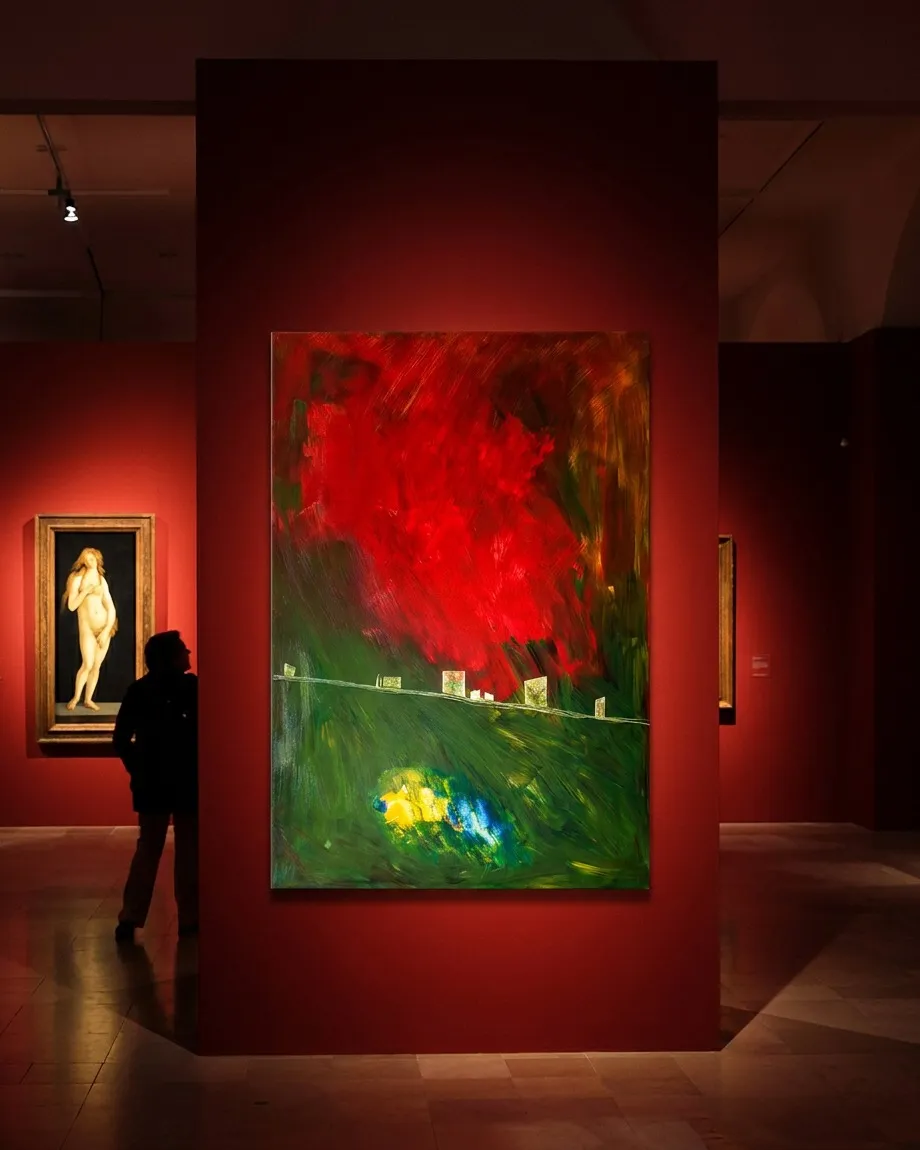
Context study / A THEORY OF LIGHT AND SHADOWS
'A Theory of Light and Shadows' in Gallery | Maurizio Valch
Fragment I: The Frontier of Detachment
Ajahn Chah, a Buddhist monk of the Thai Forest Tradition who taught how to watch the flow of the mind as one observes a falling leaf, without holding onto it or judging its path, stands in silence before the canvas. His eyes, worn by the gloom of the jungle, do not fix on the fire crowning the work, but on that precarious procession of small light blocks trembling on the horizon line. For the monk, those spectral monoliths are the "selves," the transient, striving identities we hastily construct to avoid being devoured by the burning sky or swallowed by the green abyss. They are the fictions of the ego seeking a ground on which to settle. However, the materiality of the painting exerts an unforeseen resistance that disconcerts his gaze: below, in the pit of dense green, pulses a nest of electric yellows and blues that does not behave like a mirage. It is not a mental agitation to be dissolved through pure mindfulness; it is a real, carnal presence, an unruly flash of oil paint shining with its own weight. Chah experiences a subtle perturbation in his breathing: how does one meditate before a light that does not ask permission to exist, that does not seek to extinguish itself, and that claims its right to burn in the deepest dark?
Fragment II: The Process Behind the Boundary
Drawing that very fine horizontal line over the crust of green acrylic was not a compositional calculation, but an act of physical survival. I remember the squeal of the palette knife scraping the damp canvas, opening a white wound to stop the collapse of the paint. I felt that if I did not fix that boundary, the immense red mass—that fire of pure oil that slipped from my hands like the tide of a runaway thought—would end up burying me. While painting "A THEORY OF LIGHT AND SHADOWS", my own body became that limit. There was a real fatigue in my shoulders, a tension in my jaw as I held my breath before the 120-centimeter-high stretcher. I needed those small white blocks to remain there, almost suspended, clinging to the material edge of the canvas so as not to disappear into nothingness. In the end, one discovers that the painting is always smarter than the painter: this canvas knows of my own weariness and my fear of dissolution long before I have been able to put it into words.
Fragment III: The Discord of the Parts
Before the work, Roberto Assagioli, the Italian psychiatrist and father of psychosynthesis, who conceived the human psyche not as a static territory but as an orchestra of multiple "subpersonalities" seeking, under extreme tensions, a synthesis or center of gravity, furrows his brow. He does not perceive here the silence of the contemplative forest, but an unbearable diagnostic discord. The upper red is an uncontrolled discharge of superconscious energy; the lower green, the gravity of a somber unconscious sucking in the gaze; and in the middle, the small blocks are the subpersonalities trying not to fall, balancing on the tightrope of an incision. A childlike and naive gaze takes over the scene for a moment: are those blocks small white houses where someone is trying to take shelter while the entire sky burns, or are they perhaps the tiny graves of our oldest thoughts? Assagioli stretches out his hands searching for a synthesis, a middle point that harmonizes fire and earth, but the texture of the oil prevents it. The disturbing beauty of the painting lies precisely in the fact that the red and the green refuse to reconcile. Perhaps the healing of the mind—the psychiatrist thinks with a mixture of resignation and wonder—does not consist in forcing a peaceful synthesis, but in developing the muscular strength to hold the tension of this abyss.
Fragment IV: The Discovery of the Intruder
I know what therapists and philosophers look for in my paintings, but they do not know the physical behavior of pigments. That yellow and electric blue spot floating in the lower third of the canvas, submerged in the green, was not part of any sketch or intellectual intention. It was a pure material accident: an excess of oil paint that dripped onto the still-fresh matte acrylic base. At first, I wanted to erase it, to scrape it off to restore the green to its sober vertical density, but I stopped. There was something almost biological about that intrusion, an invading vibration claiming its own space within the work. What is that luminous core? Is it an area of my own experience I do not yet recognize, or is it the ultimate proof that the canvas has an autonomous biography, independent of my creative will? I limited myself to watching the blue and yellow mix on their own for days, breaking through the gloom like a living organ beating behind the artist's back.
Fragment V: The Secret Law
The voices of the therapists, the monks, and the painter himself finally dissolve in the gloom of the exhibition room, letting the secret law of matter act: the light surviving in the depths of the dense green does not need to be justified or explained to offer shelter. The eternal conflict between the fire of the sky and the gravity of the earth is not resolved under any formula; it simply becomes habitable thanks to the humble procession of stone sentinels guarding the border. Standing before the imposing scale of the work, the chest contracts for a moment before the violence of the red, only to find physical relief and visual repose in the damp vibration of the lower oil. Is it possible that the theory of lights and shadows is not a treatise on physics, but the actual weight of paint on our own skin?
- Original artwork
- A THEORY OF LIGHT AND SHADOWS
- Actual dimensions
- 31.5 × 47.2 in / 80 × 120 cm
- Presentation
- Digital contextual visualization
Context references
abstract paintings on red walls · large format art decoration ideas · gallery painting lighting · contemporary art for modern living rooms
About this visualization
This visualization places the artwork within an architectural context to help collectors and viewers imagine its presence in a real space. It is an interpretive reference, not an exact reproduction: the original work remains the sole authority for scale, color, surface and material presence.