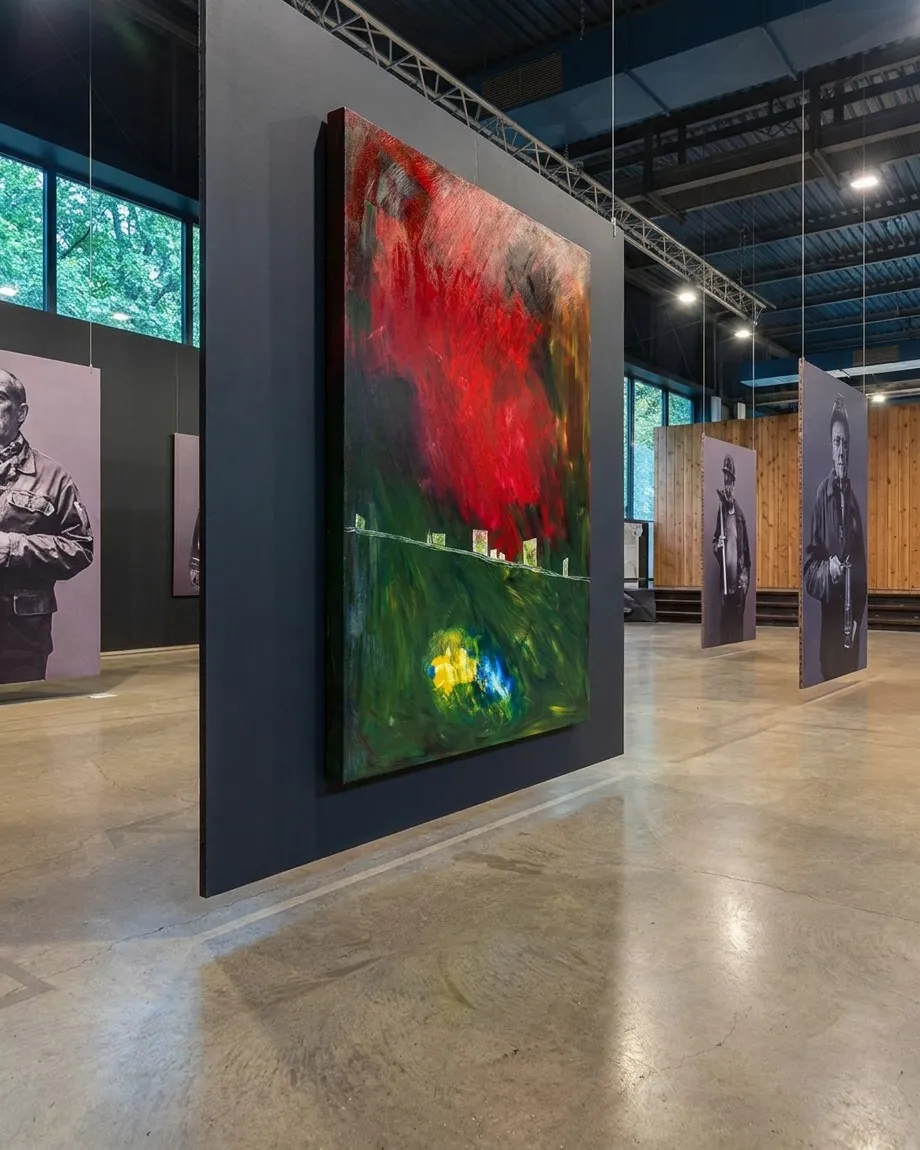
Context study / A THEORY OF LIGHT AND SHADOWS
Exhibition of 'A Theory of Light and Shadows' | Maurizio Valch
I.
The gaze pauses at the thin horizontal scar cutting across the canvas, a stroke so fine it seems to creak under the weight of the burning mass gravitating above. Facing it stands Paul Goodman, the Gestalt psychotherapist and writer who understood neurosis as an interruption of vital contact with reality, who contemplates this line not as a compositional element, but as a contact boundary. For Goodman, this tense wire is the limit where the organism defends itself from the environment; the suspended small rectangles are provisional supports, creative adjustments hastily invented to avoid being devoured by the immense red storm of consciousness raging above. The air in the room seems to grow thick, heavy with a physical resistance to the assault of that visceral sky. Is this tightrope the only parapet left to us before the world spills over us?
II.
I remember the afternoon I drew that line. My hand trembled, not from a lack of steady pulse, but from the fear of closing off the space. I used a thin palette knife, almost bare of paint, scraping the canvas until the dull green background opened into that grayish slash. Placing those small white blocks on the thread was an act of pure survival in the studio: I felt that if I did not suspend those tiny, mute forms, the entire red mass—that thick oil paint that took weeks to dry and seemed to breathe with its own heat—would collapse onto the floor of the painting, crushing the shoot emerging below. I do not know if they are houses, monoliths, or papers in the wind; I only know I needed something to float mid-fall, something to gain a foothold over nothingness.
III.
A few steps away, Abraham Isaac Kook, the mystic who tirelessly sought cosmic harmony and saw sparks of holiness in the coarsest matter, raises his head and smiles with an ancient sadness. Where Goodman sees defense and boundary, Rav Kook perceives the flow of the nitzotzot, the divine sparks that have fallen into the exile of dark matter. For the Kabbalist, the red storm is not a threat, but the divine energy of severity seeking to descend in order to be redeemed, while the yellow and blue core pulsing at the bottom is the whisper of creation responding from below, a return of light ascending with damp timidity. The spectator's breath expands in this tension: the chest tightens with the red above and relaxes with the blue below, caught in a heartbeat that joins the infinitely high with the infinitely deep through that thread of existence.
IV.
They speak of divisions and sparks, but I can only think of the dampness of the earth after the storm. While painting the lower area, I recalled a trip through the north, the smell of decay and birth rising from the ditches, and how a flash of stagnant water reflected the gray sky with an almost violent force. The blue and yellow below are not a mystical answer; they are the residue of what we could not save, matter refusing to die of cold. Sometimes, paint knows things that my own hand does not, and when I try to domesticate that light on the ground with explanations, I feel as though I am robbing it of its only refuge: the right to remain hidden in the shadow.
V.
The voices of the clinic and the temple finally fall silent in the space of the room. We are left alone with the yellow and blue core pulsing at the base of the canvas, oblivious to theories of light and shadow. There are no words for this luminous residue that shines like an animal's eye in the undergrowth or an ember in the rain. The painting is no longer explained; it is experienced like the cold of the concrete floor beneath one's shoes or the heat emanating from a nearby body in the gloom. In that nameless intimacy, the distance between what burns above and what sprouts below ceases to be a wound and becomes a fertile silence, a sacred territory where the unknown looks back at us.
- Original artwork
- A THEORY OF LIGHT AND SHADOWS
- Actual dimensions
- 31.5 × 47.2 in / 80 × 120 cm
- Presentation
- Digital contextual visualization
Context references
large format paintings in exhibitions · art gallery display ideas · contemporary abstract painting exhibition · industrial art gallery design
About this visualization
This visualization places the artwork within an architectural context to help collectors and viewers imagine its presence in a real space. It is an interpretive reference, not an exact reproduction: the original work remains the sole authority for scale, color, surface and material presence.