Series · 2025–Present
EMERSIO
Forms separating from their origin
About this series
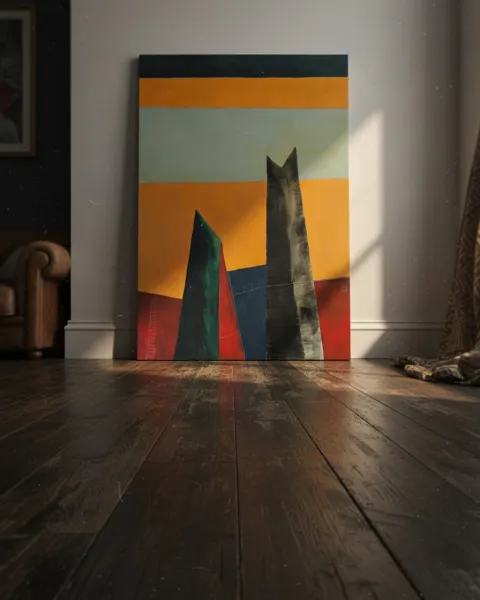
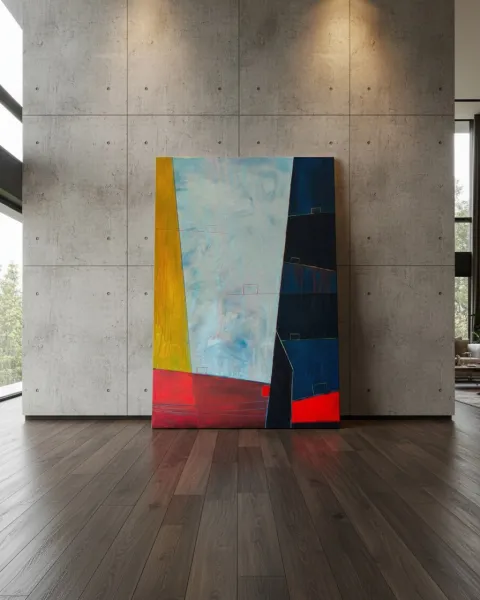
In EMERSIO, Maurizio Valch addresses the uncertain instant when a form begins to distinguish itself from the territory that contained it. Fields of colour, horizons, and structures under tension give substance to an emergence that remains vulnerable, situated between landscape, architecture, and presence.
EMERSIO focuses on a moment before all stability: the point at which something begins to occupy a place of its own without having fully detached itself from what gave rise to it. The forms do not arrive as finished figures or as signs intended to be deciphered. They arise within a territory that still sustains them, surrounds them, and, to some extent, seems to demand that they remain.
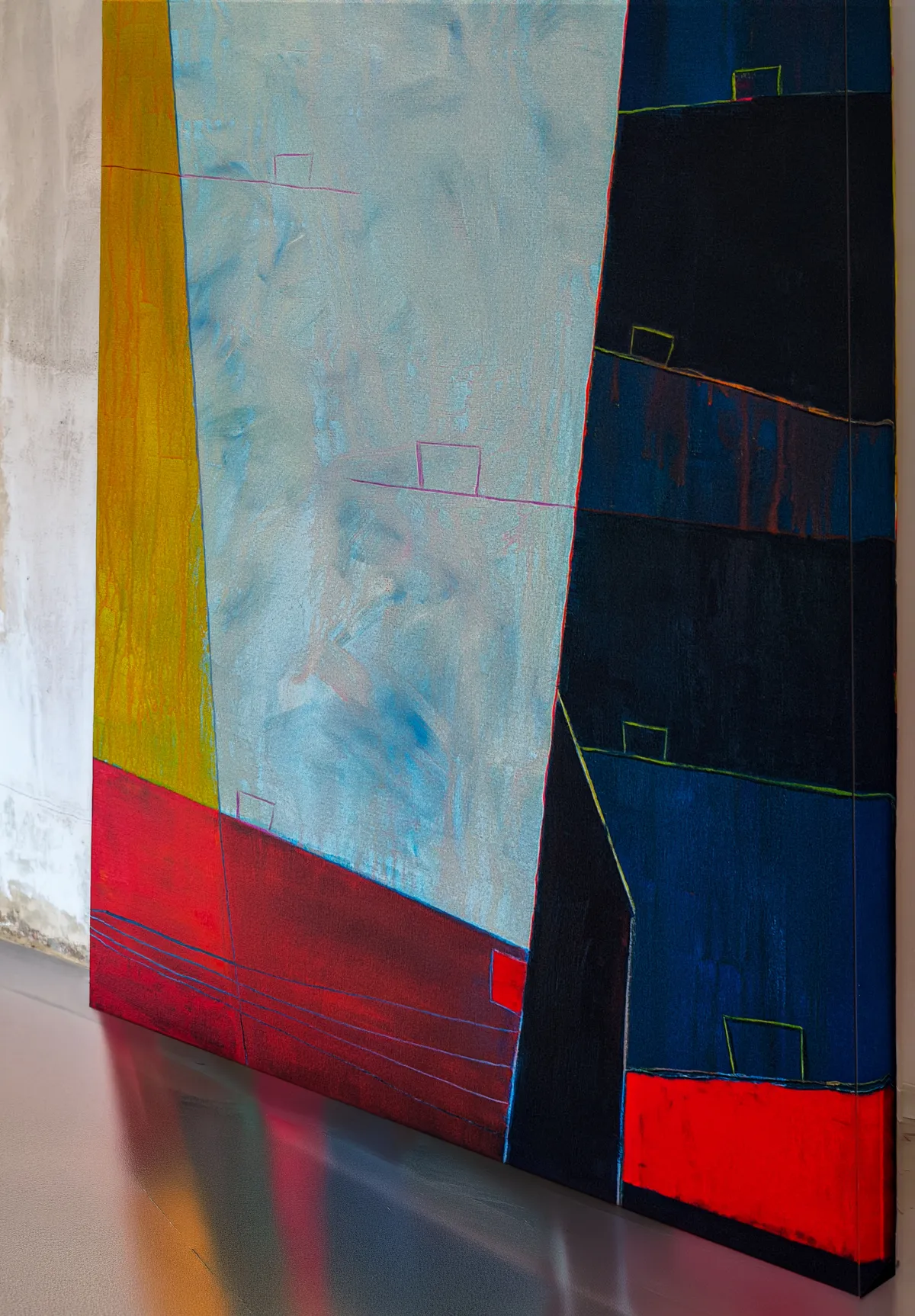
This condition of emergence extends a decisive question in Maurizio Valch’s practice: how can a form become present without immediately settling into a closed identity? His fields of colour, horizons, spatial divisions, and monolithic masses do not describe a recognisable geography, yet they retain the experience of ground, distance, and resistance. Territory ceases to function as a passive background. It produces limits, directions, and relations of scale; it compels each presence to gauge its position within a space that is not entirely external or internal.
The material process accompanies this uncertainty. Acrylic and oil on canvas allow surfaces to be built through layers, glazes, impasto, and incisions, so that the image does not appear as a form placed upon a neutral ground. The material retains sedimentations, corrections, and areas of varying density. When a structure separates from these strata, it does not attain absolute autonomy: it carries with it the pressure of the surface from which it emerges. Painting thus records an appearance that is also an exposure.
In this series, compositional austerity does not amount to a desire for definitive order. The architectures, blocks, and divisions may suggest construction, yet they retain something precarious, as though they were still learning to support themselves. This ambiguity distinguishes EMERSIO from purely geometric abstraction: form does not present itself as a rational solution, but as a presence subject to the fragility of having left behind a previous unity.
Valch’s movement from more suspended, dreamlike spaces towards territories of greater weight finds a particular inflection here. What came before does not disappear when the ground acquires structure; it remains as a silent reserve beneath the new organisation. EMERSIO does not narrate a triumphant progression. Rather, it suggests that every appearance entails a loss of protection: to become visible means accepting a more intense relation to limit, distance, and vulnerability.
Before these paintings, the viewer may recognise the emergence of a form without having to decide what it represents. The gaze remains at a threshold: something is organising itself, gaining presence, and altering the field that contains it, even though it cannot yet be fully said what it will become. This suspension keeps the series’ central question open: what does it mean to begin existing as a form when one’s origin continues to act within oneself?
Tags
contemporary abstract painting; territorial abstraction; minimalist abstraction; brutalist painting; material painting; acrylic and oil on canvas; stratified surfaces; textured surfaces; fields of colour; abstract horizons; monolithic forms; spatial divisions; incisions; abstract landscape
Series works
Works in this series