Context study / VESTIGIA
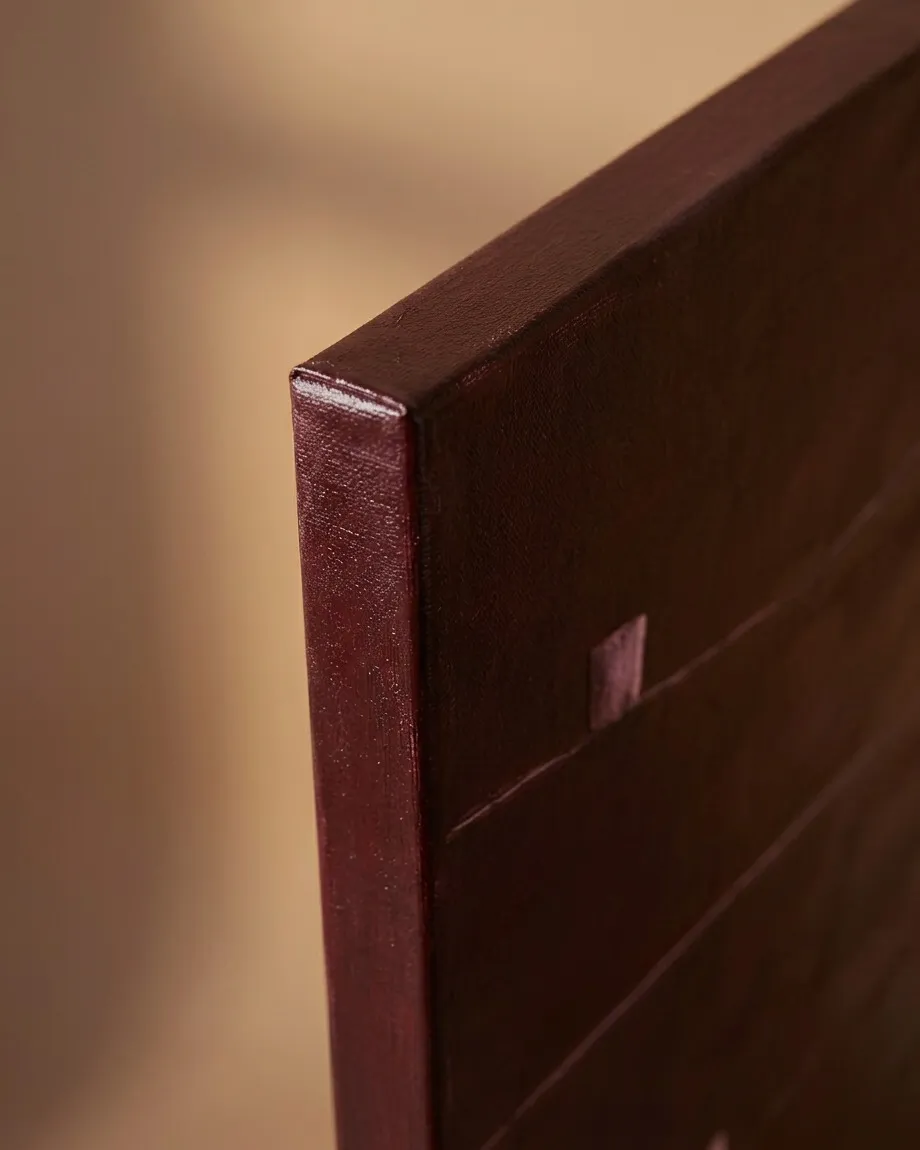
Abstract Painting Close Up Texture | VESTIGIA by Maurizio Valch
VESTIGIA does not receive the gaze from afar: it holds it back before letting it in. At a certain distance, the dark red field appears compact, almost flat, as if it had been spread to erase the difference between background and surface. However, four extremely fine incised lines cross this expanse. They barely incline, they barely cut. They could organize the canvas, but they do not succeed: instead of offering a secure direction, they force the eye to slow down. Near them persist four pale, minimal bodies, each with a different density, as if they had been arrested mid-action.
Low elevation: the first line.
At first, the line looks like a reference of height. Not a horizon, yet: rather a seam too faint to separate two zones. The red does not open behind it; it absorbs distance. The body steps back to encompass the vertical rectangle and discovers that the painting possesses a strange gravity: it does not fall, but it makes the gaze fall. Then the small pale forms appear. From a distance, they can be mistaken for interruptions, signals left by someone so as not to lose a measure. Upon drawing closer, they lose precision. They do not clear up: they become more obstinate.
I look at the first line and cannot decide whether I have traced it or if it has begun to occur on its own within the red. I feel my eyes stumble on it, though I know it occupies almost no space. I approach to master that thinness and encounter a physical resistance, as if the surface refused to let me cross it too quickly. I want to read the pale forms as something recognizable, but each turns away from that decision the very moment I fix it.
The first line no longer serves to calculate a position. It behaves like the edge of a held breath: it does not separate top from bottom, but one duration from another. The small bodies seem to have arrived later, or perhaps they were there before and the line passed next to them without touching them. The question begins to form not as a sentence, but as an ocular discomfort: how can something so small hold itself within an expanse that seems capable of erasing it without effort?
Intermediate elevation: the second line.
Here the orientation breaks down. The next line does not confirm the previous one; it shifts it. Both seem to respond to a rule, but a rule with a deliberate flaw, like a measurement whose instrument has been tilted by an unseen hand. The painting ceases to be an organized surface and begins to look like a place learning to conserve what falls upon it.
Silvina Ocampo, an Argentine writer capable of making domestic life strange, of letting the minute acquire an unsettling autonomy and of looking at reality without domesticating its oddness. Under that intelligence, the four pale bodies refuse to be buildings, marks, or the remains of a landscape. They play at looking like them, perhaps, but the play is not innocent. One has the presence of a tooth that should not be there; another could be a house shrunk until it loses its inhabitants; another keeps an uncomfortable tenderness, like a childhood object found where play is forbidden.
This detour alters the entire scale. The immense red ceases to be the dominant field and becomes that which must accommodate the small presences. They are not details suspended in a vastness: the vastness exists because they force it to exist. Each line, then, seems to have to pass by their side with care. The vision draws so close it almost loses the painting; it seeks an edge, a minimal shadow, a difference in whiteness, and this search makes the red appear deeper without ceasing to be skin.
Friction elevation: the third line.
The third line does not lead: it delays. It approaches the forms and, without embracing them, grants them a narrow strip to remain. Amartya Sen, an Indian thinker who examined how freedom, deprivation, and the real capability to choose transform human lives. Here his question does not need to leave the painting: what can such a small form do in a world that seems to have granted it barely a single line to exist?
The initial response would be to measure the distribution: lots of red, little clarity; an almost limitless expanse, four tiny spaces. But that count is mistaken. It assumes that lines distribute the field, that they assign zones and possibilities. Ocampo interrupts that certainty: the bodies do not ask the lines for permission. They do not receive a place; they essay a permanence. It could even be said that they hide, though there is nowhere to hide on that open surface.
"Why don't the little squares fall?"
The child's question shifts the weight of the painting. It does not ask what they represent or who put them there. It asks about the gravity that sustains them. After it, the red can no longer be seen as a background: it becomes an incline, a continuous force against which those pale bodies have learned to stay. The lines seem thin because they are also subjected to that force. No mark organizes the fall; they all register a different way of not disappearing.
Now I see that one of the pale forms no longer belongs to me, even if it remains within the painting. I believed it stationary next to a line, but I feel it shifting every time I look at it from another distance. I accept that I cannot return it to a name or guarantee its size. It forces me to recognize a region of the painting that does not yield to my intention and that, nevertheless, modifies everything remaining around it.
High elevation, or incomplete return: the fourth line.
The last line forces a step back. From close up, it was possible to think that each stroke kept an intimate relationship with a small pale body. From afar, the four lines appear as registers of something that has passed—not necessarily an event, perhaps a variation in pressure, a shift too subtle to be seen while it occurs. They do not describe a geography. They describe the difficulty of conserving a trace without turning it into evidence.
The four forms do not unify either. They do not form a family or a sequence. One seems closer; another is absorbed by the red; another interrupts the line like a crossed-out word; another is barely distinguishable and, for that very reason, forces a return. None becomes a fixed symbol. Their strength lies in not quite belonging to the painting as a figure would belong to its outline. They are there, but in a way that makes one doubt the word "there."
In the end, orientation is provisional. The eye recovers the whole, recognizes the four lines, recounts the four presences, but can no longer treat them as minor elements of a composition. Something minute has imposed its law without revealing it. The red continues to stretch around, vast and closed, though now it seems to hold with care that which it might have lost. The gaze turns away and leaves a precise suspicion: perhaps those forms were not waiting to be discovered; perhaps they were learning, line by line, how not to let themselves be erased.
- Original artwork
- VESTIGIA
- Actual dimensions
- 31.5 × 47.2 in / 80 × 120 cm
- Presentation
- Digital contextual visualization
Context references
textured burgundy canvas painting close up · contemporary art brushstrokes detail · dark red minimalist painting texture · impasto paint details · canvas edge fine art photography
About this visualization
This visualization places the artwork within an architectural context to help collectors and viewers imagine its presence in a real space. It is an interpretive reference, not an exact reproduction: the original work remains the sole authority for scale, color, surface and material presence.