Context study / VESTIGIA
Abstract Painting Vestigia in Contemporary Living Room | Maurizio Valch
VESTIGIA
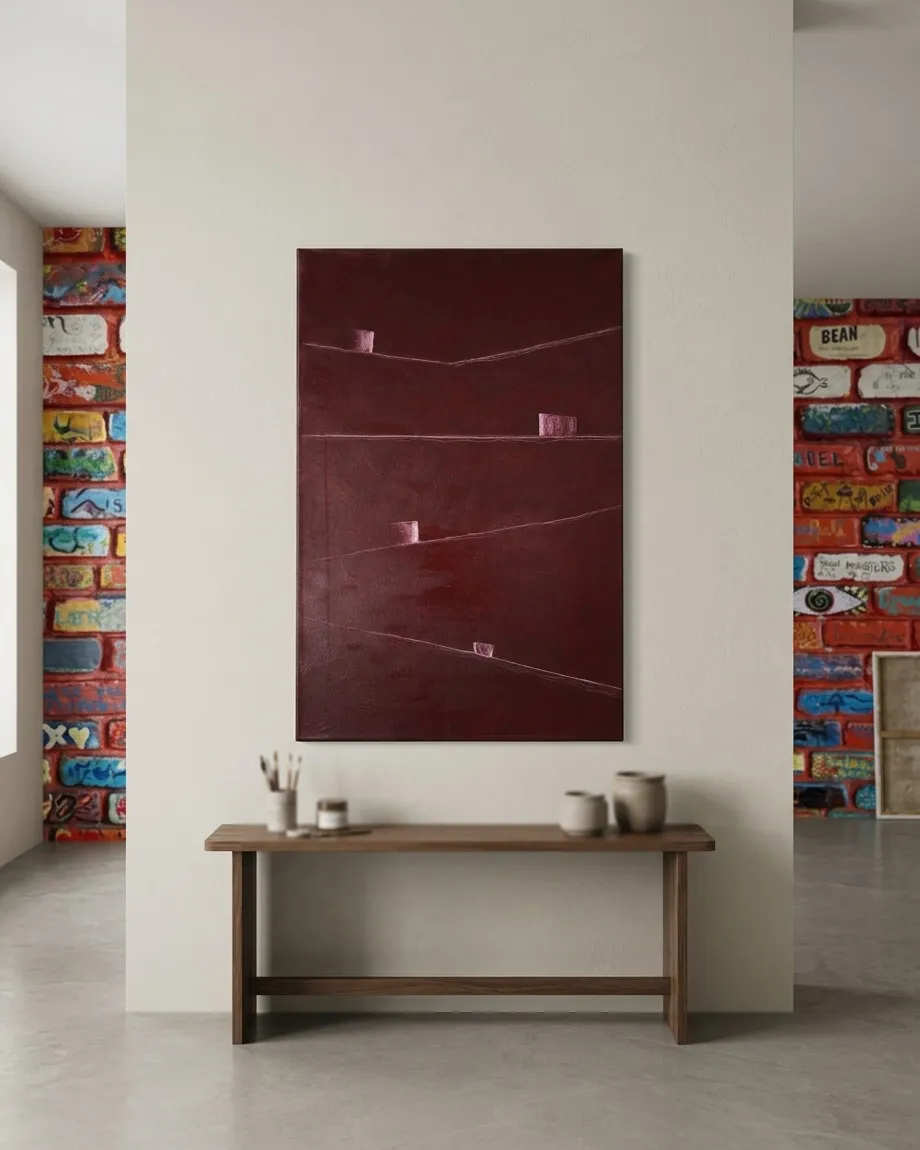
From a distance, the painting seems to hold its own temperature. It is not a red that advances or demands attention: it remains contained, dark, with the density of something seen under insufficient light. The vertical rectangle does not open up immediately as a place. First it presents itself as a wall, a night without luster, a surface that has decided not to tell what it contains. Only then do the four lines appear: so thin they could almost be scratches of the gaze, so unstable that the head tilts involuntarily to check if they actually ascend, descend, or have simply stopped halfway.
None of them becomes a horizon. They do not sustain a sky, they do not cleanly divide above and below. One seems to tighten near the top; another interrupts the field at a height that could belong to an enormous table or the edge of a room that is too deep; lower down, the remaining ones cross the red with an almost secret discretion. Following them, the eyes find small detours, minimal ripples, areas where the line seems to lose conviction. The body responds with a modest gesture: leaning in slightly, drawing the head back, seeking again the point where the direction breaks down. The painting gains depth, but not a stable depth. There is no vanishing point: there is delay.
And then there are the pale shapes. Four small, insufficient presences. One near the high line; another, further to the right, as if suspended in a pause; a third somewhat lower; the last, tiny, near the final descent. Their size should render them irrelevant against the dark expanse surrounding them. Yet, they prevent the red from closing in on itself. They are enough to make the space seem used, abandoned, interrupted. They do not explain where one is, but they make it difficult to accept that nothing has happened there.
I look at the finished painting and feel it has distanced itself from what it perhaps wanted to obey. The surface maintains a distance that my body cannot reduce, even if I get closer; the lines seem to know something I cannot translate. I do not see them as secure boundaries, but as decisions that keep changing as I look at them. The small forms, so scarce against the red, do not seem to ask for interpretation: they seem to ask not to be lost from sight.
The first clear presence functions as a minimal proof of existence. Not because it represents anything recognizable, but because it occupies a position too precise to be a visual accident. It has the obstinacy of a room without a house: a small pale volume that offers no entrance, window, or scale, and yet modifies everything left around it. The line passing nearby ceases to be an abstract line; it seems to have had to detour to admit it. In that friction, Walter Benjamin appears. A philosopher and cultural critic attentive to remnants, fleeting images, and small objects capable of containing an immense history.
His presence forces one to suspect the comfort of the landscape. The lines would not be distances, but temporal interruptions: cuts through which something has ceased to be whole. The pale shapes would not be represented objects either, but vestigia. Incomplete proofs of a situation that can only be known after having disappeared. The first form does not assert "a house was here" or "someone passed through here"; it asserts, with greater fragility, that something left a condition of possibility. Like a mark found on a table when the table is no longer there. The eye attempts to reconstruct a before, but each reconstruction makes the field containing it darker.
The second form disorganizes this impulse. It is near another line, though it does not seem to rest entirely upon it. Seen closely, it could be a block, a frozen frame, a crumb that has learned to emit light. Its clarity does not illuminate the red; rather, it makes the red seem more vast, as if the painting continued beyond the edges and that small thing had managed to stop in the middle of an expanse that does not end. A child might ask: "Why do those little boxes know where to stay?" The question leaves the lines without a function. They are not roads, or borders, or explainable folds: they are places where something small has found a way not to fall.
There David Lynch appears. A filmmaker who knew how to turn the everyday, silence, and apparent calm into thresholds to an intimate strangeness. Facing the suspicion of the vestige, his gaze resists. There is no need to recover a lost event: the scene continues to happen off-camera. The second block would not be a relic, but a motionless presence. Something that has decided not to move because it is already doing too much. Under this reading, the stillness of the painting does not equal emptiness. The red contains an activity without gesture, and the lines do not cut off a finished time: they let us hear a time that continues without showing itself.
Benjamin would want to bring the shape closer to the archive of what is missing. Lynch would prefer to leave it in the next room, where perhaps nothing is missing and yet no one wants to enter. One runs the risk of reading too much: turning each pale edge into an index, each tilt into a ruin. The other runs the opposite risk: protecting the mystery so much that nothing can be touched. The painting concedes victory to neither. When the gaze descends toward the third line, the pale shape situated next to it no longer seems either pure remnant or complete presence. It becomes bodily. Its small visual thickness forces one to imagine the weight of something that could be touched with the fingertip, though the painting remains at a distance. It is not a figure that can be narrated; it is a resistance against the red, a slight pressure that the space accepts without absorbing.
I am not sure there are figures here. When I try to call them blocks, remnants, or bodies, the painting becomes more distant; when I try to leave them nameless, they acquire an almost uncomfortable closeness. Perhaps they are not placed on the lines, but listening to them. Perhaps the red is not a background and the four small clarities are not what interrupts, but what prevents everything from disappearing into a single surface.
The fourth presence is the hardest to hold onto. Near the lower area, it seems smaller than the others, almost reduced to a pale tilt. At first glance it could pass for an irregularity. But returning to it after traversing the others, it alters the entire scale. The first form no longer seems isolated; the second no longer seems arrested; the third no longer seems merely tactile. Between the four, a kind of wordless conversation has formed. They do not order themselves as stations or characters. They correct each other at a distance. Each makes the previous one improbable.
At that point, Benjamin discovers something that does not fit in the archive: the physical desire to follow a line until the eyes tire, the slight tension in the neck, the feeling that a mark can lead nowhere and yet be necessary. Lynch, for his part, finds a less threatening stillness. The shapes do not necessarily wait for something terrible or extraordinary to happen. They can also guard a place. They can remain so that the space does not sink. Tenderness appears without softening anything: like the decision of a minimal thing to sustain itself in an immense darkness.
Upon moving away again, the painting does not go back to being the silent field of the beginning. The lines no longer seem discreet: they seem to have touched the surface four times to check if it responded. The red retains its reserve, its contained temperature, its appearance of a closed expanse, but now it is contaminated by those tiny proofs of existence. Above, the first pale presence—the one that earlier seemed like a small room without a house—is no longer simply next to its line: it seems to have tilted toward it, as if it had just begun to move forward.
- Original artwork
- VESTIGIA
- Actual dimensions
- 31.5 × 47.2 in / 80 × 120 cm
- Presentation
- Digital contextual visualization
Context references
large format red abstract painting · artist paintings for minimalist living room · maurizio valch artworks strata series · decorating with original abstract art · sober contemporary wall art · brutalist red painting on canvas
About this visualization
This visualization places the artwork within an architectural context to help collectors and viewers imagine its presence in a real space. It is an interpretive reference, not an exact reproduction: the original work remains the sole authority for scale, color, surface and material presence.