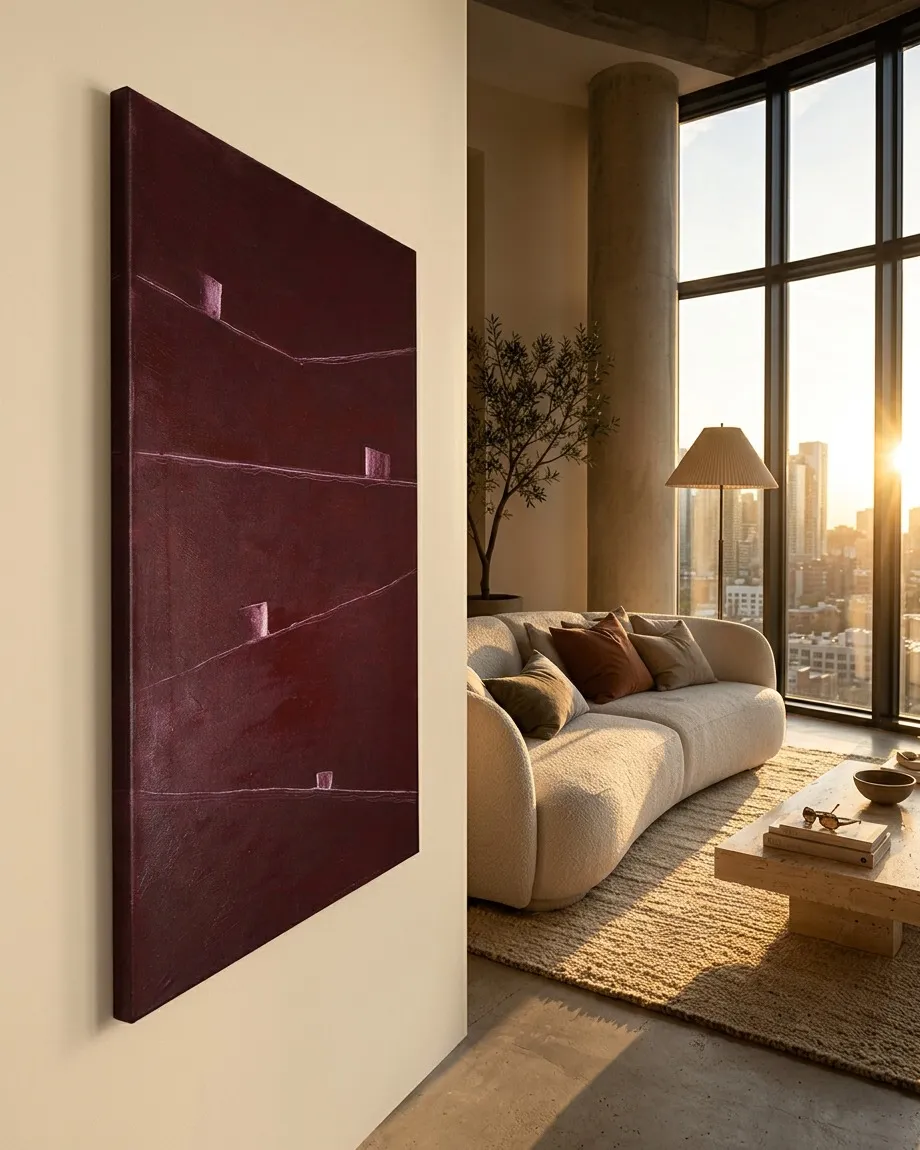
Context study / VESTIGIA
VESTIGIA by Maurizio Valch - Abstract Painting for Modern Spaces
Manual for Not Falling into VESTIGIA
First height: where the line barely dares to be a line
Above, the first incision does not quite organize the red. It crosses it with a slight slant, as if it had arrived from another plane and still retained the memory of that displacement. Over it, to the left, a light shape stops. It does not rest: it stops. It is too small to assure anything and too present to disappear in the dark field.
Pauline Oliveros was a composer who transformed listening into a practice of radical attention, capable of perceiving silences, distances, and sounds normally left out.
Here she does not ask for the line to be heard as a melody. She asks for something more uncomfortable: to listen to the separation between the line and the upper edge, to listen to the silent thickness surrounding the small shape, to listen to the moment when the eye reaches it and slows down. The red then ceases to be a background. It has a retained temperature, a slow breathing, zones that seem to approach and others that prefer to remain behind a film of shadow.
The first light shape does not save the line, but prevents it from becoming a pure opening. It does not suture it. It barely gives it a reason not to continue alone.
Can something so small prevent a horizon from becoming a wound? At this height, the question still seems excessive, almost comical: a minuscule volume facing a vast extension, as if a disproportionate will had decided to stand in the least convenient place.
Second height: the ground begins too late
The next line goes down with less security than it appears to have. It crosses the red and stretches toward a pale shape situated on the right. That shape seems to have arrived before the ground. Or perhaps the ground arrives too late to receive it.
Albert Einstein was a physicist who learned to distrust what seems fixed and showed that space, time, and position also depend on the observer.
He wants to locate it: calculate how far it falls, from where it is held, what distance separates it from the line. But the line does not cooperate. It is not entirely horizontal; nor does it declare its slant. The painting forces us to suspect that “above” and “below” may be fragile agreements between a gaze and a surface. If that small shape stands, it is not because gravity has ceased to act, but because here gravity seems to have changed its manners.
Oliveros resists fixing coordinates. Before measuring the shape, her attention says, one must hear the interval separating it from the other. Between the first and the second line there is no void: there is a long pause, a red delay. The eye descends, stops, looks for support again. That pause produces a kind of rhythm, but not a reassuring rhythm. Each line arrives when the previous one is no longer enough.
I look at this red and discover that it does not allow itself to be looked at as a still surface. The light shapes, which I thought I could keep in a discreet obedience, have become less obedient than I expected: they seem to expect something from the lines, or demand something from them. I do not know if I still contain them with my gaze or if they are the ones that have begun to distribute my attention within the painting.
Slight test: squint your eyes until the variations in the red come together without completely disappearing. The second line will become more uncertain; the shape on the right, on the other hand, will retain an almost stubborn insistence. It does not increase in size, but it modifies the scale of everything around it. Then you notice that the ground does not begin beneath it: it begins in the doubt of whether it will be able to touch it.
Third height: closeness solves nothing
The third line crosses an area where the red seems less distant. It no longer offers itself as a single great extension. Minimal changes are perceived: a darkness accumulating toward one side, a dim light brushing another, a density that seems to linger around the line. The surface does not tell a story; it behaves like something that has different thicknesses and does not wish to show them all at once.
The third light shape appears toward the left, on a line that seems to ascend or yield depending on the position from which it is contemplated. Einstein begins to listen, against his initial habit. He does not seek the sound of a non-existent object; he attends to the difference between two silences: the silence above the line and the silence below. He discovers that this difference modifies the distance. Something can be close without being reachable.
Oliveros, for her part, accepts that silence has geometry. It does not allow itself to be reduced to a measurement, but it has an edge, a pressure, a slope. The light shape emits no noise, and yet it alters the balance of the line with the precision of an event. It is not enough to say it is perched. It could also be causing the line to slant to receive it.
A simple question then arises, almost too simple to keep quiet: what if these small things are not on the lines, but the lines bend to keep them from falling?
The question opens a real crack. Einstein had assumed a direction of fall before verifying it. Oliveros had paid so much attention to the separation that she had not considered the tenderness of a line tired of holding. Neither can decide if the shape is heavy. Neither can assure that it is not. The red, meanwhile, retains its silence without becoming neutral.
Here the secret question shifts. It is no longer about something small healing a wound. Perhaps it is about finding out if a wound can learn to support that which interrupts it.
Last height: where the line seems to lose its edge
The lower line approaches the right edge with a more visible instability. It seems to curve, plunge, or correct itself at the last moment. Near the center, a tiny pale shape interrupts its path. It dominates nothing. Precisely for that reason, it is difficult to ignore. Its presence forces us to look at the line not as a base, but as something making an effort.
There are no longer four horizons ordered from top to bottom. There are four attempts to hold the gaze at different heights, and the last is the most fragile because it promises no stability. The line seems to want to abandon its object; the object seems to want to retain its line. Between the two there is no agreement: only a tense proximity.
Einstein would go on saying that space has been modified. The slant does not belong solely to the eyes; it belongs to the very place that the painting constructs. Oliveros would maintain another reservation: what is transformed is not space, but the attention of the one who learns to linger in it. For one intelligence, the painting changes the coordinates. For the other, it changes the disposition to perceive what does not impose itself.
They do not quite coincide. It is better that way. A painting so empty does not need two modes of attending to it to embrace in order to be at peace. It needs their difference to remain active, like a very fine tension in the red.
I feel the weight of this lower area in my body, although I cannot say which side it falls on. I want to move closer to the small shape and, at the same time, move away so as not to force it to become something recognizable. There is a slant in the surface that modifies my breathing; it makes me wait for a displacement that does not arrive. Even for me, an unknown region remains here: I do not know if the red guards it or if the line is searching for it.
Look at the four shapes again without naming them. Look at the upper one as if it were too far away, the second as if it had arrived before the ground, the third as if you were hearing a line bend, the last as if it were the exact point where a fall is postponed. Then, let the lines change function: perhaps they support the shapes; perhaps the shapes, with their small will, support the lines.
- Original artwork
- VESTIGIA
- Actual dimensions
- 31.5 × 47.2 in / 80 × 120 cm
- Presentation
- Digital contextual visualization
Context references
abstract painting for over sofa · dark red minimalist art · Maurizio Valch painter · living room decor ideas large painting · original abstract painting fine art
About this visualization
This visualization places the artwork within an architectural context to help collectors and viewers imagine its presence in a real space. It is an interpretive reference, not an exact reproduction: the original work remains the sole authority for scale, color, surface and material presence.