Context study / TRIA
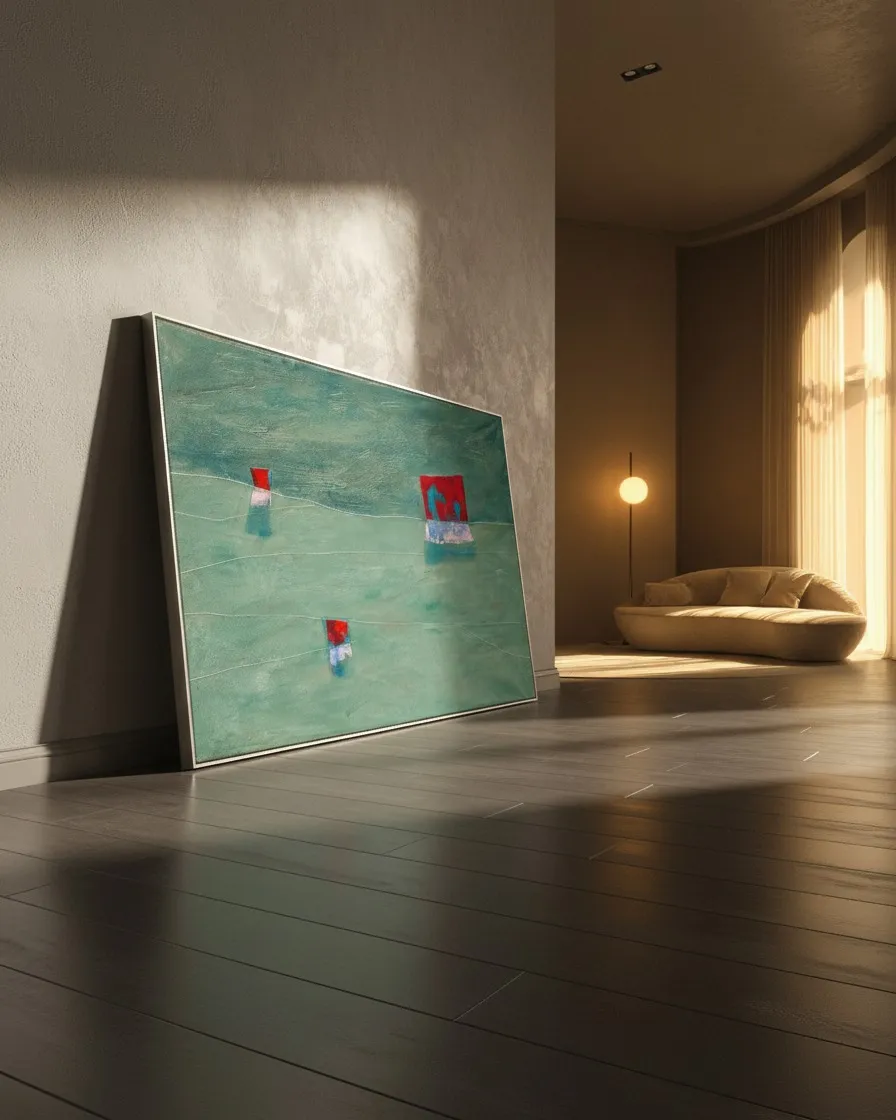
TRIA Abstract Painting by Maurizio Valch - STRATA Series
The eye does not enter the painting frontally, but through a detour imposed by the host architecture itself. Resting directly on the dark wood floor, slightly tilted against a sandy-textured wall, TRIA forces the observer to shed the conventional gallery distance. Natural light, entering on a clean diagonal, grazes the dense emerald surface, revealing first what is most exposed: the vibration of those three crimson blocks interrupting the green plain. However, this initial encounter is only a protective threshold. Behind the chromatic impact, the gaze is guided laterally by a series of fine horizontal incisions that slow down the pace and force one to search for what is not immediately given: the underlying glazes suggesting a submerged ground, a stratum covered but not erased by time.
When I place those red masses on the canvas, I do not seek to establish a static focal point or a closed symbol; I am interested in creating transitional tensions. While painting TRIA, I conceived those monoliths as resting points for an eye that needs to pause before continuing its journey through the vastness of the green field. At first, the crimson mark seems to dominate everything, but its true function is to act as a necessary distraction. While the viewer dwells on its weight and the impasto gathered by the palette knife at the edges, the gaze slips, almost unnoticed, toward the incised lines traversing the matter. Those incisions are not there to decorate; they are grooves cutting into the surface, physical interruptions forcing one to wonder what has been buried beneath the weight of the paint.
This organization of space proposes a temporal experience that contradicts the immediacy of traditional geometric abstraction. While the dense chromatic masses of Nicolas de Staël operated as stark architectural presences, in Valch's work these blocks behave as provisional signals in an unstable territory. The gaze is driven to circulate between them across a subtly broken horizon that recalls the territorial construction of Richard Diebenkorn, yet here stripped of reassuring external references. What we discover first—the vibrant contrast between crimson and emerald—gradually loses authority as the palette knife's relief and the oil scrapings become evident. The composition then acts as a perceptual trap: it uses the force of form to divert attention and reveal, only upon a second, slower look, the fragility of the canvas's skin.
Seeing the work resting on the floor, stripped of the easel's rigidity, I understand that its scale does not seek to impose itself on the room, but to integrate into its silence. I am often wary of definitive explanations of what I paint, because I know that thought tends to bury the fact under layers of interpretation. In scraping the wet oil to make way for the raw light of the support, I was not looking to draw a map with a clear destination, but to leave the trace of a physical action, a mark that invites one to look beneath the appearance of stability. I do not know if what remains hidden in TRIA is a wounded memory or a belief starting to erode; the only thing that belongs to me is the effort to sustain that tension between what is urgently shown and what waits in the depth of the stratum.
Ultimately, TRIA confronts us with the idea that seeing is an exercise in dis-identification. If the gaze's first step contents itself with classifying the monoliths and the emerald color within a formal theory, the work remains mute, turned into an aesthetic bunker. But if the viewer accepts the direction proposed by the subtle geography of the incisions, the apparent order begins to crack. The true perceptual transformation occurs when one discovers that the surface is not a closed plane, but a tactile edge where the visible and the hidden touch. The painting does not resolve the mystery of what lies beneath its layers; it guards it, allowing the gaze to descend and recognize itself in the empty space left between the forms.
- Original artwork
- TRIA
- Actual dimensions
- 47.2 × 31.5 in / 120 × 80 cm
- Presentation
- Digital contextual visualization
Context references
green and red abstract paintings · large format living room painting · original minimalist abstract art · interior design with contemporary art · artworks resting on the floor
About this visualization
This visualization places the artwork within an architectural context to help collectors and viewers imagine its presence in a real space. It is an interpretive reference, not an exact reproduction: the original work remains the sole authority for scale, color, surface and material presence.