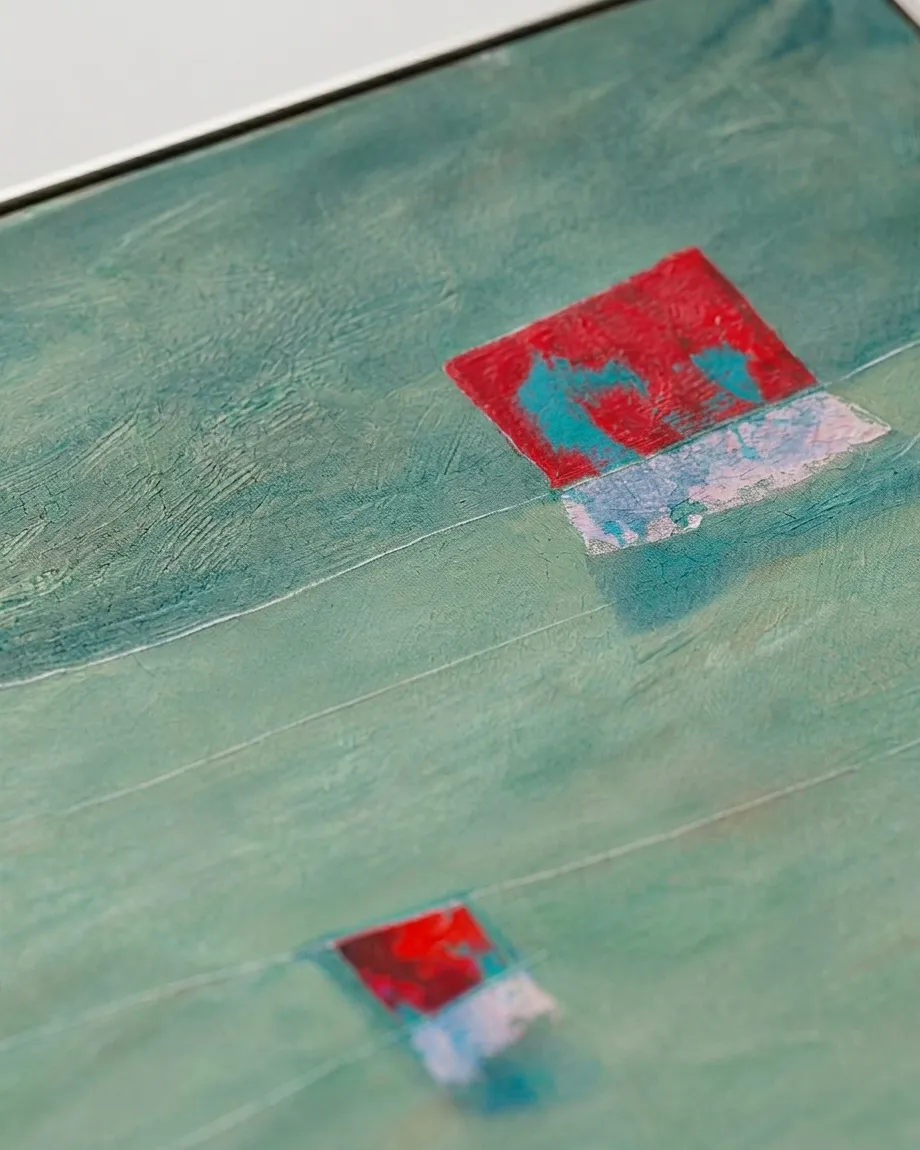
Context study / TRIA
Detail of TRIA - Abstract Painting by Maurizio Valch
The foreground of TRIA reveals a territory that refuses to behave as a journal of illustrated events. There are no dates here, no names of abandoned cities, nor chronicles of domestic shipwrecks; instead, the gaze stumbles upon a vast emerald field where the paint has settled in layers, like dust accumulating in the transient rooms we once inhabited. Two red shapes, dense and rough, sit on the surface like presencies claiming their own weight, interrupting the flow of matter. This geography does not recount a life through a linear sequence of successes or defeats, but exposes it as a silent topography—a material residue where the past is not narrated, but compressed and turned into relief.
Sometimes people ask me about the maps of my travels, about the exhaustion accumulated over miles of walking, or about the urgent decisions that forced me to change houses time and again. However, when I face the canvas, I find that memory does not operate as an archive of ordered anecdotes. These horizontal incisions cutting through the emerald are not passable roads or timelines; they are physical cuts in the matter, clefts where my hand has scraped the oil to reveal what was hidden beneath. I do not need to explain what pain or what move produced each stroke, because the vibration of the surface already retains the trace of the pressure exerted, turning the paint into a body that remembers without needing to speak.
The relationship between the red block and the immersive background evokes that tension Nicolas de Staël maintained between the weight of the chromatic mass and the lightness of the space surrounding it. But while in De Staël the block still retains the echo of an external landscape, in Valch's painting the form folds in on itself to function as a structure of thought that has acquired hardness. Here, territory behaves like a skin that has endured friction, wear, and sedimentation. By avoiding figurative representation, the work allows autobiography to free itself from the tyranny of historical data; life appears, but it does so stripped of its anecdotes, converted into a geography of tensions, where each stratum is a year that has ceased to be a story and has become density.
For a long time, I harbored the belief that my existence had to be a great quest, a constant ascent justifying every step through some distant recognition or ultimate revelation. Painting TRIA forced me to lay down that armor and accept the honesty of the detour, the fall of the line that renounces the straightness of the level. These red blocks that seem to float or run aground on the green plane celebrate no victory; they are simply presences that hold the gaze before the unfinished. I have learned that peace does not wait at the end of a convincing explanation of who I am, but in the capacity to observe the rough matter and accept that being here is enough, before thought begins to construct another theory about myself.
The photographic approach to the work, cropping the canvas and placing us at its tactile edge, accentuates this condition of a living object that stands by its own physical laws. The metal frame barely contains a portion of a geography that seems to continue beyond the visible limits, suggesting that the painting is not a window to look at the world, but a surface exposed to the friction of its environment. By collapsing analytical distance, the viewer does not decipher a closed symbology but comes into contact with a residue of real time. TRIA thus offers itself as a threshold where explanations run dry and autobiography detaches from the word, proving that a life can be fully visible in the mere resistance of a stratum that refuses to be erased.
- Original artwork
- TRIA
- Actual dimensions
- 47.2 × 31.5 in / 120 × 80 cm
- Presentation
- Digital contextual visualization
Context references
abstract painting close up · oil and acrylic textures · original work maurizio valch · emerald green abstract art
About this visualization
This visualization places the artwork within an architectural context to help collectors and viewers imagine its presence in a real space. It is an interpretive reference, not an exact reproduction: the original work remains the sole authority for scale, color, surface and material presence.