Context study / TRIA
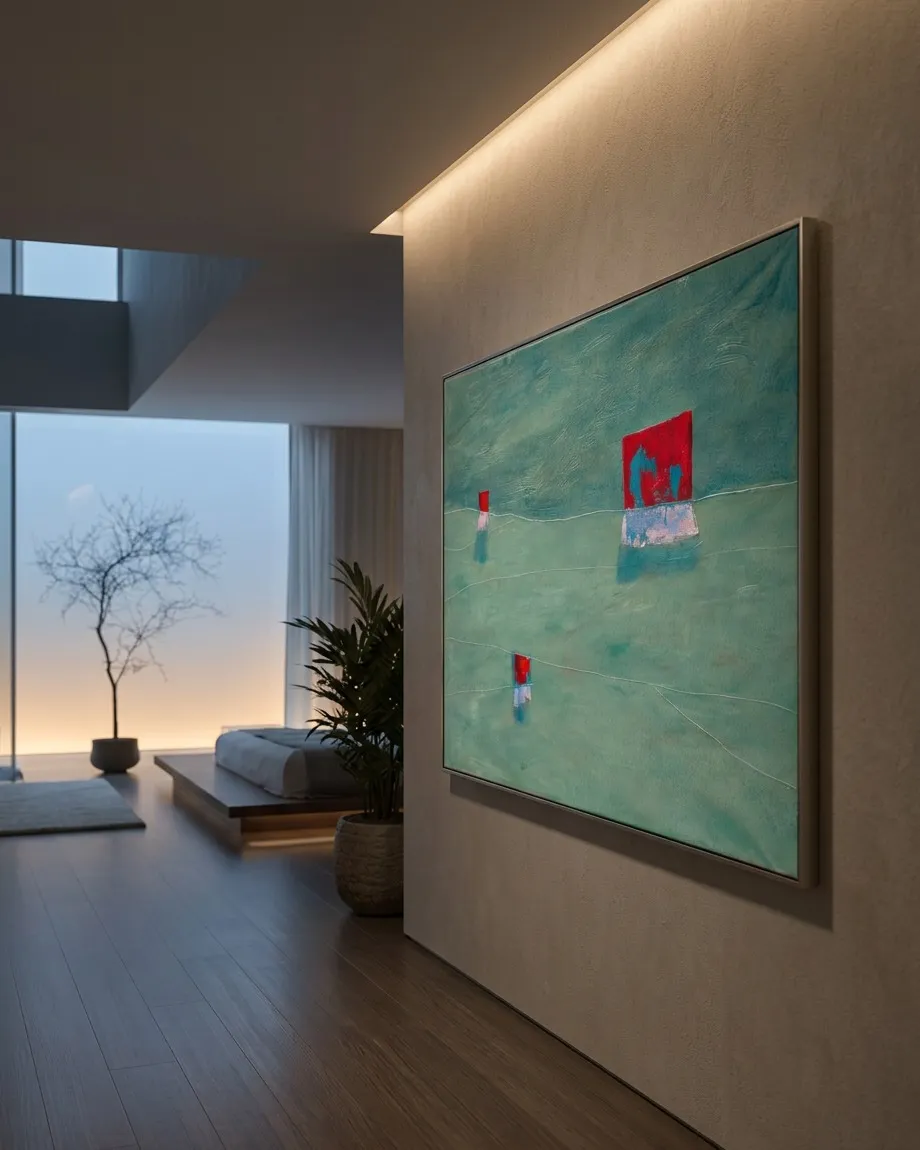
TRIA in Transit Hallway - Minimalist Art by Maurizio Valch
The overhead lighting sliding down the wall of this domestic transit space only accentuates the painting’s threshold-like quality. Located in a transitional zone, stripped of the haste of common areas, TRIA does not demand a decorative gaze; it calls for a physical pause. The scale of the piece, set against the emptiness of the corridor and the quiet of the adjoining room, enters into a dialogue with the minimalist architecture that hosts it. There is no visual distraction here, but a material presence that reorganizes the air around it. The contrast between the roughness of the wall and the relief of the canvas turns the painted surface into a tactile edge, a point where the viewer is invited to momentarily abandon chronological time to step into a dimension of pure expectation.
When I prepared the background of this work, mixing acrylic with oil to achieve that emerald density, I was not thinking of an external landscape. I was looking for a ground with the weight of accumulated time, a base that would resist. The incisions crossing the plane from side to side emerged later, not as drawn lines to separate heaven from earth, but as physical cuts in the wet matter, scars recording a force passing through the space. I was interested in seeing how a subtractive mark, which removes paint instead of adding it, could structure the entire canvas. By scraping the surface, I felt I was not inventing a map, but unearthing a structure that already existed beneath the layers of color.
This renunciation of literal representation is precisely what allows the work to approach an order that dispenses with names. By avoiding any recognizable iconography or hermetic symbology, the painting detaches itself from traditional dogmatic narratives to stand solely on the vibration of color and the gravity of forms. The three red blocks, dense and applied with a palette knife, do not act as warning signs or allegories; they stand as silent monoliths retaining their own secret. This formal refinement, evoking the tension of color fields where space becomes a mystical event without the need for altars, appeals to an unburdened attention. The viewer does not stand before a window illustrating a sacred story, but before a material mirror reflecting their own inner silence.
Now, seeing the piece installed on this wall, I wonder if those red blocks floating or resting on the incised line belong to me at all. There is a moment in the studio where the painter’s will must withdraw so the work can assume its own physics. At first, one believes they govern the process, mastering the palette knife and directing the accident; but in the end, when the oil settles and the glazes find their density, what remains is a presence both alien and familiar to me. These red monoliths are no longer my technical decisions; they are compact bodies supporting the plane, reminding me that real silence only appears when the mind understands and abandons its own noise.
The transit of the observer in front of TRIA thus becomes an exercise in dis-identification. By collapsing the analytical distance that seeks to decipher the painting as if it were a hieroglyph, the emerald plane ceases to be a background and transforms into a territory of somatic resonance. The beauty of the work does not reside in a pacified symmetry, but in the honesty of its tensions, in that invisible slope where forms seem to slide and resist simultaneously. At the end of the path, the painting does not propose an escape from everyday reality, but an approximation to the quiet that dwells beneath its surface. It is the revelation that the invisible does not require temples to manifest, but simply a space clear enough for matter to present itself.
- Original artwork
- TRIA
- Actual dimensions
- 47.2 × 31.5 in / 120 × 80 cm
- Presentation
- Digital contextual visualization
Context references
minimalist hallway paintings · minimalist living room decor ideas · contemporary green and red painting · contemplative home art
About this visualization
This visualization places the artwork within an architectural context to help collectors and viewers imagine its presence in a real space. It is an interpretive reference, not an exact reproduction: the original work remains the sole authority for scale, color, surface and material presence.