Context study / TRIA
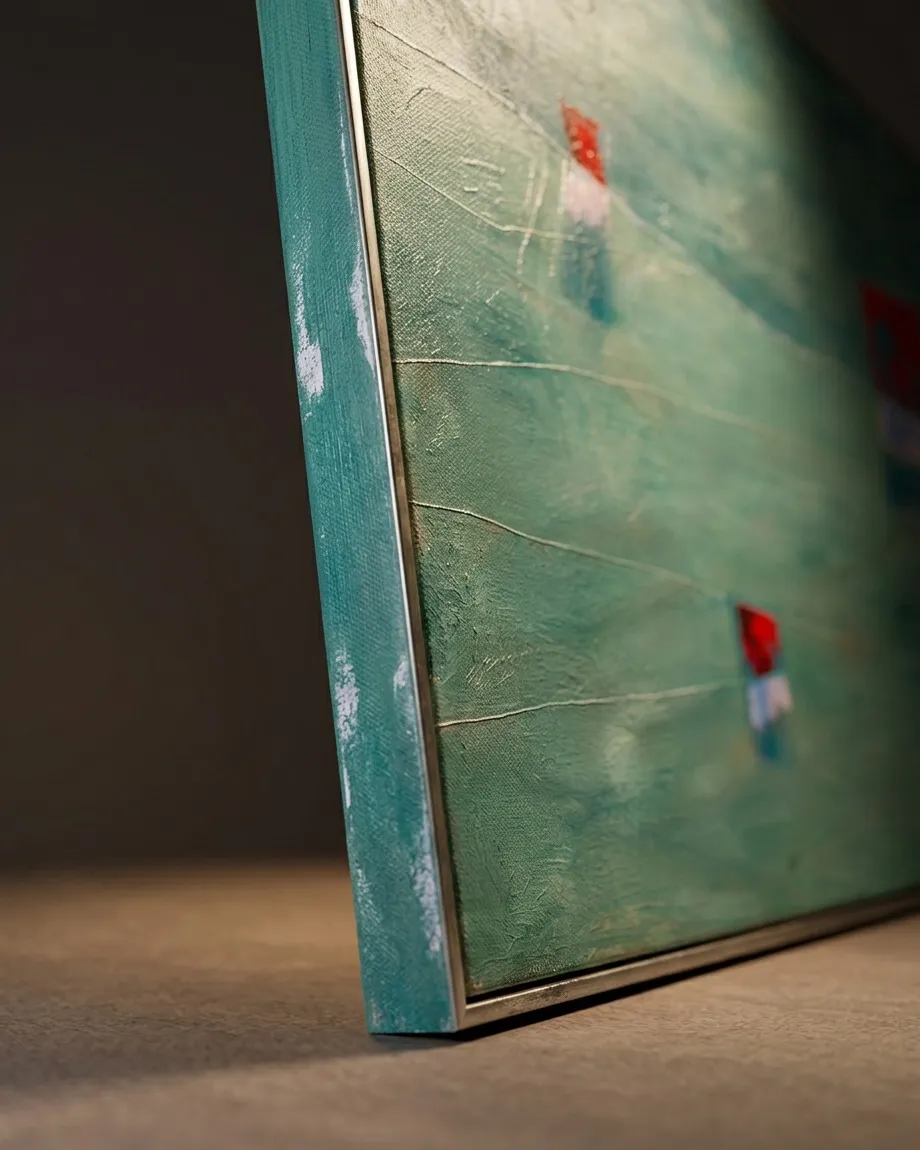
Detail of the Stretcher and Textures of TRIA - Maurizio Valch
The side view of TRIA's stretcher reveals a material truth that two-dimensional distance usually conceals: the emerald color is not a floating surface, but a skin that physically wraps the edge of the wood, coexisting with remnants of white primer and rough scrapings before being contained by the subtle metal frame. This tactile density immediately distances the work from the optical flatness that characterized much of mid-20th century American abstraction. When a chromatic field ceases to behave as an atmospheric window—as Mark Rothko conceived it—and instead presents itself as a delimited, heavy territory subjected to the friction of the palette knife, the historical reference is stripped of its original mysticism. The green of the canvas does not appeal to a contemplative dissolution; it is a compact ground that has received pressure, time, and sediment.
Often I have observed Barnett Newman’s zip as an absolute division organizing the void, but on my canvases that dividing line could never remain clean or two-dimensional. When I hold the tool and cut through the wet oil, I am not seeking an impeccable metaphysical boundary, but a real incision, a subtractive gesture that penetrates the emerald strata to lay bare the support that sustains them. The line thus becomes a physical scar on the body of the painting, an open path interrupting the continuity of the plane. By wounding the matter in this way, the stroke ceases to be a quote of historical minimalism and becomes a path of its own, a temporal mark registering the pressure of my own hand on the territory of the painting.
This conversion of the referent into a physical necessity is also visible in the red geometric blocks that interrupt the green expanse. While Nicolas de Staël’s dense masses hovered between the suggestion of landscape and the solidity of architecture, in TRIA these crimson monoliths behave as compact, almost bodily presences exerting gravitational pressure on the space. They do not function as closed symbols of a European pictorial heritage, but as tensions of scale that arrest the viewer’s eye. Colliding with the horizontal incisions, these blocks force a slow, somatic reading, where the weight of the form is not deciphered through an intellectual code but experienced as a real force altering the balance of the surface.
When I contemplate the work resting directly on the floor, assuming its three-dimensional weight under the raking light of the space, I understand that dialogues with the past are only real if they are assimilated through the fatigue of the process itself. I did not paint this work to illustrate a conversation with Newman or De Staël, but to discover at what point their inquiries into space and mass collapsed before my own questions about memory and wear. The rustic edge of the canvas, captured by the camera in all its material imperfection, shows that painting does not belong to the purity of artistic categories, but to the world of things subject to gravity, touch, and the wear of time.
Ultimately, TRIA demonstrates that an artistic affinity is only transformative when it is violated by the creator's experience. By turning the pure divisions of abstraction into incisions marked by erosion, and the color fields into a dense, textured geological ground, Valch's language does not pay an academic homage, but rather dismantles the origin of its influence to found a sovereign geography. The painting ceases to be an echo of art history and establishes itself as a tactile threshold for the viewer. It is in this transit, where the reference dissolves under the real weight of scraped pigment, that the artwork truly acquires its right to exist.
- Original artwork
- TRIA
- Actual dimensions
- 47.2 × 31.5 in / 120 × 80 cm
- Presentation
- Digital contextual visualization
Context references
oil on canvas detail close up · contemporary abstract paint textures · painted canvas edges artwork · thin metal frames for paintings · palette knife and scraping technique oil painting
About this visualization
This visualization places the artwork within an architectural context to help collectors and viewers imagine its presence in a real space. It is an interpretive reference, not an exact reproduction: the original work remains the sole authority for scale, color, surface and material presence.