Context study / NEXUS
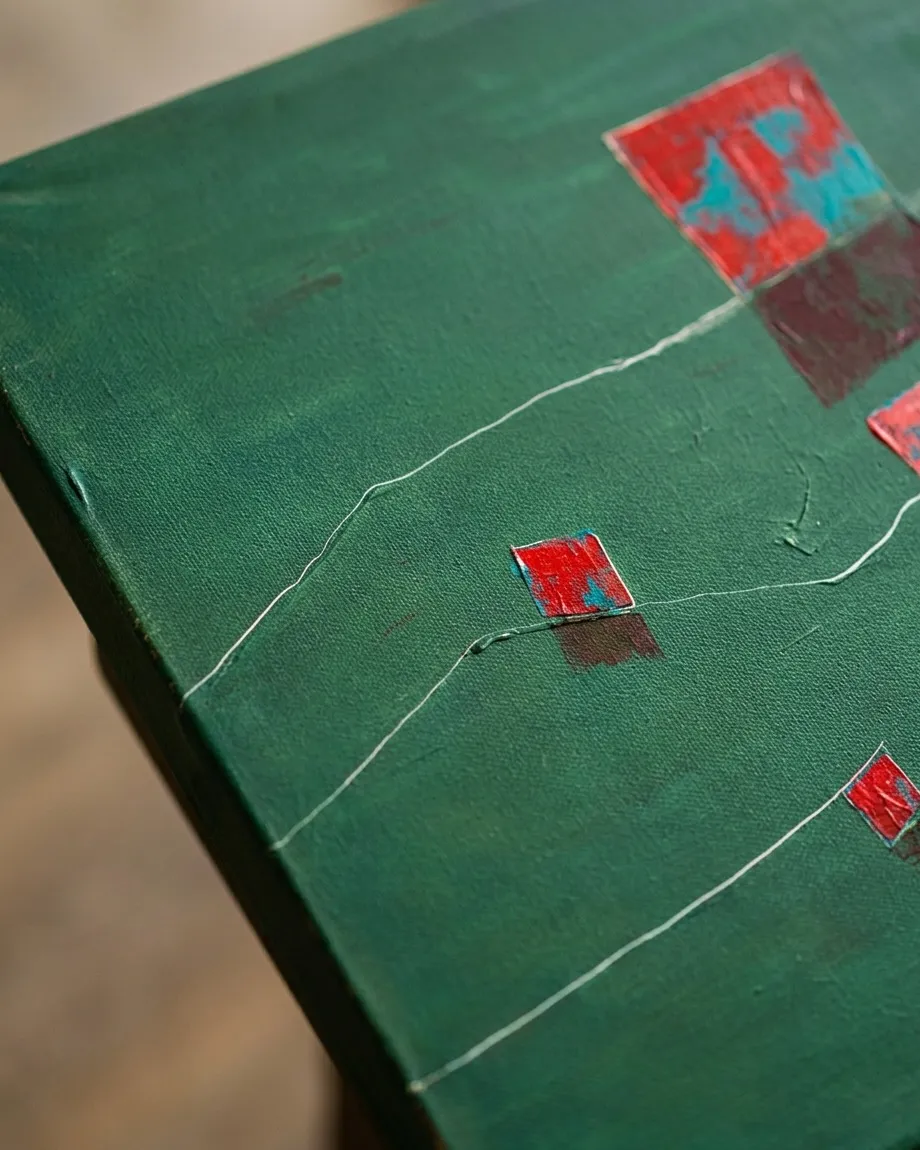
Close-up of NEXUS — Details of Texture and Materiality
A drastic cut, a thin white trench on the canvas, interrupts the apparent uniformity of the paint to inaugurate a geography of resistance. As we approach the emerald plane of NEXUS, the surface reveals its condition as a skin: a dense, textured territory where Maurizio Valch applies scraping, glazes, and accumulations of matter that hold the history of its own physical transformation. Far from acting as an inert, flat background, the emerald becomes a tactile support hosting the gravity of small crimson blocks. These geometric masses, with their imperfect edges and rustic surfaces, project a real shadow downward, altering the scale and lending the composition an unexpected three-dimensionality that nullifies the traditional two-dimensionality of the painting.
To hold one's gaze upon these small suspended blocks requires entering the tension the artist poses between rational structures and the immensity of silence. The dense, accumulated crimson behaves as the materialization of convictions that have acquired permanence and weight over time, defying the constant flow of a space that seems to remember. By placing these thermally opposed masses on the emerald green, Valch explores how solidified thought seeks to anchor itself or float in the midst of uncertainty. Here, color and relief do not function as decorative elements, but as a way to record that something has occurred, a need to find a minimal order that regulates the pressure of memory without relying on the eloquence of words.
In the STRATA series, this encounter between resisting matter and the vacuum surrounding it acquires a more intimate and demanding dimension. By dispensing with figurative representation, the canvas becomes a space where thought unfolds as a territory and incised lines function as the scars of an internal cartography. There is no desire here to illustrate an absolute truth or offer a walkable path; the incised lines tremble with the imperfection of the human pulse and cross the fabric from edge to edge without promising a clear destination. This process of material excavation dismantles the pretense of constructing convincing explanations about one's own identity, suggesting that awareness does not lie outside the layers that form us, but precisely in the capacity to observe their cuts and resistances.
This way of treating the canvas as a marked body, where paint behaves like a wall or a skin exposed to wear, establishes an inescapable affinity with the material sensitivity of Antoni Tàpies. Like the Catalan master, Valch understands that the surface must retain the physical trace of action, turning the support into an archive of duration and accident. However, where Tàpies seeks the rawness of residue and the informality of the wall, Valch retains a restrained territorial organization and an elemental geometry that actively dialogues with light. In the intimacy of this close-up, the proximity of the stretcher’s side edge and the subtle shadows cast by the crimson blocks reveal a painting that does not simulate being a window to elsewhere, but a physical presence inhabiting real space with the gravity of a three-dimensional object.
- Original artwork
- NEXUS
- Actual dimensions
- 47.2 × 31.5 in / 120 × 80 cm
- Presentation
- Digital contextual visualization
Context references
details of matter painting · acrylic and oil texture on canvas · close-up of abstract green painting · incised lines and scraping in contemporary art · details of stretcher and painting up close
About this visualization
This visualization places the artwork within an architectural context to help collectors and viewers imagine its presence in a real space. It is an interpretive reference, not an exact reproduction: the original work remains the sole authority for scale, color, surface and material presence.