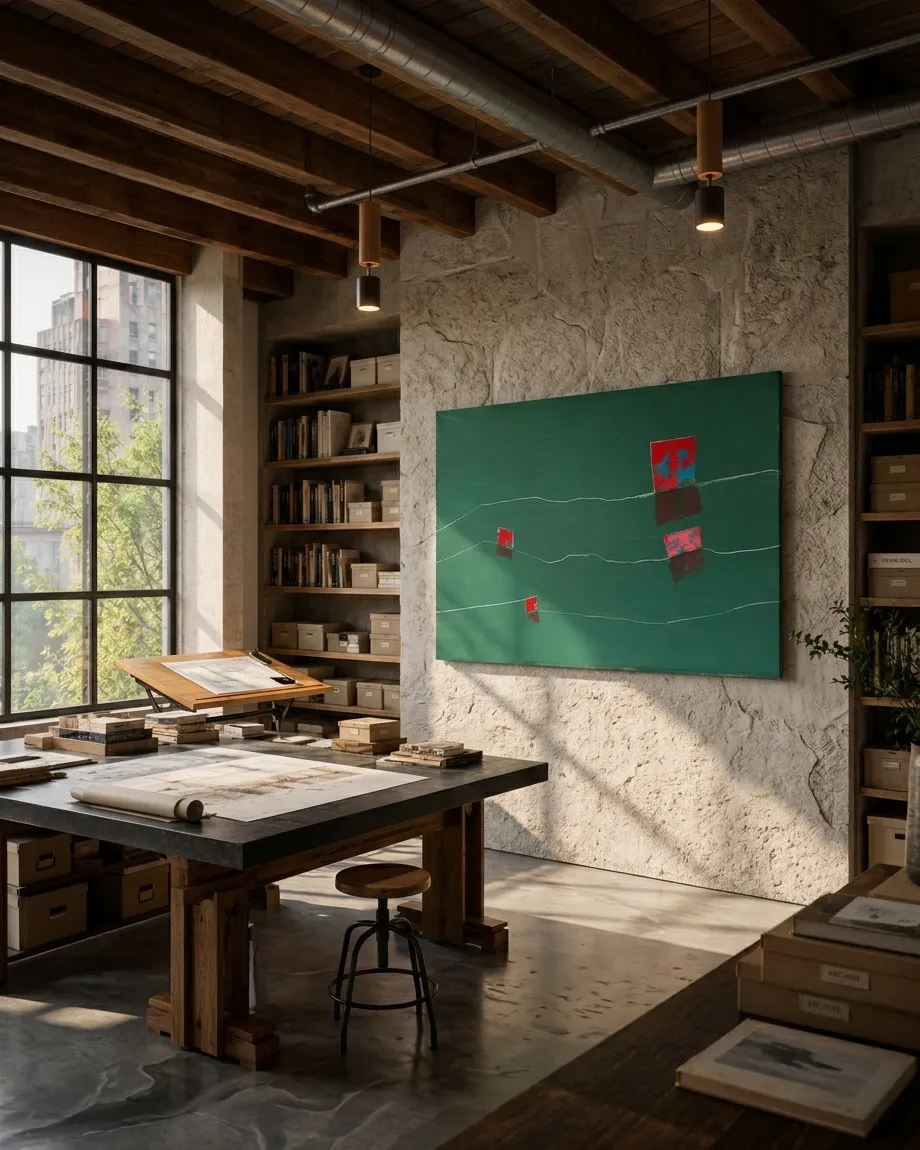
Context study / NEXUS
NEXUS Large Abstract Green Painting on Wide Frame | Maurizio Valch
When the white incision slides through the thickness of the side frame, the painting abandons its function as a window to behave as a fragment of an incalculable territory. In NEXUS, Maurizio Valch does not delimit a contained landscape; the emerald matter behaves as an exposed section of a much larger geography. The three incised lines that furrow the surface neither begin nor end within the canvas, but rather continue their path along the physical edges of the painting. This material continuity alters the scale of the work, decentering the viewer's gaze, who is forced to imagine the invisible extensions of a cartography overflowing the frame. This refusal to close off the painting connects with an inner search where the journey is defined not by its destinations, but by the imprecise traces left by passage. For the artist, thought operates as a territory and memory as a surface occupied by structures attempting to fix experience. The crimson and blue blocks suspended over the incisions act as those dense certainties or memories seeking anchorage, yet the vastness of the green background and the lateral escape of the lines suggest that any attempt at absolute order is provisional in the face of the drift of psychological time. Examining the relationship between the incision and the support reveals the concept of the tactile edge developed in Valch's writing. The pictorial surface is not a passive boundary, but a contact membrane where the dualities between subject and space dissolve. The incisions, far from functioning as Cartesian axes of control, behave as scars and pathways of memory that disobey the tyranny of the plane. By extending the paint to the sides of the frame, the work transforms into a three-dimensional object claiming its presence in the real space of this architecture studio, where the technical, measurable plans of the desks confront the incalculable width of this painted territory. In this way of treating the surface as a skin exposed to wear, Valch's practice dialogues closely with the materiality of Antoni Tàpies. However, while the Catalan artist turns the support into a dense, eroded wall of an primarily mineral character, Valch maintains a more contained territorial and atmospheric organization. The tension of NEXUS lies not in the destruction of matter, but in the unstable balance between the gravity of its chromatic blocks and the infinite escape of its incised paths, consolidating a singular position where abstraction becomes body, trajectory, and silent memory.
- Original artwork
- NEXUS
- Actual dimensions
- 47.2 × 31.5 in / 120 × 80 cm
- Presentation
- Digital contextual visualization
Context references
NEXUS Maurizio Valch · emerald green abstract painting · painting with incised lines · abstract artwork on wide frame · contemporary art STRATA series
About this visualization
This visualization places the artwork within an architectural context to help collectors and viewers imagine its presence in a real space. It is an interpretive reference, not an exact reproduction: the original work remains the sole authority for scale, color, surface and material presence.