Context study / NEXUS
NEXUS by Maurizio Valch in an Architecture Studio
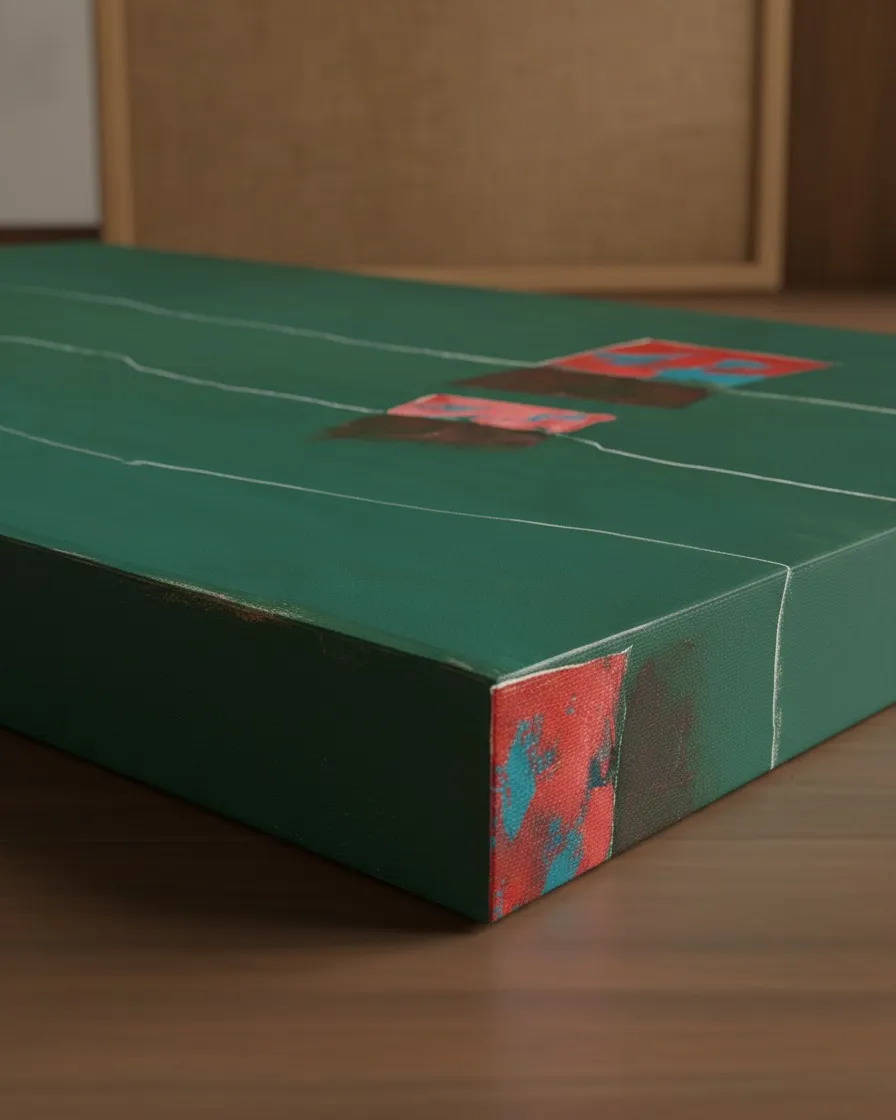
The physical presence of a material painting radically alters the atmosphere of a design or architecture studio. By placing NEXUS in a space dominated by technical drawing tables, precision blueprints, and orthogonal measuring instruments, Maurizio Valch's dense emerald green field and rough blocks establish a silent friction with the instrumental lightness of the environment. While technical drawing projects a future space through the abstraction of the straight line, the three-centimeter-thick canvas imposes itself as a monolithic, three-dimensional object. Its physical weight acts as a counterweight of tactile gravity, a fragment of territory that does not seek to complement the room's design, but to question its logic of mathematical control through the imperfection of sedimented matter.
This collision between projected order and the density of the built echoes the need to find a minimal order that does not rely on verbal or conceptual explanations. The pictorial field, worked through layers of acrylic and oil that accumulate pressure and wear, refers to the experience of what has had to resist to acquire a structure. The white incisions traversing the canvas horizontally tremble with the irregularity of a real pulse, distancing themselves from the millimeter fijeza of drafting rulers. It is a somatic reminder that lived territory always retains scars and detours that the utilitarian planning of a Cartesian blueprint prefers to omit to maintain its illusion of cleanliness.
In this context, the compact shapes floating or anchored on the incisions of NEXUS dialogue closely with the thoughts developed by the artist in his essay on the remembering surface. These crimson and blue structures, which cast a slight shadow and extend their matter over the edges of the frame, function as blocks of convictions or memories hardened by time. Like the analysis of how the accumulation of strata of experience shapes consciousness, the artwork behaves as a wall or a skin exposed to wear. It does not illustrate a concept, but offers real resistance to the designer's or architect's gaze, drawing attention back to the intrinsic resistance of materials and the structural decisions that shape a life.
This way of conceiving the pictorial plane as an eroded and dense surface brings Valch's practice close to the sensibility of Antoni Tàpies, for whom painting operates with the gravity of a wall or a body marked by time. However, where the Catalan artist yields to the informal rawness of material accident, Valch maintains a highly contained territorial organization and a subtle geometric tension. When the work is presented at the scale of a creative studio, leaning or suspended between wood and technical paper, this uniqueness becomes radicalized. The painting abandons the sterile distance of the art gallery to become a physical and spatial boundary that halts the urgency of planning, opening a zone of silence where thought can, simply, contemplate its own traces.
- Original artwork
- NEXUS
- Actual dimensions
- 47.2 × 31.5 in / 120 × 80 cm
- Presentation
- Digital contextual visualization
Context references
abstract painting for architecture studio · emerald painting minimalist decor · large green painting design office · textured contemporary art · Maurizio Valch STRATA
About this visualization
This visualization places the artwork within an architectural context to help collectors and viewers imagine its presence in a real space. It is an interpretive reference, not an exact reproduction: the original work remains the sole authority for scale, color, surface and material presence.