Context study / INTERVALLUM
INTERVALLUM by Maurizio Valch | Low-Angle View
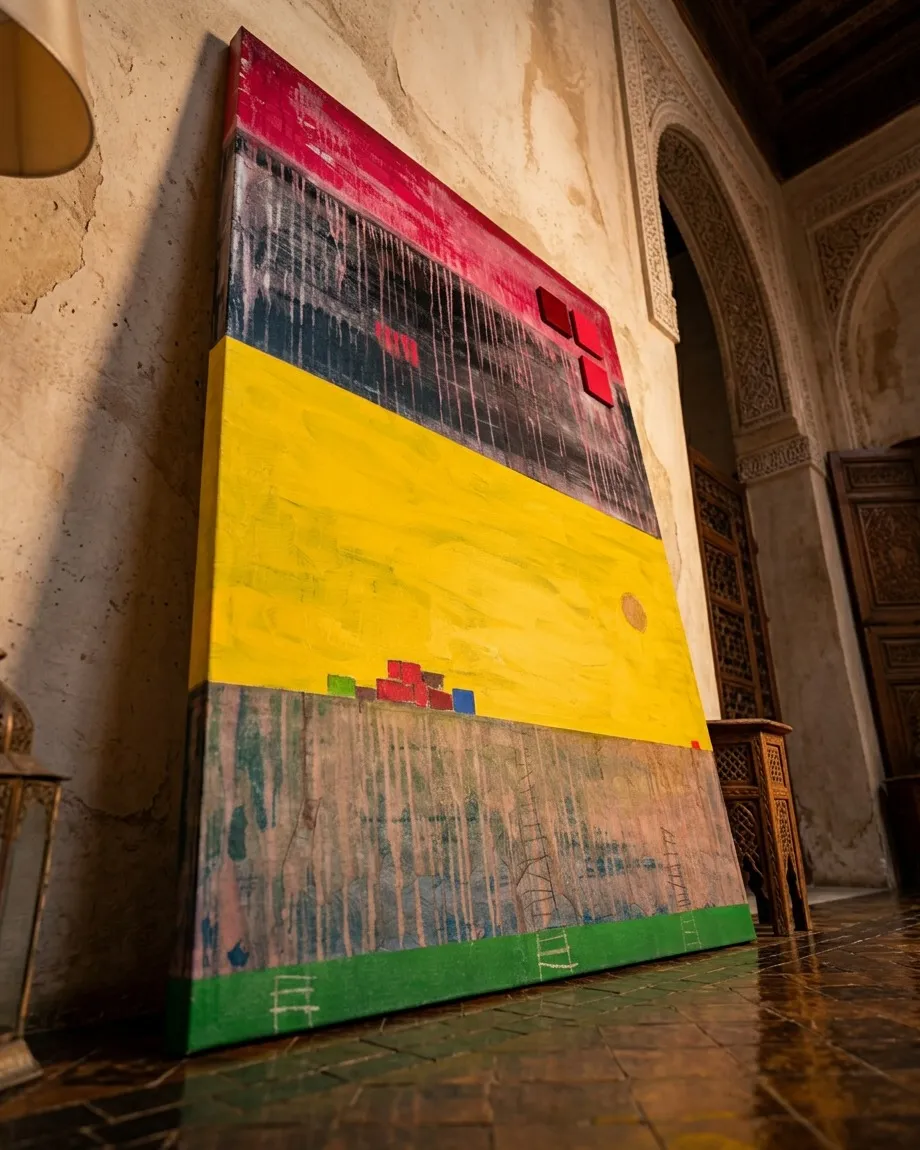
Seen from the floor, INTERVALLUM loses the calm of a horizontal order: its bands rise one above another, and the 120-centimetre canvas takes on the perceptual incline of a slope. The low viewpoint makes the green edge near the floor support the small incised stairs as precarious beginnings; far above, the carmine rectangles separate from any possible route and remain suspended in the upper area. This alteration of scale reveals a central feature of Maurizio Valch’s language: colour fields and divisions do not organize a stable space, but construct a territory under pressure. The drips descending across the dark band and the irregularity of the layers prevent the strata from reading as distinct steps. A direction is suggested, but the material does not grant a continuous path.
That difficulty relates to a persistent distinction in the artist’s thought: a course may be traceable in the outer world and still fail to resolve the inner direction of the person moving through it. In this painting, the stair does not offer the reassurance of a complete route; it only registers a possible link between levels that remain apart. The gaze rises from the lower incisions, crosses the eroded brown section and the yellow expanse, but encounters interruptions, drips, and distances rather than arrival. This resistance may be understood as an experience of attention rather than a closed allegory: ascending does not necessarily mean progressing, but remaining in relation to what does not yet allow itself to be fully ordered.
In “The Ascent Without a Staircase,” Valch understands ascent as an effort that does not promise completion: revisiting an inherited position and responding differently does not eliminate the layers or friction that condition that gesture. INTERVALLUM sustains this intuition in an early, visible form. The stairs at the lower edge indicate a minimal orientation, while the red blocks, inaccessible from them, deny the image of a resolved conquest. The ascending arrangement exists, but it does not become a narrative. Even the yellow, which might open a zone of passage, retains a vacant and uneven breadth; the small earthen circle and the group of squares at its lower boundary do not clarify the route, but measure its distance. The painting thus shifts ascent away from a goal and towards the work of sustaining an incomplete orientation.
Paul Klee offers a specific affinity for reading these small geometric units as signs capable of altering the scale of a larger field. In INTERVALLUM, however, the squares in the yellow area and the upper carmine reliefs do not introduce a playful architecture or a legible system. Their isolation makes the disproportion between the minimal gesture of the stairs and the remote mass of the blocks more keenly felt. The low angle of this presentation intensifies that difference: the painting physically rises before the viewer, and the promise of connection remains held within its own slope. What persists is not the expectation of reaching the upper end, but the awareness that between one level and another one must look, pause, and measure the distance again.
- Original artwork
- INTERVALLUM
- Actual dimensions
- 31.5 × 47.2 in / 80 × 120 cm
- Presentation
- Digital contextual visualization
Context references
INTERVALLUM Maurizio Valch · abstract painting with incised stairs · large vertical abstract painting · contemporary art in a historic interior · painting with yellow red and dark bands · abstract artwork with texture and drips
About this visualization
This visualization places the artwork within an architectural context to help collectors and viewers imagine its presence in a real space. It is an interpretive reference, not an exact reproduction: the original work remains the sole authority for scale, color, surface and material presence.