Context study / INTERVALLUM
INTERVALLUM in profile: abstract painting with a 3 cm depth
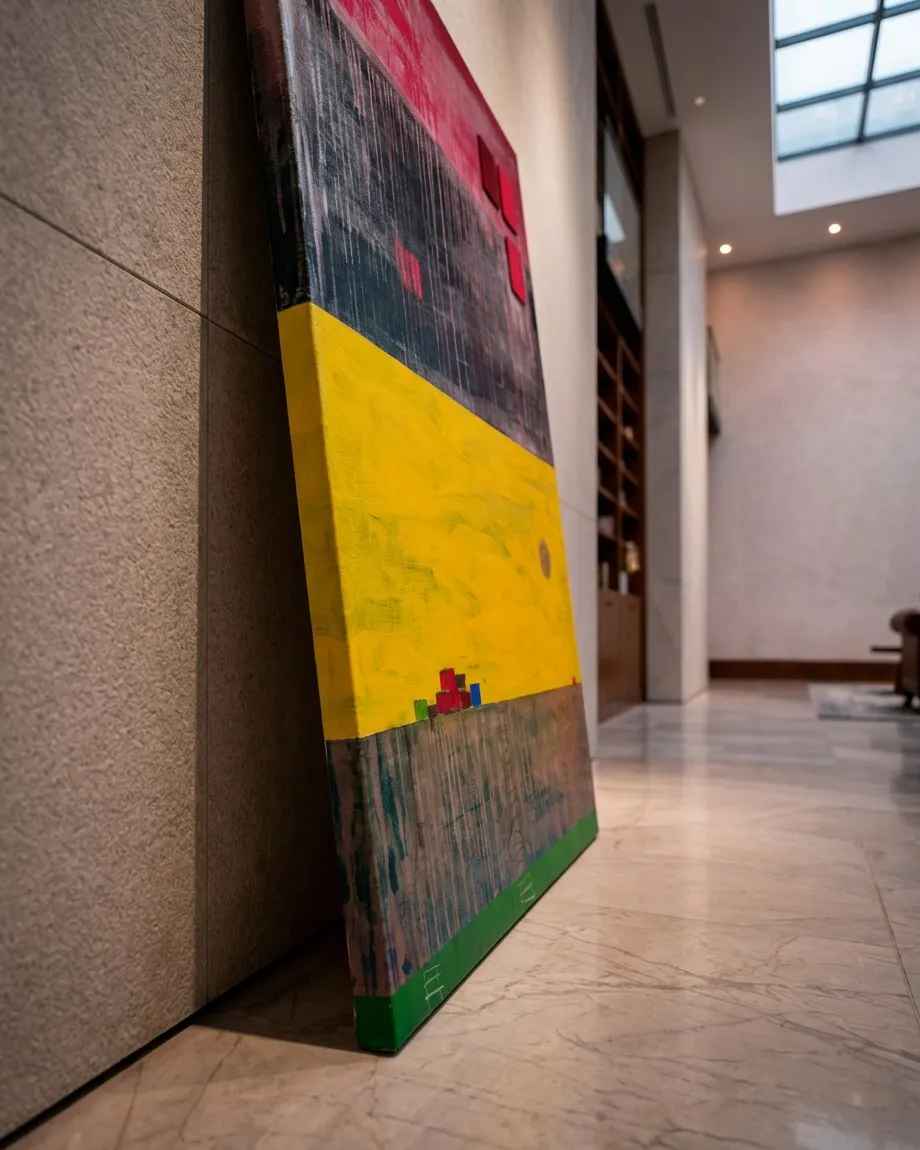
Seen at floor level, INTERVALLUM’s three-centimetre depth alters the usual logic of a painting: the bands of crimson, black, yellow, brown and green are no longer arranged only before the eye, but advance as the profile of an object set apart from the wall. The dark edge, visible along the stretcher, lends weight to the drips and incisions; they cease to be signs contained within an image and become part of a surface occupying a precise volume. Maurizio Valch’s practice works with chromatic fields, divisions and interventions that penetrate layers of paint, but this presentation makes a concrete consequence of that language visible in this work: the lower green boundary and the incised routes do not end at the frontal plane; they sustain a body that projects into the passage space.
The uncertain orientation proposed by the LIMINA series therefore becomes bodily as well. The lightly engraved small stairs and the minimal group of blocks near the lower area might suggest trajectories, but the side view removes any diagrammatic ease from them: they are inscribed in matter with thickness, edge and resistance. This condition enters into an open dialogue with the importance the artist gives to the difference between a path that can be traced and a movement whose direction is not assured. There is no need to read the incisions as biography or as a literal map; it is enough to recognise that the painting prevents passage from being reduced to a clear route. The distance between wall and canvas introduces a first real interval, prior to any imagined destination.
In “The Incisions of the Map,” Valch understands the scored line as a subtractive operation: it does not add information to a neutral surface, but excavates the material and allows relief to intervene in perception. The essay associates this operation with the moment when painting acquires physical autonomy outside the studio’s immediate control. INTERVALLUM is not presented as a freestanding monolith, yet the low oblique view makes a related autonomy perceptible: the canvas asserts itself against the wall without merging with it. Its horizontal divisions retain a territorial appearance, while the edge reveals that this territory begins in a material thing, vulnerable to light and situated before whoever moves around it.
The affinity with Antoni Tàpies helps specify this condition without diluting Valch’s singularity. In both cases, the surface can be read as wall or skin marked by layers, scraping and wear; relief demands an attention that is not exclusively optical. INTERVALLUM, however, retains a much more explicit organisation of levels: the open yellow, the dark band crossed by drips and the final green do not form an undifferentiated wall, but a field of thresholds. From this lateral viewpoint, the painting does not abandon its question of territory; it shifts it to the edge from which that territory separates from the wall and begins to alter the room.
- Original artwork
- INTERVALLUM
- Actual dimensions
- 31.5 × 47.2 in / 80 × 120 cm
- Presentation
- Digital contextual visualization
Context references
side view of an abstract painting · 3 cm deep canvas · abstract painting with visible canvas edge · vertical painting leaning against a wall · contemporary art in a modern hallway · abstract painting stretcher detail
About this visualization
This visualization places the artwork within an architectural context to help collectors and viewers imagine its presence in a real space. It is an interpretive reference, not an exact reproduction: the original work remains the sole authority for scale, color, surface and material presence.