Context study / INTERVALLUM
INTERVALLUM by Maurizio Valch in a Classical Interior
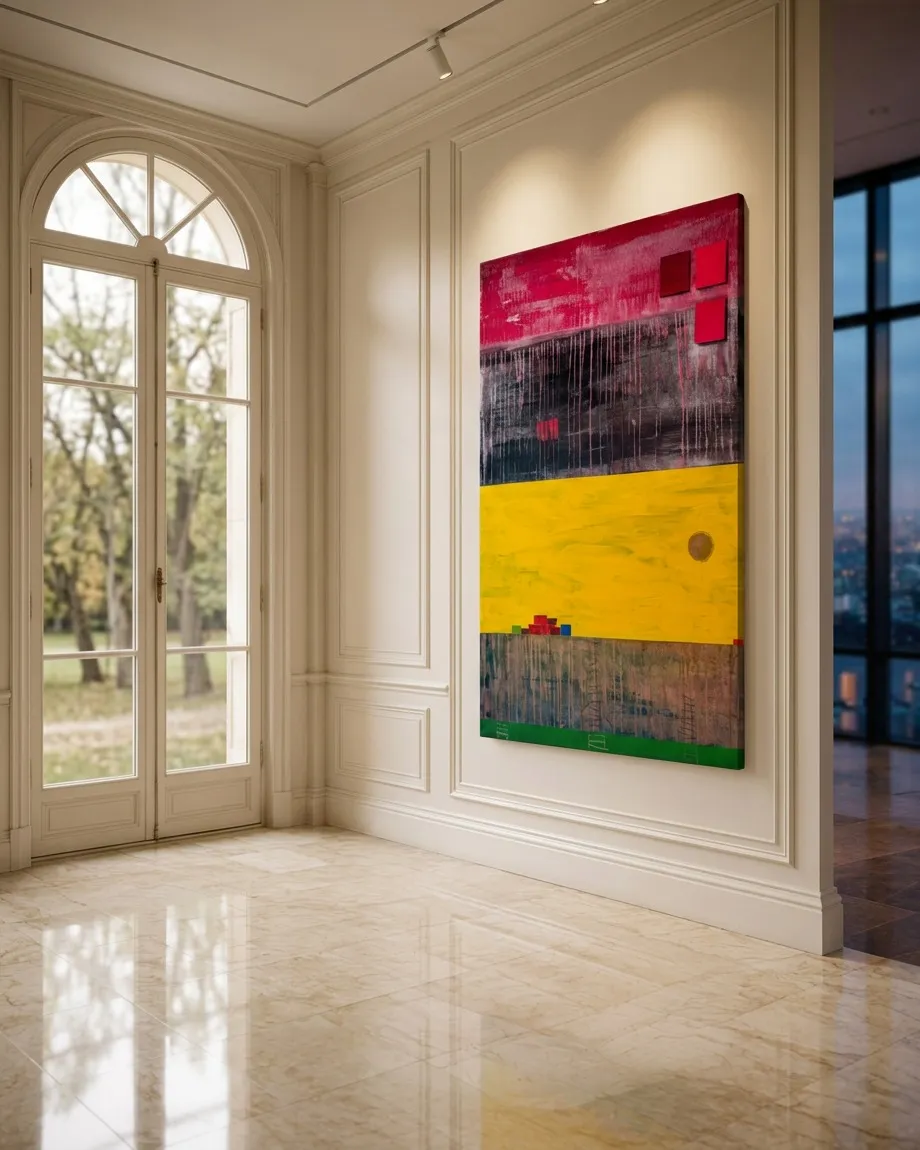
The window promises a continuity that the canvas refuses to grant. Beside it, the mouldings, arched glazing, and regular joints of the floor establish a stable grammar: each vertical finds its frame, and the eye can move clearly towards the trees. INTERVALLUM introduces another kind of order. Its bands of carmine, black, yellow, brown, and green divide the 80 by 120 centimetre vertical format into distinct levels, yet smears, seepage, and drips make their boundaries porous. The lower incisions resemble routes only just begun; the small rectangles, isolated at the edges, maintain a presence without becoming an unequivocal sign. This combination belongs to Maurizio Valch’s territorial language: the structure does not disappear, but matter prevents it from becoming an instruction.
The clarity of the room makes more palpable an experience that runs through the artist’s thought: being situated does not necessarily mean knowing where to go. His life has given importance to journeys, temporary rooms, and the distinction between a path that can be traced and an inner movement that offers no map. The painting does not translate this experience into a private anecdote; it preserves it as a perceptual condition. Before the bright opening, the yellow territory seems available and yet the earthen circle on the right and the small chromatic grouping at the lower edge indicate no destination. The incised stairs suggest a possible relation between strata, not a promise of ascent. Orientation remains open without becoming a lack.
In “When the Ground Appeared,” Valch describes territory as a structure capable of supporting, separating, and ordering, though never neutral: before any choice, there are already limits, routes, and inherited ways of seeing. LIMINA brings that idea to a point of instability. The frontal arrangement of INTERVALLUM may recall an elemental architecture, but it does not offer the perspective that the surrounding room administers so easily. The drips descending from the dark area and the marks that persist in the brown stratum make visible how every organized ground retains pressures, interruptions, and unresolved zones. In this presentation, the painting does not duplicate the classical order of the interior; it places within it the moment when a structure still supports, but no longer fully orients.
The affinity with Paul Klee helps clarify the role of the small geometric units: the red rectangles at the upper edge, the minimal blocks along the yellow band, and the lower incisions alter the scale of the field without imposing a scene. As in certain elemental architectures by Klee, these signs activate a distance between the large and the minute. Valch departs, however, from any playful lightness: here the forms do not animate an ordered world, but remain separated within a dense surface affected by glazes and runs. The room receives them amid rigorous frames and an open window; they return a slower question about what it may mean to inhabit a place when its connections still guarantee no passage.
- Original artwork
- INTERVALLUM
- Actual dimensions
- 31.5 × 47.2 in / 80 × 120 cm
- Presentation
- Digital contextual visualization
Context references
INTERVALLUM Maurizio Valch · abstract artwork in a classical interior · vertical artwork for a living room with high ceilings · contemporary art beside a window · abstract painting with yellow carmine and black · decorating with vertical abstract art
About this visualization
This visualization places the artwork within an architectural context to help collectors and viewers imagine its presence in a real space. It is an interpretive reference, not an exact reproduction: the original work remains the sole authority for scale, color, surface and material presence.