Context study / INTERVALLUM
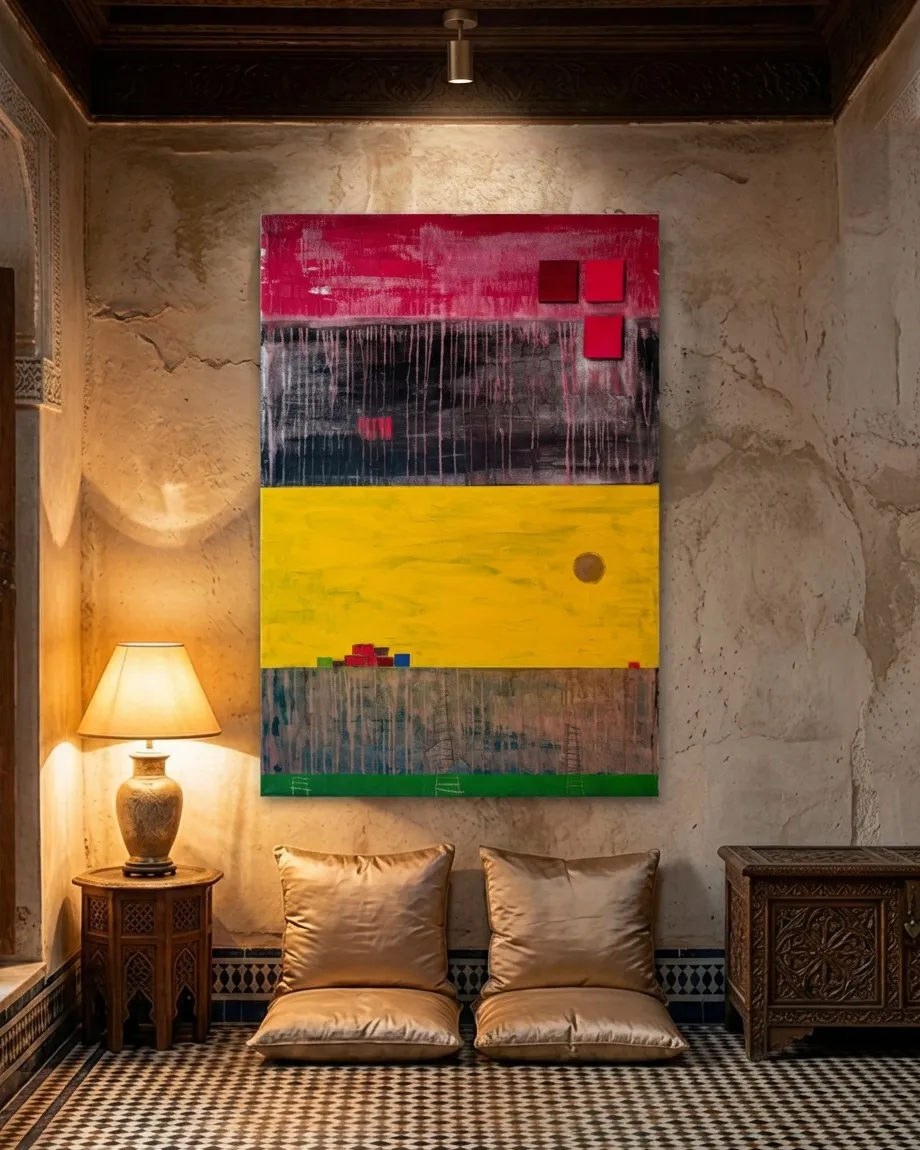
INTERVALLUM in an aged-wall interior
A boundary gains substance when it lets through what it was meant to organise. In INTERVALLUM, bands of crimson, darkness, yellow, brown and green establish distinct levels, yet the drips descending across the black field and the incisions persisting in the lower area disobey that arrangement. The painting thus confirms a central feature of Maurizio Valch’s language: divisions are not added as a drawing that dominates the surface, but are affected by layers, cuts and seepage. Hung against cracked plaster, the 80 × 120 cm canvas does not erase the wall’s uneven age; it answers it with another temporality, made of glazes, dragged passages and deposits of pigment. The chromatic order makes the surrounding wear perceptible, and that wear in turn makes clear that the painting’s own order is not impermeable.
This permeability finds a measured echo in the artist’s attention to territories of passage. His experience of movement has sharpened a distinction between a path that can be traced and an inner movement that offers no secure direction; the small incised stairs in the lower band can be felt through this proximity, though they do not illustrate it. They indicate a possible communication between strata without promising ascent or arrival. The earth-coloured circle, isolated to the right of the yellow, and the minimal grouping of squares by the lower edge likewise refuse to fix a route. The painting sustains separations without turning them into psychological destinations: it leaves the viewer before a territory where being between two levels matters more than reaching either one.
In “The Tactile Shore,” Valch returns to the idea of the coast in order to consider the boundary not as a battle line, but as a membrane of contact. INTERVALLUM carries that intuition into a concrete economy of bands and material passages. Between the upper red and the black, there is no purely geometric border: the paint drips, becomes transparent and alters the division. Between the open yellow and the lower brown area, continuity becomes even more uncertain through the marks, small chromatic presences and incised lines. The distance between body and canvas also takes part in this active interval: the setting requires the work to be seen against a wall whose texture retains stains, fissures and repairs. The two surfaces do not merge; their difference is precisely what sustains the experience of contact.
The affinity with Antoni Tàpies clarifies this material condition without reducing it to a genealogy. As in certain surfaces by the Catalan artist, the wall can be a useful figure for understanding the painting: a body exposed to time, capable of receiving marks and resisting them. Valch departs, however, from a surface wholly given over to the density of sign or erosion. In INTERVALLUM, he maintains an explicit territorial organisation: the final green contains, the yellow expands, the black concentrates, and the suspended rectangles alter the scale of the field. Against the aged wall of this presentation, that structure does not assert itself as a defence against irregularity. It offers itself as a way of coexisting with it, allowing each edge to retain its difference and yet remain open to contact.
- Original artwork
- INTERVALLUM
- Actual dimensions
- 31.5 × 47.2 in / 80 × 120 cm
- Presentation
- Digital contextual visualization
Context references
abstract painting in a Moroccan-style interior · abstract artwork for a textured wall · contemporary art on an aged wall · vertical abstract painting decor · large abstract painting for a living room · wall art in red yellow and green
About this visualization
This visualization places the artwork within an architectural context to help collectors and viewers imagine its presence in a real space. It is an interpretive reference, not an exact reproduction: the original work remains the sole authority for scale, color, surface and material presence.