Context study / INTERVALLUM
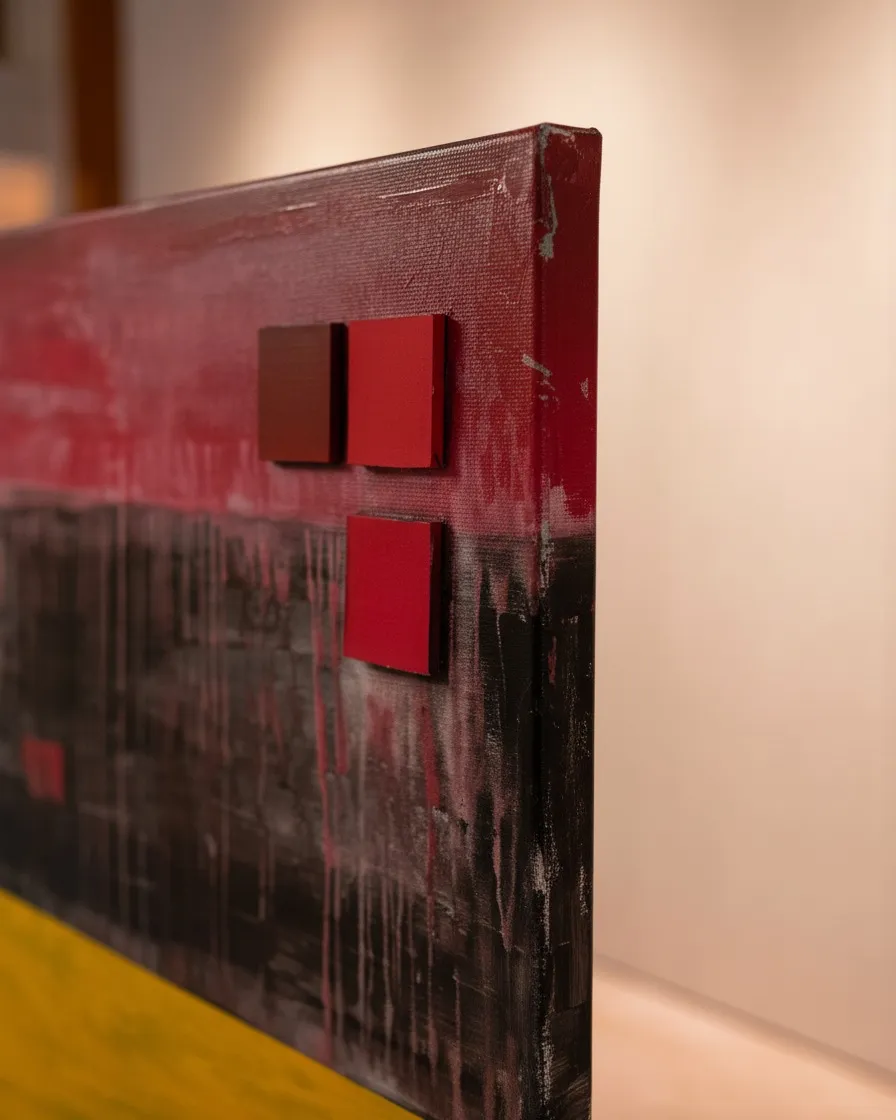
Relief detail of Maurizio Valch’s INTERVALLUM
A few millimetres are enough to disrupt the plane’s obedience. Seen from the side, the three red rectangles in INTERVALLUM are not confused with the stains or glazes of the crimson field: they cast a slight shadow and bring their edges forward into the air. This difference transforms the entire upper area. While the dark drips descend, held by the canvas, these elements detach from it and make the painting’s 3 cm depth perceptible as an active site. In Maurizio Valch’s language, elementary forms can remain open between block, sign, or presence; in this work, before referring to any of those possibilities, they acquire the immediate solidity of something occupying real space.
Proximity does not provide an explanation for these presences; it provides a material fact. This reserve corresponds with a documented concern in Valch’s thinking: the ease with which the mind extends a fact through interpretation until it obscures it. For a moment, the rectangles make possible a less hurried attention: they are there, projected forward from the field around them, without asking to become doors, bodies, or emblems at once. Perhaps this is why their isolation weighs more heavily than their small size. The horizontal organisation of LIMINA offers levels and possible routes, but these suspended units introduce a tactile pause, a distance that does not necessarily lead anywhere.
In “The Incisions of the Map,” Valch describes incision as a subtractive action: by scraping the painted layer, the line reveals support, relief, and a shifting relation to light. The essay makes it possible to see that the surface is not an abstract boundary, but the result of operations that can remove, recess, or raise material. INTERVALLUM shifts this problem: in contrast to the dark traces that descend across the plane and register an internal gravity within the painting, the red rectangles seem to counter this adherence. They neither excavate nor flow; they project forward. The interruption does not destroy the structure of bands, but prevents it from being understood as an entirely two-dimensional distribution. The interval of the title thus becomes a measurable separation between the canvas and that which begins to detach from its continuity.
The affinity with Paul Klee is specific and clarifying: his small geometric units could activate the scale of a larger field without being exhausted by a descriptive function. Valch shares this economy of sign, but transforms it by granting the three rectangles a relief presence confirmed by the side view. They do not float lightly over an imagined territory; they physically interrupt its crimson skin and compel the eye to move around, if only mentally, their edges. Between the gesture that leaves traces on the canvas and these forms that separate from it, the painting sustains a quiet question: when does a mark cease to belong entirely to the surface that made it possible?
- Original artwork
- INTERVALLUM
- Actual dimensions
- 31.5 × 47.2 in / 80 × 120 cm
- Presentation
- Digital contextual visualization
Context references
INTERVALLUM Maurizio Valch detail · abstract painting with relief · painting with raised red rectangles · painted surface detail · contemporary material abstract art · painting with raised geometric forms · texture and relief in abstract painting
About this visualization
This visualization places the artwork within an architectural context to help collectors and viewers imagine its presence in a real space. It is an interpretive reference, not an exact reproduction: the original work remains the sole authority for scale, color, surface and material presence.