Context study / INTERVALLUM
INTERVALLUM by Maurizio Valch | Abstract Artwork
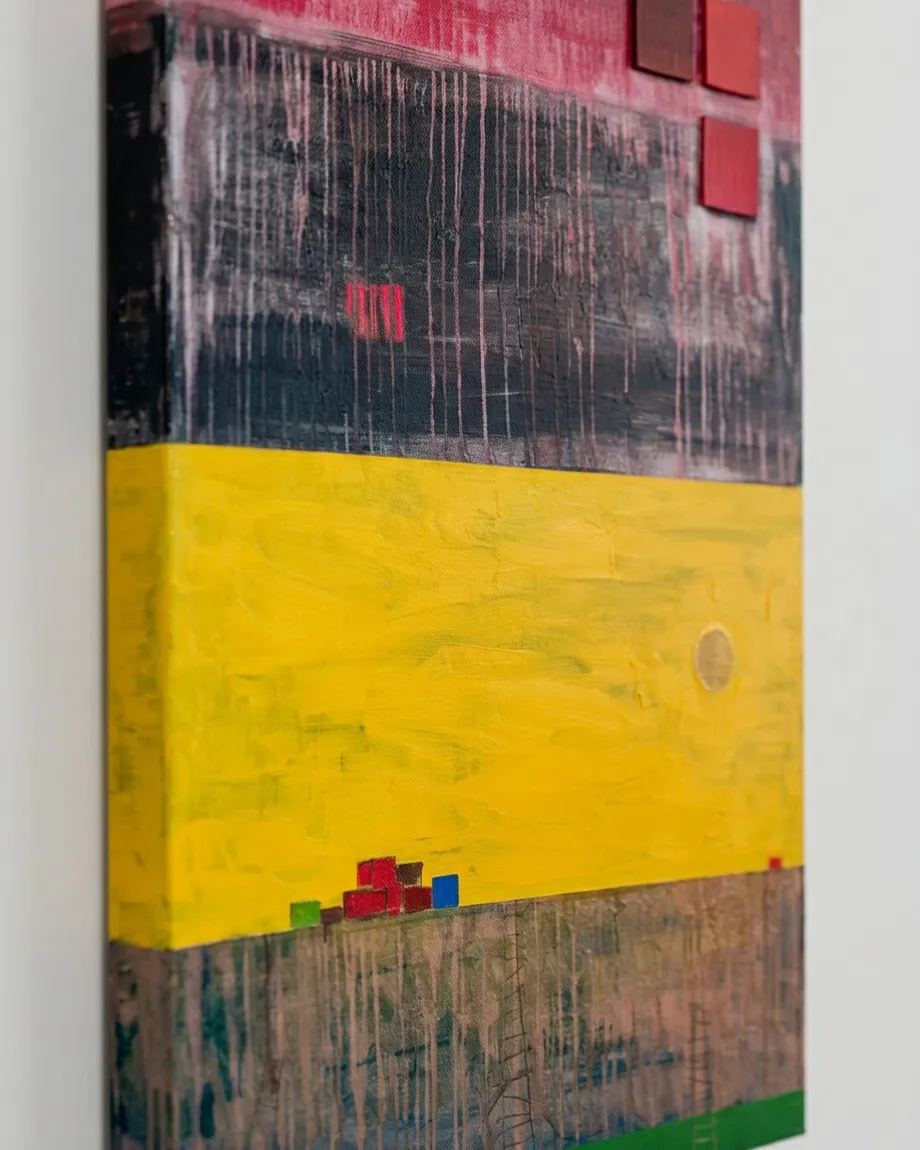
The yellow band holds the gaze just as the adjacent bands seem to offer it a direction. Beneath the dark passage of vertical drips and before the lower earthen stratum, it opens out as an expanse that cannot be traversed all at once. This presentation’s close oblique view makes its irregular brushwork, glazes, and subtle shifts in density legible: it is not a luminous fill between two denser zones, but a worked field. In INTERVALLUM, Valch brings his language of divided territories, horizons, and transforming surfaces to a concentrated scale. The isolated brown circle on the right, the small chromatic grouping near the lower edge, and the minimal red accent at the opposite end do not form a sequence; they introduce different measures of distance within a single plane.
Sustaining that dispersion without forcing an explanation also corresponds to a broader concern in the artist’s work. His experience of displacement has distinguished between an outer route, which can be traced, and an inner movement whose direction is not assured. The painting does not turn that experience into anecdote, nor the small forms into personal emblems, but it allows an affinity to emerge: a visible course does not guarantee arrival. The fragile incisions in the brown area suggest possible connections and yet the yellow band suspends any impulse to resolve them. Attention remains before separations that are neither dramatic obstacles nor promises of passage, but perceptual facts that must be sustained on their own terms.
In “The Missing Beat,” Valch considers the rhythmic interval as an absence that activates the body: when the expected pulse does not arrive, listening internally produces what is missing in order to sustain the structure. That idea illuminates the yellow in INTERVALLUM without reducing it to a musical translation. Its breadth delays the reading between the darkness above and the earthen base; while the small signs refuse to establish a centre, the gaze tests connections, abandons them, and begins again. The field’s apparent clarity demands a similar form of participation: it does not provide a route, but asks the viewer to provisionally complete the distances. The interval thus acquires temporal density; it is the place where composition ceases to lead and perception must find its own pulse.
The affinity with Paul Klee is precise in this economy of small units that alter the scale of a larger field. In both cases, a minimal form can concentrate presence without becoming a narrative figure. Valch’s signs, however, depart from the playful mobility associated with Klee: the circle and chromatic blocks in INTERVALLUM carry weight through their isolation, through the amount of yellow that separates them, and through the impossibility of deciding which one should organize the whole. The closeness of this presentation makes that difference even more tangible: each element seems settled on a surface that retains the time of its making. They do not orient the territory; they make perceptible how long a gaze takes to inhabit it.
- Original artwork
- INTERVALLUM
- Actual dimensions
- 31.5 × 47.2 in / 80 × 120 cm
- Presentation
- Digital contextual visualization
Context references
INTERVALLUM Maurizio Valch · vertical abstract artwork with yellow and red · abstract painting with colour bands · contemporary art with incisions and drips · vertical geometric abstract painting · yellow abstract wall art
About this visualization
This visualization places the artwork within an architectural context to help collectors and viewers imagine its presence in a real space. It is an interpretive reference, not an exact reproduction: the original work remains the sole authority for scale, color, surface and material presence.