Context study / INTERVALLUM
INTERVALLUM by Maurizio Valch in a Contemporary Library
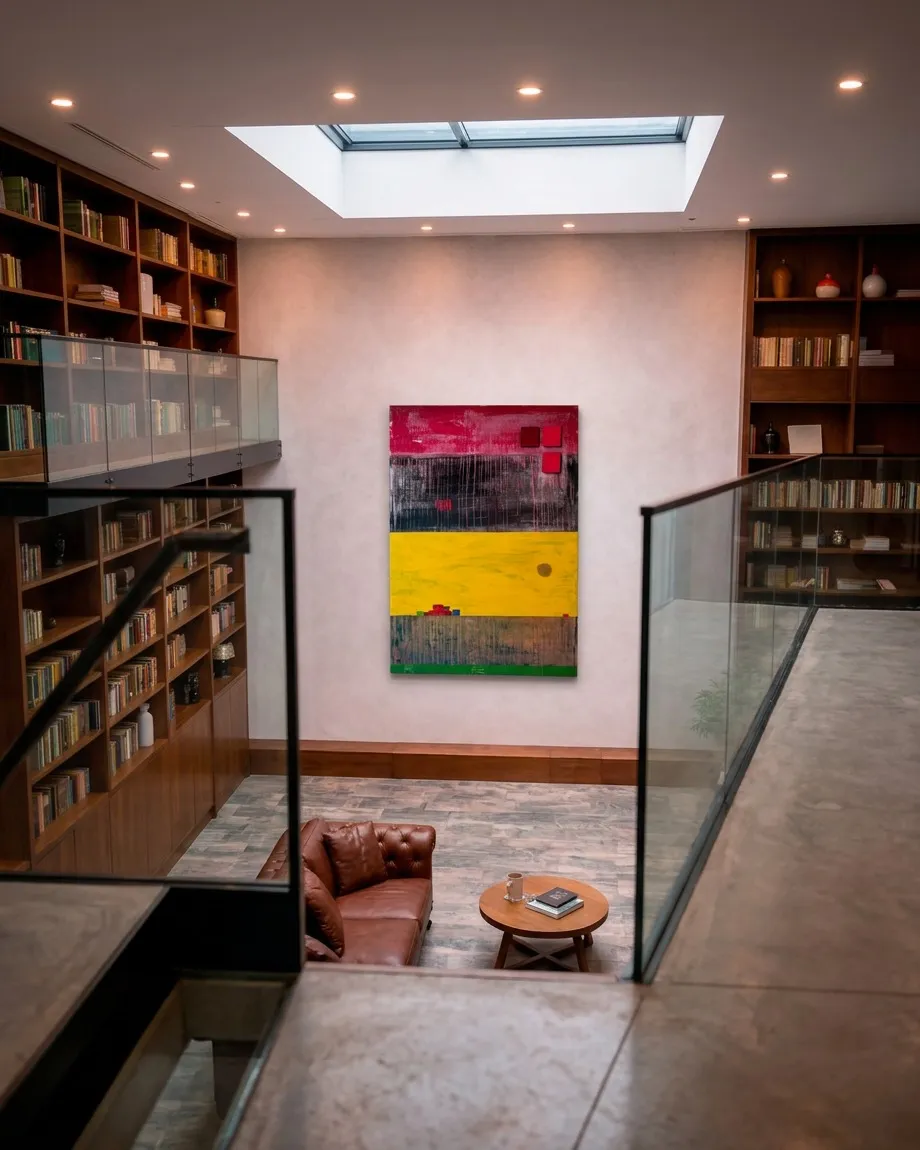
From the landing, the painting is subject to a double distance: the horizontal architecture of its bands is immediately recognisable, yet the dark drips and incisions resist a quick reading. INTERVALLUM shares with the library around it a logic of layers, repetition, and levels; the shelves raise and order volumes, while the 80 × 120 cm canvas superimposes crimson, darkness, yellow, brown, and green. Yet where book spines promise location and consultation, Maurizio Valch’s surface retains traces without offering a key. The incisions, which in his practice physically penetrate the layers of paint, introduce routes and boundaries, but not decipherable writing. Its frontal placement at the far end of the central void intensifies this reserve: the work allows itself to be found, though not classified.
This resistance coincides with the artist’s persistent attention to memory as a territory occupied by explanations. His experience of paths and movement has enabled him to distinguish between an external route, capable of being traced, and an inner movement whose direction is not assured. The small incised stairs in the lower area of INTERVALLUM may suggest a connection between bands, but their fragility confirms neither ascent, arrival, nor progress. Likewise, the minimal squares and the earthy circle in the yellow band acquire presence without becoming signs of a stable vocabulary. The painting sustains a material memory—pressures, layers, decisions, glazes—without turning this record into biography or doctrine. What remains is the condition of the trace: something happened in the matter, even if it cannot be wholly recovered.
In “From Dream to Territory,” Valch describes LIMINA as the moment when drips, first incisions, and zones of transit appear, without spatial order reaching definitive stability. This presentation makes that condition visible: the library gathers accumulated and accessible knowledge, but INTERVALLUM introduces at its centre a kind of archive that cannot be consulted in the same way. “STRATA: The Surface That Remembers” develops a related intuition by understanding incisions as alterations that indicate an event without reconstructing its history. Although INTERVALLUM belongs to an earlier series, its bands already contain this question: the dark band records vertical falls over an apparently firm boundary; the brown one retains lines that seem to begin a journey and abandon it. The painting does not deny the need to organise; it shows the excess that every order leaves outside.
The affinity with Paul Klee helps clarify the function of the small units, not as emblems to be translated, but as unstable measures within a larger field. The suspended red rectangles above and the tiny grouping near the lower edge alter the scale of the bands and make the territory seem at once vast and close. Valch departs, however, from the sign-like lightness associated with Klee: his forms carry weight through isolation and the eroded density that contains them. Set against the legible rows of books, these groups could be catalogued, yet they change function when seen from the landing or when the closeness of the surface is imagined. Their memory is thus offered as present matter rather than available information.
- Original artwork
- INTERVALLUM
- Actual dimensions
- 31.5 × 47.2 in / 80 × 120 cm
- Presentation
- Digital contextual visualization
Context references
INTERVALLUM Maurizio Valch · abstract painting for a library · vertical painting for a landing · contemporary art for a high wall · abstract painting with incisions · abstract painting with horizontal bands · wall art for a modern library
About this visualization
This visualization places the artwork within an architectural context to help collectors and viewers imagine its presence in a real space. It is an interpretive reference, not an exact reproduction: the original work remains the sole authority for scale, color, surface and material presence.