Context study / INTERVALLUM
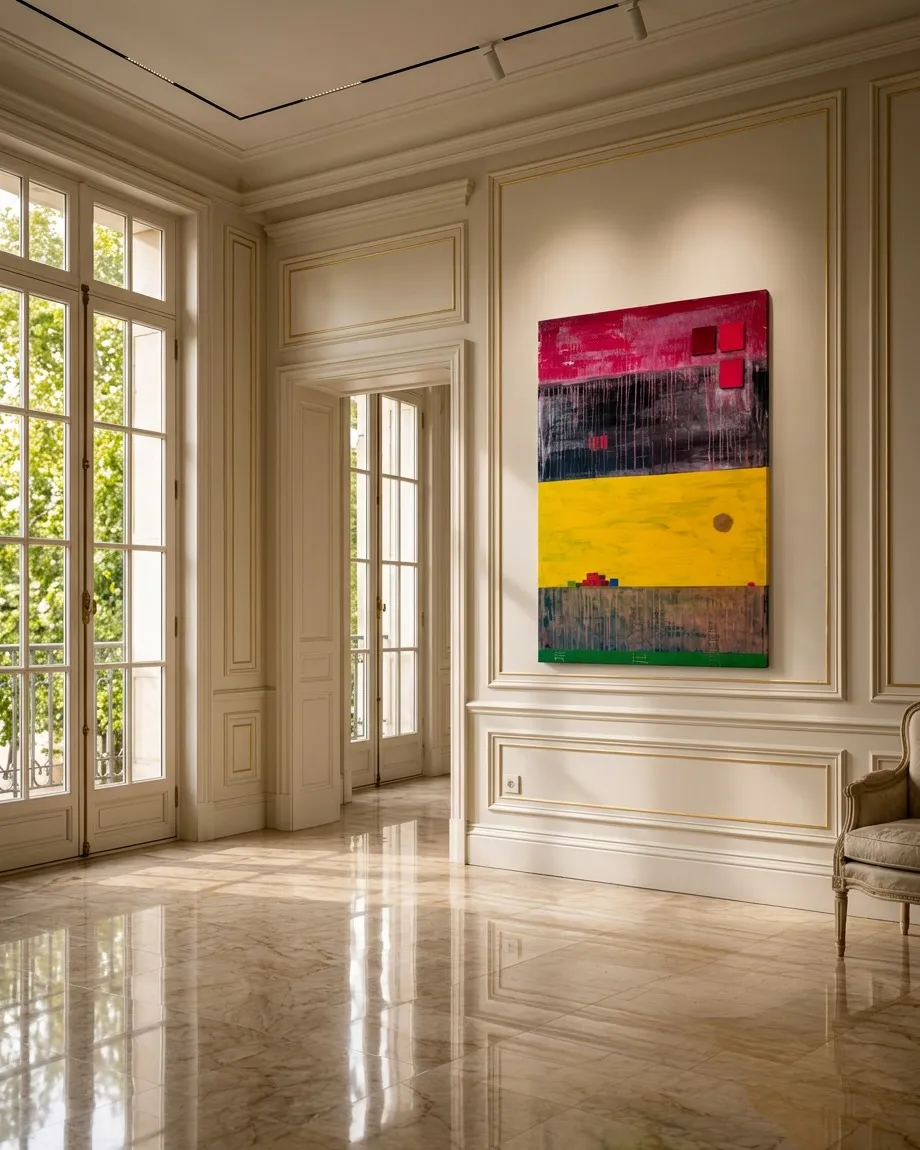
INTERVALLUM by Maurizio Valch in a Light-Filled Living Room
The eye does not take in INTERVALLUM all at once. Beside the tall windows, lateral light accompanies the yellow expanse and makes its irregular brushstrokes, the isolated earthy circle, and the brief grouping of colour near the lower edge legible. Above, the crimson retains glazes and dragged passages; between them, the dark band delays vision beneath a pattern of pink, grey, and black descents. This unevenness of access matters more than the contrast of colours: each field seems to demand a different duration. In Maurizio Valch’s language, horizons, layers, and incisions do not arrange a territory in order to make it transparent; they preserve the trace of actions and pressures that prevent space from closing into a diagram.
This delay finds a possible echo in an enduring concern of the artist: the difference between an outer journey, which can be mapped, and an inner movement whose direction remains uncertain. His experiences of travel have sharpened an attentiveness to intervals, fatigue, temporary rooms, and periods in which apparently nothing happens. INTERVALLUM does not turn these experiences into narrative, but it allows a similar time to be felt: the yellow offers itself with relative immediacy, while the black area requires the eye to remain until it can distinguish the drips running through it. The small incised stairs in the lower bands do not correct this uncertainty; they merely sustain the possibility of a relation between levels.
In “When the Ground Appeared,” Valch places LIMINA at the moment when a territory begins to support, separate, and order without wholly leaving behind its earlier suspension. The essay specifies that, at the threshold, light remains uncertain and divisions lose their rigidity beneath seepage, marks, and interruptions. The present setting makes this formulation perceptible without illustrating it: the light from the windows does not homogenise the canvas, but instead brings its layers forward at different rhythms. The painting seems to retain the ground as a condition of orientation and, at the same time, as a surface that never fully gives itself over. Looking thus becomes an experience of adjustment: it is not a matter of finding a definitive direction, but of noticing how long each boundary takes to become visible.
The affinity with Antoni Tàpies helps clarify the density of the dark band, treated less as a background than as a surface marked by sedimentation and downward movement. In both cases, matter can demand a slow gaze, attentive to what the first glance does not resolve. Yet Valch departs from the condition of wall or skin that this reference illuminates: in INTERVALLUM, erosion remains inscribed within an architecture of bands, thresholds, and small displaced presences. The black does not simply absorb light; it holds marks that reappear gradually and return the painting to its condition as a territory still in transit.
- Original artwork
- INTERVALLUM
- Actual dimensions
- 31.5 × 47.2 in / 80 × 120 cm
- Presentation
- Digital contextual visualization
Context references
INTERVALLUM Maurizio Valch · abstract art for a light-filled living room · contemporary vertical painting for a white wall · yellow and crimson abstract art · abstract painting with texture and incisions · elegant contemporary art decor
About this visualization
This visualization places the artwork within an architectural context to help collectors and viewers imagine its presence in a real space. It is an interpretive reference, not an exact reproduction: the original work remains the sole authority for scale, color, surface and material presence.