Context study / ASCENSUS
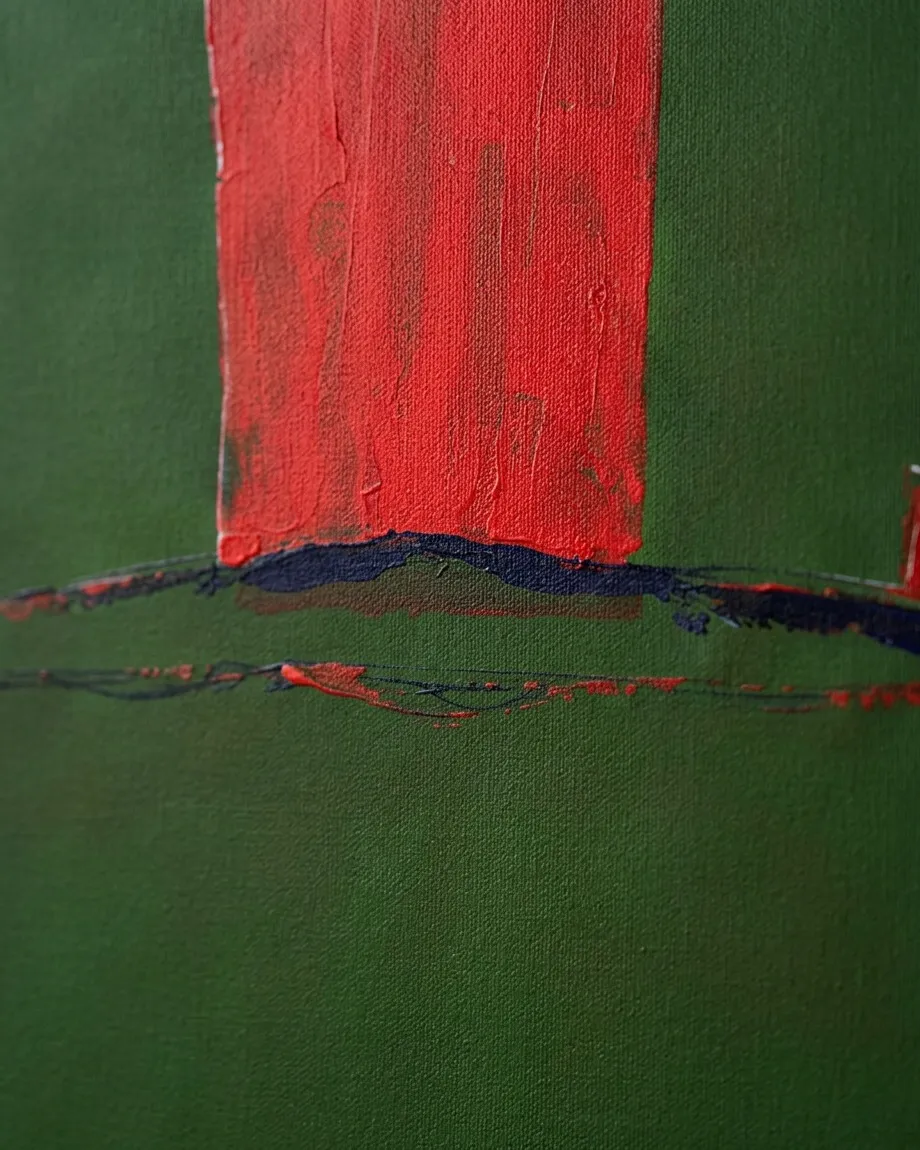
Texture and Color Detail in ASCENSUS - Maurizio Valch
An imposing vertical presence challenges the chromatic flatness of the canvas, standing as a monument that claims its right to exist in the middle of nowhere. This is not a simple geometric arrangement, but an atavistic impulse evoking the first constructions of European megalithic culture, those primitive menhirs and dolmens that human beings raised with great effort to break the horizontality of the landscape and establish the first sacred situs. The commanding red mass of the composition is sustained with brutalist gravity over a dark and uneven horizon line, flanked by two small satellite blocks acting as silent sentinels of a disputed territory. At the base, a somber and dense block anchors the gaze to the floor, establishing an insurmountable tension between the weight of the terrestrial and the urgency of an elevation struggling between sovereignty and isolation.
When I stood before this canvas of eighty by one hundred and twenty, I was not seeking to trace a symbol of power or a sacred emblem; it was the pure insistence of the matter that dragged me to divide the space. I needed that fracture, that abrupt black incision cutting the green and establishing an insurmountable boundary upon which to raise the color. The large red block did not emerge from an ordered mental plan, but from a physical accumulation of pigment, a strike of heat and weight claiming its own place against that green void surrounding it and threatening to devour it. As I scraped the edges and let the spatula leave its scar on the canvas, I understood that the work demanded a bodily presence from me, a mass that would not just float, but exert a real pressure, a testament to the effort of my own hands against the inert flatness of the canvas.
This static ascension raises a profound question about the nature of the order we build to inhabit the physical and mental world. Contemplating the vertical structure connecting the dense dark base with the luminous affirmation of the upper block, it is inevitable to evoke the thought of Carl Gustav Jung, for whom this type of axial composition operated as a mandala of individuation, a psychic map capable of integrating the shadow of the lower block with the consciousness of the ascending block. However, this triumphal ascent is not free from suspicion; the apparent harmony of the monument could well be a sterile mirage. It is here that the relentless suspicion of G. I. Gurdjieff resonates, the mystic philosopher who denounced the automatism of the human being and our tendency to live in a state of hypnotic sleep, suggesting that our most ordered structures are often nothing more than the machinery of blind repetition, a tower of illusion where we believe we are rising when in reality we are only reproducing a rigid template.
I resist solemn explanations that attempt to close off the meaning of what I paint, and I deeply distrust those who look in my paintings for a revealed mystical truth or a comfortable refuge. For me, the heart of the work does not reside in the triumph of the great central block, but in the silent instability of those small satellite blocks that barely manage to sustain themselves on the margins of the composition, almost on the verge of falling. Pay attention to the friction at the edges, to the wearing away of color where the red surrenders to the darkness; that is where the true tension of the painting vibrates, in the trace of the conflict of matter. And below, sustaining everything with mineral stubbornness, that lower black block imposes itself, seeking neither dialogue nor redemption, but asserting a geological and absolute silence that refuses to be domesticated by the warmth of the red.
In the end, stripped of dogmas and theoretical discourses, the painting returns to its condition of pure textured matter offered to the gaze without intermediaries. The viewer's eye travels the contrast between the vibrant smoothness of the green field and the rough, almost organic crust of the red pigment that seems to pulse with its own temperature on the canvas. It is on that physical frontier where the work ceases to be an idea to become a tactile experience, a relief where the time of creation has been frozen. We are left then with the uncertainty of this suspended threshold: a monument that does not know if it is celebrating an imminent victory of the human spirit or if, on the contrary, it contemplates in silence the inevitable weight of its own geological collapse.
- Original artwork
- ASCENSUS
- Actual dimensions
- 31.5 × 47.2 in / 80 × 120 cm
- Presentation
- Digital contextual visualization
Context references
brushstroke and oil texture details · close up of abstract painting · acrylic canvas texture · artwork details · palette knife crimson painting
About this visualization
This visualization places the artwork within an architectural context to help collectors and viewers imagine its presence in a real space. It is an interpretive reference, not an exact reproduction: the original work remains the sole authority for scale, color, surface and material presence.