Context study / ASCENSUS
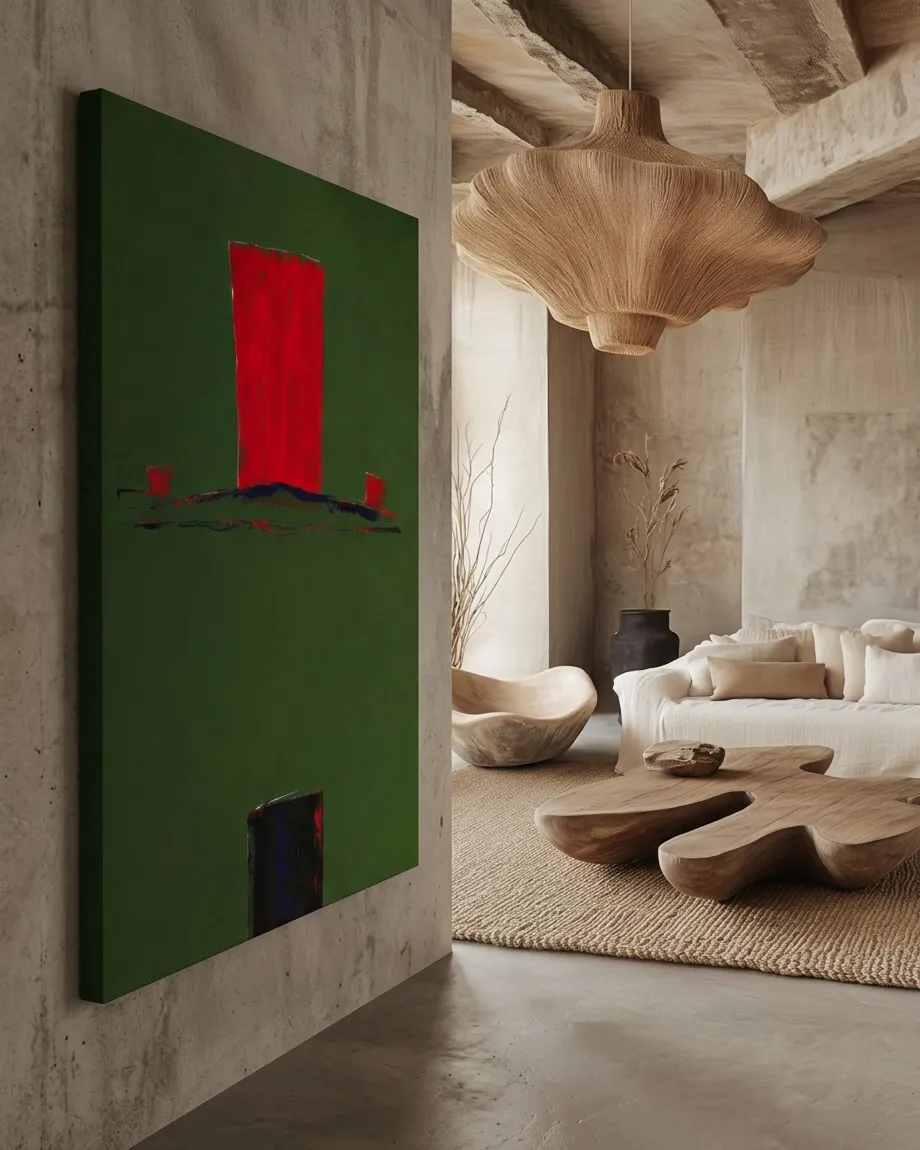
ASCENSUS Painting by Maurizio Valch on Bare Concrete Wall
Contemplating the imposing presence of ASCENSUS on the bare concrete wall reveals that an entire life can be recorded in a painting without needing to narrate a single event. In this space where the sober architecture dialogues with the scale of the painting, the vast olive green expanse does not function as a passive landscape, but as the reservoir of an accumulated temporality. There are no anecdotes here, no faces, no navigable maps; what is offered is a rigorous diagram of forces where lived time has condensed into weights, boundaries, and spatial divisions. The painting behaves like a secret diary that has replaced events with gravities, allowing biography to manifest solely through the resistance of the medium.
Every morning I shake off the suspicion that painting does not consist in illustrating the inventory of my departures and weariness, but in finding the physical structure that all that drift left within me. I have spent years moving, inhabiting temporary rooms, and crossing paths on foot, but this dense green is not a forest or a high road; it is the very matter of isolation, a ground I have had to work with the palette knife until leaving it clear of explanations. Each time I decide to draw a dark line or place a heavy mass at the lower limit of the canvas, I am not narrating a concrete loss or a personal achievement. I am simply measuring the anchor I need to hold the present without thought immediately turning it into a conflict about the totality of my existence.
The relationship established in this room between the roughness of the concrete and the painted skin of the canvas underscores that condition of an exposed body defining Valch's work. In harmony with the material tradition of Antoni Tàpies, where the surface assumes the scars of existence, the large central crimson block of ASCENSUS does not float immaterially; it rests heavily on a horizontal suture of dark scrapings that seems to creak under its own volume. This collision of densities suggests that the true milestones of a life—difficult transitions, irrevocable decisions, the psychological prolongations of conflict—do not require description to be present. They are felt somatically in the tension between the order of the green plane and the violent intrusion of the red pigment, a boundary that functions as both contact and fracture.
There was a time when I believed existence had to be a great quest, a succession of battles from which the creator had to return transformed and with hands full of trophies. Today, in the quiet of my studio, I recognize the weariness of that personal mythology and prefer the honesty of a simple fact, like celery sticks on the table or the clean fall of a line that renounces the plumb line. When I place the black block at the base of the composition, I am not seeking to represent a psychological wound or a spiritual revelation; I place a weight where stability is needed, a dark counterweight to the noise of my own thoughts. The painting is saved when it stops trying to impress and assumes, with sobriety, the scale of its own silent material reality.
In the end, the gaze that traverses this room does not seek to resolve a biographical enigma, but to stand before a threshold that remains open. The monolithic forms and discrete signals flanking the central plane of ASCENSUS invite us to inhabit a distance that cannot be gridded or translated into closed concepts. Valch’s non-narrative autobiography operates precisely by subtraction, removing the anecdote so that only the vibration of the interval and the quiet of empty space remain. In that absence of narrative, the true power of painting is revealed: a territory where everyone can encounter their own strata of memory, suspended in the contained silence breathing behind the matter.
- Original artwork
- ASCENSUS
- Actual dimensions
- 31.5 × 47.2 in / 80 × 120 cm
- Presentation
- Digital contextual visualization
Context references
abstract painting for concrete wall · brutalist decoration with art · large format painting modern living room · minimalist green paintings
About this visualization
This visualization places the artwork within an architectural context to help collectors and viewers imagine its presence in a real space. It is an interpretive reference, not an exact reproduction: the original work remains the sole authority for scale, color, surface and material presence.