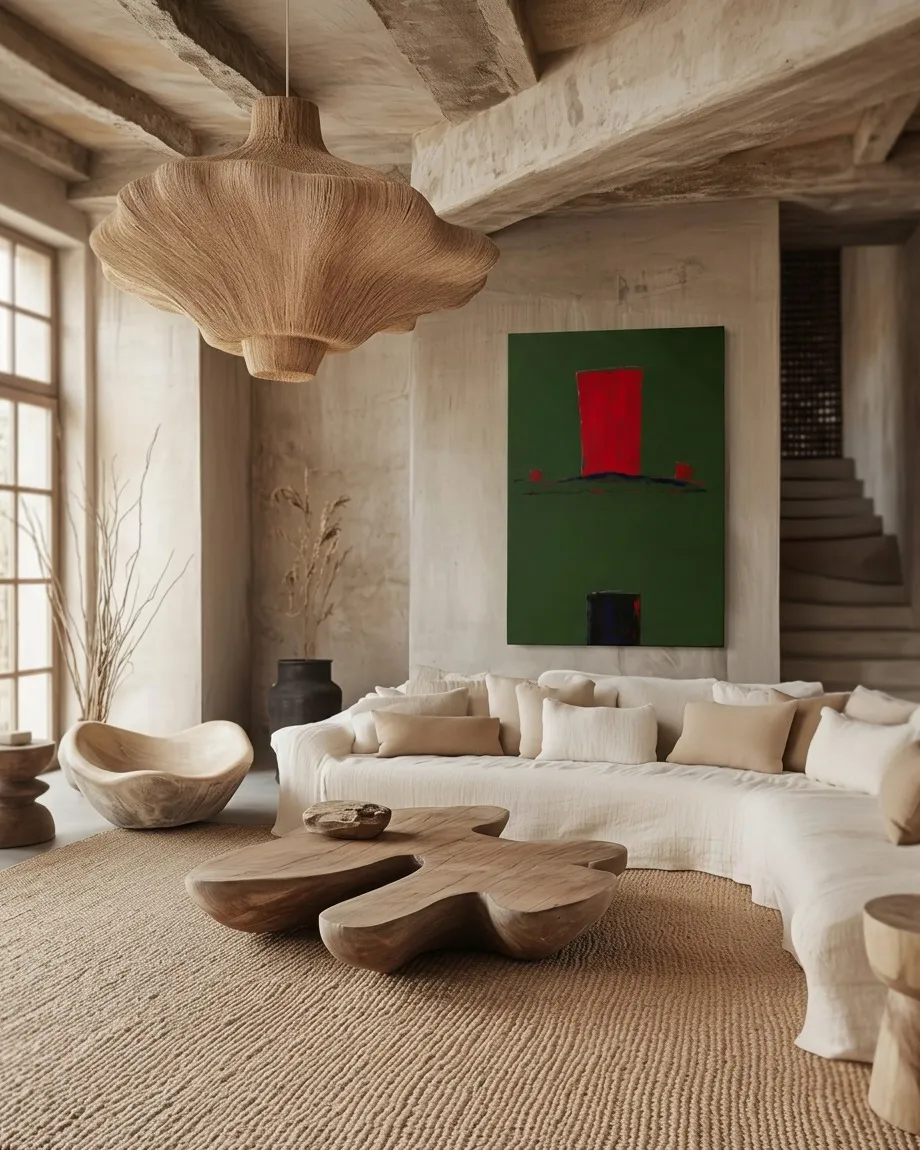
Context study / ASCENSUS
Abstract Painting ASCENSUS in a Warm Minimalist Living Room
At the bottom, there is no base; there is barely an insistence. The small dark mass, pressed against the lower edge, seems too short to support the height of the painting, and yet it forces us to begin there. The gaze tilts, shrinks a little. That compact form does not offer a clear entry: it acts more like a threshold reduced to the size of a doubt.
It does not rise yet. It retains its opacity.
Above, the dark green does not surrender as a background. It seems to occupy the space, to squeeze it. There is no innocent air around the lower shape: there is an expanse surrounding it, measuring it, perhaps keeping it down. The eye begins to lift from that dark area, but encounters an irregular horizontal strip before reaching the red. It is a low, broken, almost modest line; nonetheless, it halts us.
Why does it seem to contain pressure?
It is not exactly ground. Nor is it a peaceful division between above and below. There is something in its discontinuities, in its way of traversing the green, that gives the impression of a register: the painting has been crossed there by a lateral force, and the mark has not closed. The eye would like to use it as a step. The strip does not cooperate. It allows one to ascend, but makes the effort felt.
John Coltrane was a jazz saxophonist and composer who knew how to open up time with repetition, intensity, and a breath pushed to its limit.
The line could then be heard as a beat refusing to end. It does not accompany the ascent: it scrapes it. Above it, the large red rectangle appears without a gradual rise, as if it had been suddenly suspended in the upper half of the green. It does not entirely dominate the field; it holds itself within it. Its verticality is neither clean nor triumphant. Its edges seem to have had to negotiate with the surface to remain standing.
The red endures.
It is not reduced to a sign or a peak. It is a suspended visual body, and the suspension produces a strange physical discomfort: the gaze expects it to fall, or to continue rising, but the rectangle stays. Its stillness does not equal rest. The long note Coltrane allows us to imagine never resolves because it finds a persistent friction in the lower strip. The sound, if there were any, would not entirely detach from the painting.
“I see the finished red and can no longer return it to an initial intention. I look at it and doubt that it is truly vertical, that it is alone, that it has the authority it seems to claim. I wanted to see it as a sustained presence, but now it is the red that seems to decide how much space it leaves around itself and how much weight it removes from beneath it. I do not feel it is obedient: it has separated from me and remains there, slightly unsettled.”
The apparent solitude of the rectangle is broken when looking at the two small lateral reds. One on the left, one on the right. They are minimal, but not discreet. They do not serve to decorate the line or to make the central block more legible. Each seems like a brief attack against the stability of the whole. The large one ceases to be unique: it can no longer present itself as the sole intensity of the painting.
Perhaps the small reds are saying that height does not belong only to the high.
One of them seems to have remained caught in the strip; the other, barely displaced, tenses the space with an almost comical obstinacy. They do not lift the larger rectangle, nor do they tear it down. They change its atmosphere. The large red mass, seen after them, no longer seems suspended over a uniform vacuum: it seems surrounded by two small interruptions that know something of its weight.
Isamu Noguchi was a sculptor and designer attentive to how stone, void, and scale transform the body of those moving around them.
Here there would be no scene to contemplate from afar, but an uncomfortable arrangement for the body. If the upper rectangle could be touched, would it have the compact weight of a block or a more tenuous resistance, like something that only exists while the gaze lasts? If the small lower dark form could be walked around, would it force one to bend down? Would one have to stand very close to feel its density, or move away until its relationship with the red became unbearable?
The green compresses between both forms. It is not an available void: it pushes, separates, retains.
Noguchi would want to find a distribution of weights, a point on the ground from which the dark below and the red above balanced each other. But the breath opened by Coltrane spoils that possibility. The rectangle does not only weigh: it seems to last longer than its form allows. And that which lasts is not easily accommodated on a scale. The horizontal line does not serve as a shelf either. It is a scraped duration, a pause still at work.
Then comes a question, small and exact, as if someone had drawn too close to the painting:
Why does the red above need the little black square below to stay awake?
The question changes the direction of the eyes. It no longer seeks only to know how the red ascends. It forces us to see if the lower form watches, endures, contradicts, or simply refuses to disappear. Perhaps it does not support the rectangle as a column supports a load. Perhaps it prevents it from becoming a clean escape, an elevation without friction, a height that has to answer to nothing.
The gaze descends.
The horizontal strip, as we pass through it again, no longer seems only a resistance. It seems a measured distance between two obstinacies. Above, the red remains whole and strangely vulnerable. Below, the dark mass has gained thickness: before, it was too small a threshold; now it seems to concentrate some of the duration of the red, as if it had received a shadow from that sustained note.
But it is not a shadow. Nor is it sufficient counterweight.
The dark form retains insecure edges and a closed presence. It can seem a door, a weight, a container, a piece of night, a small tower that has decided not to grow. None of those possibilities completely possesses it. Faced with the ambition of giving it a function, it stays still. Therein lies its strength: it does not explain why the red stays up; it makes it harder to stop asking.
- Original artwork
- ASCENSUS
- Actual dimensions
- 31.5 × 47.2 in / 80 × 120 cm
- Presentation
- Digital contextual visualization
Context references
modern rustic living room decor ideas · painting above the sofa · warm minimalist art · decorating with earth tones and green
About this visualization
This visualization places the artwork within an architectural context to help collectors and viewers imagine its presence in a real space. It is an interpretive reference, not an exact reproduction: the original work remains the sole authority for scale, color, surface and material presence.